








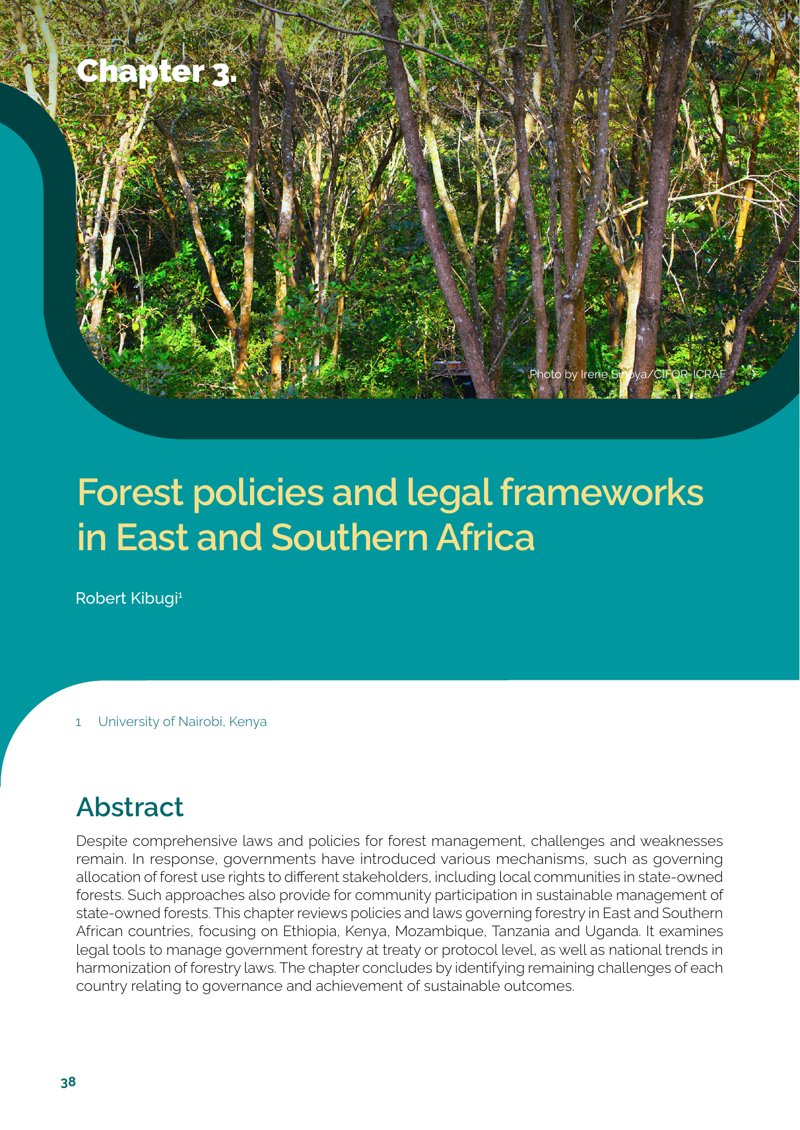


Despite comprehensive laws and policies for forest management, challenges and weaknesses remain. In response, governments have introduced various mechanisms, such as governing allocation of forest use rights to different stakeholders, including local communities in state-owned forests. Such approaches also provide for community participation in sustainable management of state-owned forests. This chapter reviews policies and laws governing forestry in East and Southern African countries, focusing on Ethiopia, Kenya, Mozambique, Tanzania and Uganda. It examines legal tools to manage government forestry at treaty or protocol level, as well as national trends in harmonization of forestry laws. The chapter concludes by identifying remaining challenges of each country relating to governance and achievement of sustainable outcomes.
This work is licensed under CC-BY 4.0
This work is licensed under CC-BY 4.0
Export citation:
RIS (.ris)
TI  - Forest policies and legal frameworks in East and Southern Africa
AU  - Kibugi, R.
AB  - Despite comprehensive laws and policies for forest management, challenges and weaknesses remain. In response, governments have introduced various mechanisms, such as governing allocation of forest use rights to different stakeholders, including local communities in state-owned forests. Such approaches also provide for community participation in sustainable management of state-owned forests. This chapter reviews policies and laws governing forestry in East and Southern African countries, focusing on Ethiopia, Kenya, Mozambique, Tanzania and Uganda. It examines legal tools to manage government forestry at treaty or protocol level, as well as national trends in harmonization of forestry laws. The chapter concludes by identifying remaining challenges of each country relating to governance and achievement of sustainable outcomes.
PY  - 2026
PB  - CIFOR-ICRAF
PP  - Bogor, Indonesia and Nairobi, Kenya
UR  - https://www.cifor-icraf.org/knowledge/publication/46403/
KW  - community forestry, community involvement, forest management, forest policy, legal framework, stakeholders
ER  -
Endnote (.ciw)
%T Forest policies and legal frameworks in East and Southern Africa
%A Kibugi, R.
%D 2026
%I CIFOR-ICRAF
%C Bogor, Indonesia and Nairobi, Kenya
%U https://www.cifor-icraf.org/knowledge/publication/46403/
%X Despite comprehensive laws and policies for forest management, challenges and weaknesses remain. In response, governments have introduced various mechanisms, such as governing allocation of forest use rights to different stakeholders, including local communities in state-owned forests. Such approaches also provide for community participation in sustainable management of state-owned forests. This chapter reviews policies and laws governing forestry in East and Southern African countries, focusing on Ethiopia, Kenya, Mozambique, Tanzania and Uganda. It examines legal tools to manage government forestry at treaty or protocol level, as well as national trends in harmonization of forestry laws. The chapter concludes by identifying remaining challenges of each country relating to governance and achievement of sustainable outcomes.
%K community forestry
%K community involvement
%K forest management
%K forest policy
%K legal framework
%K stakeholders
Publication year
2026
Authors
Language
English
Keywords
community forestry, community involvement, forest management, forest policy, legal framework, stakeholders
Source
State of the Forests 2025: The Forests of the East and Southern Africa. CIFOR-ICRAF: Bogor, Indonesia and Nairobi, KenyaGeographic
Ethiopia, Kenya, Mozambique, Tanzania, Uganda