







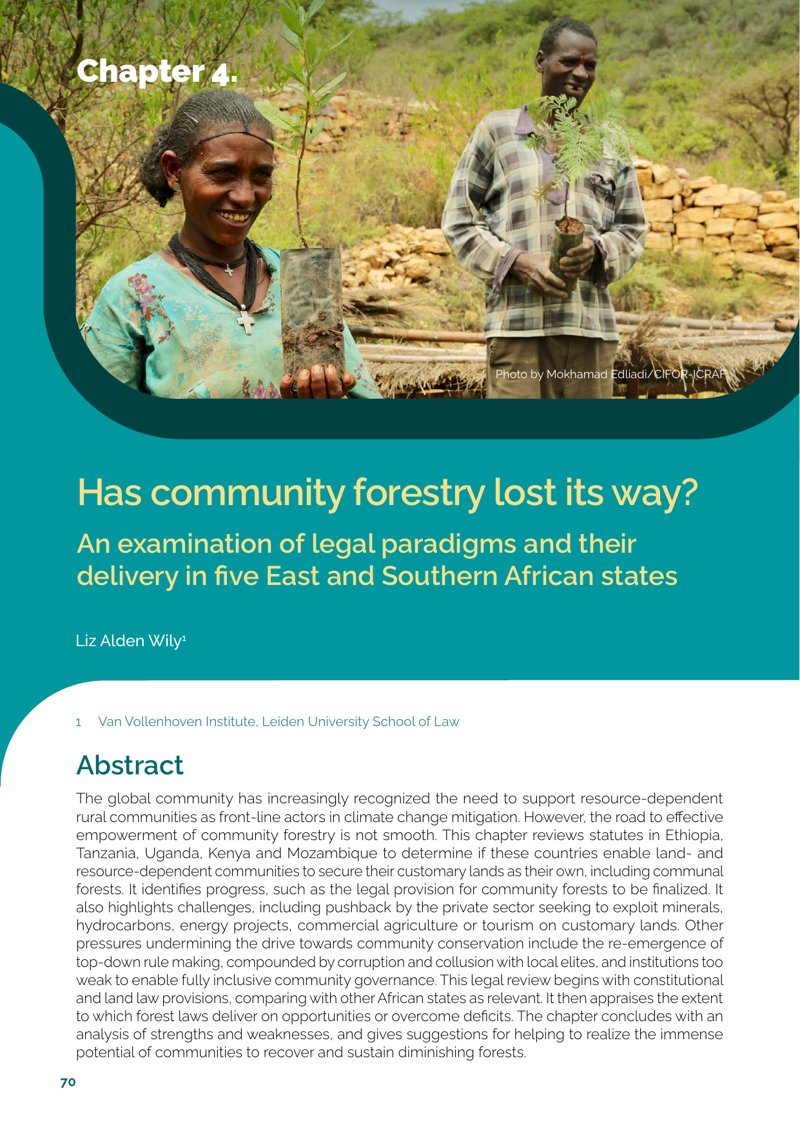


The global community has increasingly recognized the need to support resource-dependent rural communities as front-line actors in climate change mitigation. However, the road to effective empowerment of community forestry is not smooth. This chapter reviews statutes in Ethiopia, Tanzania, Uganda, Kenya and Mozambique to determine if these countries enable land – and resource-dependent communities – to secure their customary lands as their own, including communal forests. It identifies progress, such as the legal provision for community forests to be finalized. It also highlights challenges, including pushback by the private sector seeking to exploit minerals, hydrocarbons, energy projects, commercial agriculture or tourism on customary lands. Other pressures undermining the drive towards community conservation include the re-emergence of top-down rule making, compounded by corruption and collusion with local elites, and institutions too weak to enable fully inclusive community governance. This legal review begins with constitutional and land law provisions, comparing with other African states as relevant. It then appraises the extent to which forest laws deliver on opportunities or overcome deficits. The chapter concludes with an analysis of strengths and weaknesses, and suggestions for helping to realize the immense potential of communities to recover and sustain diminishing forests.
This work is licensed under CC-BY 4.0
This work is licensed under CC-BY 4.0
Export citation:
RIS (.ris)
TI  - Has community forestry lost its way? An examination of legal paradigms and their delivery in five East and Southern African states
AU  - Wily, L.W.
AB  - The global community has increasingly recognized the need to support resource-dependent rural communities as front-line actors in climate change mitigation. However, the road to effective empowerment of community forestry is not smooth. This chapter reviews statutes in Ethiopia, Tanzania, Uganda, Kenya and Mozambique to determine if these countries enable land – and resource-dependent communities – to secure their customary lands as their own, including communal forests. It identifies progress, such as the legal provision for community forests to be finalized. It also highlights challenges, including pushback by the private sector seeking to exploit minerals, hydrocarbons, energy projects, commercial agriculture or tourism on customary lands. Other pressures undermining the drive towards community conservation include the re-emergence of top-down rule making, compounded by corruption and collusion with local elites, and institutions too weak to enable fully inclusive community governance. This legal review begins with constitutional and land law provisions, comparing with other African states as relevant. It then appraises the extent to which forest laws deliver on opportunities or overcome deficits. The chapter concludes with an analysis of strengths and weaknesses, and suggestions for helping to realize the immense potential of communities to recover and sustain diminishing forests.
PY  - 2026
PB  - CIFOR-ICRAF
PP  - Bogor, Indonesia and Nairobi, Kenya
UR  - https://www.cifor-icraf.org/knowledge/publication/46404/
KW  - collusion, community forestry, corruption, customary rights, forest management, governance, legal framework, local communities
ER  -
Endnote (.ciw)
%T Has community forestry lost its way? An examination of legal paradigms and their delivery in five East and Southern African states
%A Wily, L.W.
%D 2026
%I CIFOR-ICRAF
%C Bogor, Indonesia and Nairobi, Kenya
%U https://www.cifor-icraf.org/knowledge/publication/46404/
%X The global community has increasingly recognized the need to support resource-dependent rural communities as front-line actors in climate change mitigation. However, the road to effective empowerment of community forestry is not smooth. This chapter reviews statutes in Ethiopia, Tanzania, Uganda, Kenya and Mozambique to determine if these countries enable land – and resource-dependent communities – to secure their customary lands as their own, including communal forests. It identifies progress, such as the legal provision for community forests to be finalized. It also highlights challenges, including pushback by the private sector seeking to exploit minerals, hydrocarbons, energy projects, commercial agriculture or tourism on customary lands. Other pressures undermining the drive towards community conservation include the re-emergence of top-down rule making, compounded by corruption and collusion with local elites, and institutions too weak to enable fully inclusive community governance. This legal review begins with constitutional and land law provisions, comparing with other African states as relevant. It then appraises the extent to which forest laws deliver on opportunities or overcome deficits. The chapter concludes with an analysis of strengths and weaknesses, and suggestions for helping to realize the immense potential of communities to recover and sustain diminishing forests.
%K collusion
%K community forestry
%K corruption
%K customary rights
%K forest management
%K governance
%K legal framework
%K local communities
Publication year
2026
Authors
Language
English
Keywords
collusion, community forestry, corruption, customary rights, forest management, governance, legal framework, local communities
Source
State of the Forests 2025: The Forests of the East and Southern Africa. CIFOR-ICRAF: Bogor, Indonesia and Nairobi, KenyaGeographic
Ethiopia, Kenya, Mozambique, Tanzania, Uganda