


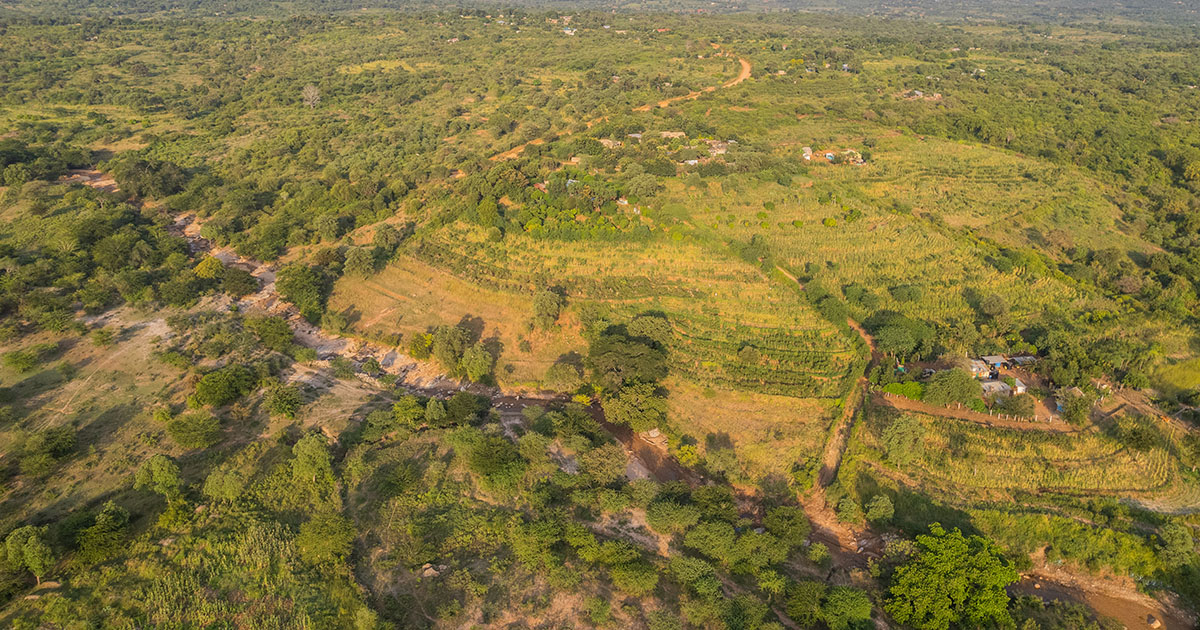







Rapid expansion of unsustainable farming practices in upland areas of Southeast Asia threatens food security and the environment. This study assessed alternative agroforestry systems for sustainable land management and livelihood improvement in northwest Vietnam. The performance of fruit tree-based agroforestry was compared with that of sole cropping, and farmers’ perspectives on agroforestry were documented. After seven years, longan (Dimocarpus longan Lour.)-maize-forage grass and son tra (Docynia indica (Wall.) Decne)-forage grass systems had generated 2.4- and 3.5-fold higher average annual income than sole maize and sole son tra, respectively. Sole longan gave no net profit, due to high investment costs. After some years, competition developed between the crop, grass, and tree components, e.g., for nitrogen, and the farmers interviewed reported a need to adapt management practices to optimise spacing and pruning. They also reported that agroforestry enhanced ecosystem services by controlling surface runoff and erosion, increasing soil fertility and improving resilience to extreme weather. Thus, agroforestry practices with fruit trees can be more profitable than sole-crop cultivation within a few years. Integration of seasonal and fast-growing perennial plants (e.g., grass) is essential to ensure quick returns. Wider adoption needs initial incentives or loans, knowledge exchange, and market links.
This work is licensed under CC-BY 4.0

This work is licensed under CC-BY 4.0
DOI:
https://doi.org/10.3390/land9110451Altmetric score:
Dimensions Citation Count:
Export citation:
RIS (.ris)
TI  - Fruit Tree-Based Agroforestry Systems for Smallholder Farmers in Northwest Vietnam—A Quantitative and Qualitative Assessment
AU  - Do, V.H.
AU  - La, N.
AU  - Mulia, R.
AU  - Bergkvist, G.
AU  - Dahlin, A.S.
AU  - Nguyen, V.T.
AU  - Pham, H.T.
AU  - Öborn, I.
AB  - Rapid expansion of unsustainable farming practices in upland areas of Southeast Asia threatens food security and the environment. This study assessed alternative agroforestry systems for sustainable land management and livelihood improvement in northwest Vietnam. The performance of fruit tree-based agroforestry was compared with that of sole cropping, and farmers’ perspectives on agroforestry were documented. After seven years, longan (Dimocarpus longan Lour.)-maize-forage grass and son tra (Docynia indica (Wall.) Decne)-forage grass systems had generated 2.4- and 3.5-fold higher average annual income than sole maize and sole son tra, respectively. Sole longan gave no net profit, due to high investment costs. After some years, competition developed between the crop, grass, and tree components, e.g., for nitrogen, and the farmers interviewed reported a need to adapt management practices to optimise spacing and pruning. They also reported that agroforestry enhanced ecosystem services by controlling surface runoff and erosion, increasing soil fertility and improving resilience to extreme weather. Thus, agroforestry practices with fruit trees can be more profitable than sole-crop cultivation within a few years. Integration of seasonal and fast-growing perennial plants (e.g., grass) is essential to ensure quick returns. Wider adoption needs initial incentives or loans, knowledge exchange, and market links.
PY  - 2020
UR  - https://www.cifor-icraf.org/knowledge/publication/19891/
DO  - https://doi.org/10.3390/land9110451
KW  - agroforestry system, fruit trees, small scale farming
ER  -
Endnote (.ciw)
%T Fruit Tree-Based Agroforestry Systems for Smallholder Farmers in Northwest Vietnam—A Quantitative and Qualitative Assessment
%A Do, V.H.
%A La, N.
%A Mulia, R.
%A Bergkvist, G.
%A Dahlin, A.S.
%A Nguyen, V.T.
%A Pham, H.T.
%A Öborn, I.
%D 2020
%U https://www.cifor-icraf.org/knowledge/publication/19891/
%R https://doi.org/10.3390/land9110451
%X Rapid expansion of unsustainable farming practices in upland areas of Southeast Asia threatens food security and the environment. This study assessed alternative agroforestry systems for sustainable land management and livelihood improvement in northwest Vietnam. The performance of fruit tree-based agroforestry was compared with that of sole cropping, and farmers’ perspectives on agroforestry were documented. After seven years, longan (Dimocarpus longan Lour.)-maize-forage grass and son tra (Docynia indica (Wall.) Decne)-forage grass systems had generated 2.4- and 3.5-fold higher average annual income than sole maize and sole son tra, respectively. Sole longan gave no net profit, due to high investment costs. After some years, competition developed between the crop, grass, and tree components, e.g., for nitrogen, and the farmers interviewed reported a need to adapt management practices to optimise spacing and pruning. They also reported that agroforestry enhanced ecosystem services by controlling surface runoff and erosion, increasing soil fertility and improving resilience to extreme weather. Thus, agroforestry practices with fruit trees can be more profitable than sole-crop cultivation within a few years. Integration of seasonal and fast-growing perennial plants (e.g., grass) is essential to ensure quick returns. Wider adoption needs initial incentives or loans, knowledge exchange, and market links.
%K agroforestry system
%K fruit trees
%K small scale farming
Publication year
2020
ISSN
2073-445X
Authors
Do, V.H.; La, N.; Mulia, R.; Bergkvist, G.; Dahlin, A.S.; Nguyen, V.T.; Pham, H.T.; Öborn, I.
Language
English
Keywords
agroforestry system, fruit trees, small scale farming
Source
Land. 9(11): 451