


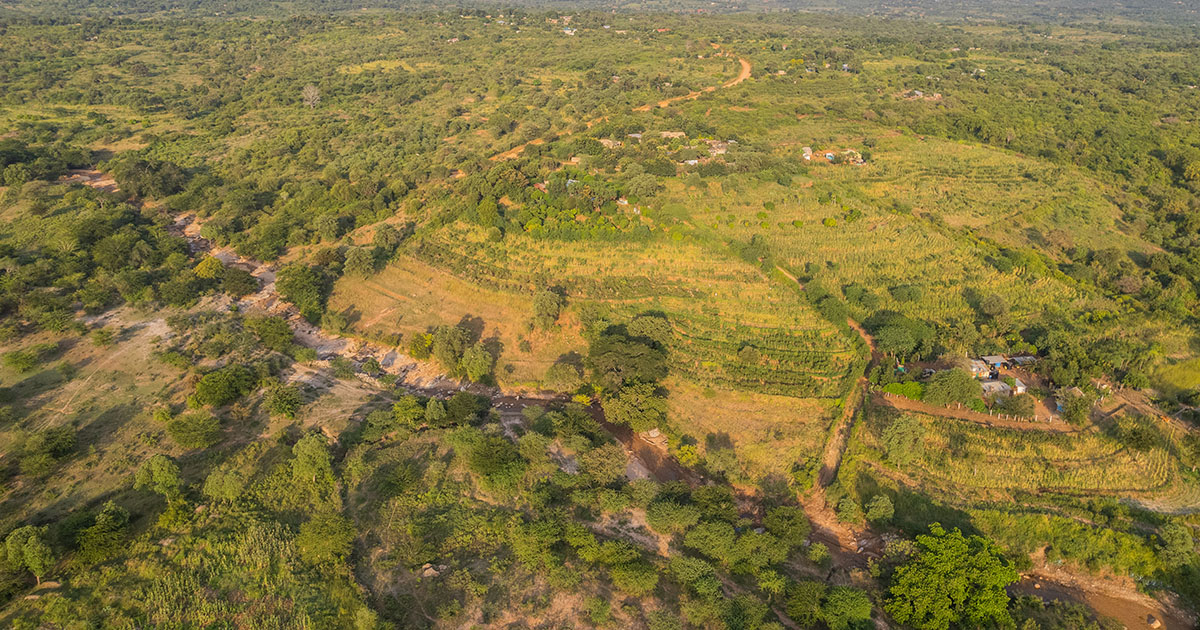







The UN Decade on Ecosystem Restoration offers immense potential to return hundreds of millions of hectares of degraded tropical landscapes to functioning ecosystems. Well-designed restoration can tackle multiple Sustainable Development Goals, driving synergistic benefits for biodiversity, ecosystem services, agricultural and timber production, and local livelihoods at large spatial scales. To deliver on this potential, restoration efforts must recognise and reduce trade-offs among objectives, and minimize competition with food production and conservation of native ecosystems. Restoration initiatives also need to confront core environmental challenges of climate change and inappropriate planting in savanna biomes, be robustly funded over the long term, and address issues of poor governance, inadequate land tenure, and socio-cultural disparities in benefits and costs. Tackling these issues using the landscape approach is vital to realising the potential for restoration to break the cycle of land degradation and poverty, and deliver on its core environmental and social promises. © 2021 Elsevier Inc.

DOI:
https://doi.org/10.1016/j.cub.2021.08.058Altmetric score:
Dimensions Citation Count:
Export citation:
RIS (.ris)
TI  - Upscaling tropical restoration to deliver environmental benefits and socially equitable outcomes
AU  - Edwards, D.P.
AU  - Cerullo, G.R.
AU  - Chomba, S.
AU  - Worthington, T.A.
AU  - Balmford, A.P.
AU  - Chazdon, R.L.
AU  - Harrison, R.D.
AB  - The UN Decade on Ecosystem Restoration offers immense potential to return hundreds of millions of hectares of degraded tropical landscapes to functioning ecosystems. Well-designed restoration can tackle multiple Sustainable Development Goals, driving synergistic benefits for biodiversity, ecosystem services, agricultural and timber production, and local livelihoods at large spatial scales. To deliver on this potential, restoration efforts must recognise and reduce trade-offs among objectives, and minimize competition with food production and conservation of native ecosystems. Restoration initiatives also need to confront core environmental challenges of climate change and inappropriate planting in savanna biomes, be robustly funded over the long term, and address issues of poor governance, inadequate land tenure, and socio-cultural disparities in benefits and costs. Tackling these issues using the landscape approach is vital to realising the potential for restoration to break the cycle of land degradation and poverty, and deliver on its core environmental and social promises. © 2021 Elsevier Inc.
PY  - 2021
UR  - https://www.cifor-icraf.org/knowledge/publication/23900/
DO  - https://doi.org/10.1016/j.cub.2021.08.058
KW  - biodiversity, climate change, ecological restoration, landscape, poverty, sustainable development
ER  -
Endnote (.ciw)
%T Upscaling tropical restoration to deliver environmental benefits and socially equitable outcomes
%A Edwards, D.P.
%A Cerullo, G.R.
%A Chomba, S.
%A Worthington, T.A.
%A Balmford, A.P.
%A Chazdon, R.L.
%A Harrison, R.D.
%D 2021
%U https://www.cifor-icraf.org/knowledge/publication/23900/
%R https://doi.org/10.1016/j.cub.2021.08.058
%X The UN Decade on Ecosystem Restoration offers immense potential to return hundreds of millions of hectares of degraded tropical landscapes to functioning ecosystems. Well-designed restoration can tackle multiple Sustainable Development Goals, driving synergistic benefits for biodiversity, ecosystem services, agricultural and timber production, and local livelihoods at large spatial scales. To deliver on this potential, restoration efforts must recognise and reduce trade-offs among objectives, and minimize competition with food production and conservation of native ecosystems. Restoration initiatives also need to confront core environmental challenges of climate change and inappropriate planting in savanna biomes, be robustly funded over the long term, and address issues of poor governance, inadequate land tenure, and socio-cultural disparities in benefits and costs. Tackling these issues using the landscape approach is vital to realising the potential for restoration to break the cycle of land degradation and poverty, and deliver on its core environmental and social promises. © 2021 Elsevier Inc.
%K biodiversity
%K climate change
%K ecological restoration
%K landscape
%K poverty
%K sustainable development
Publication year
2021
ISSN
0960-9822
Authors
Edwards, D.P.; Cerullo, G.R.; Chomba, S.; Worthington, T.A.; Balmford, A.P.; Chazdon, R.L.; Harrison, R.D.
Language
English
Keywords
biodiversity, climate change, ecological restoration, landscape, poverty, sustainable development
Source
Current Biology. 31(19): R1326-R1341