

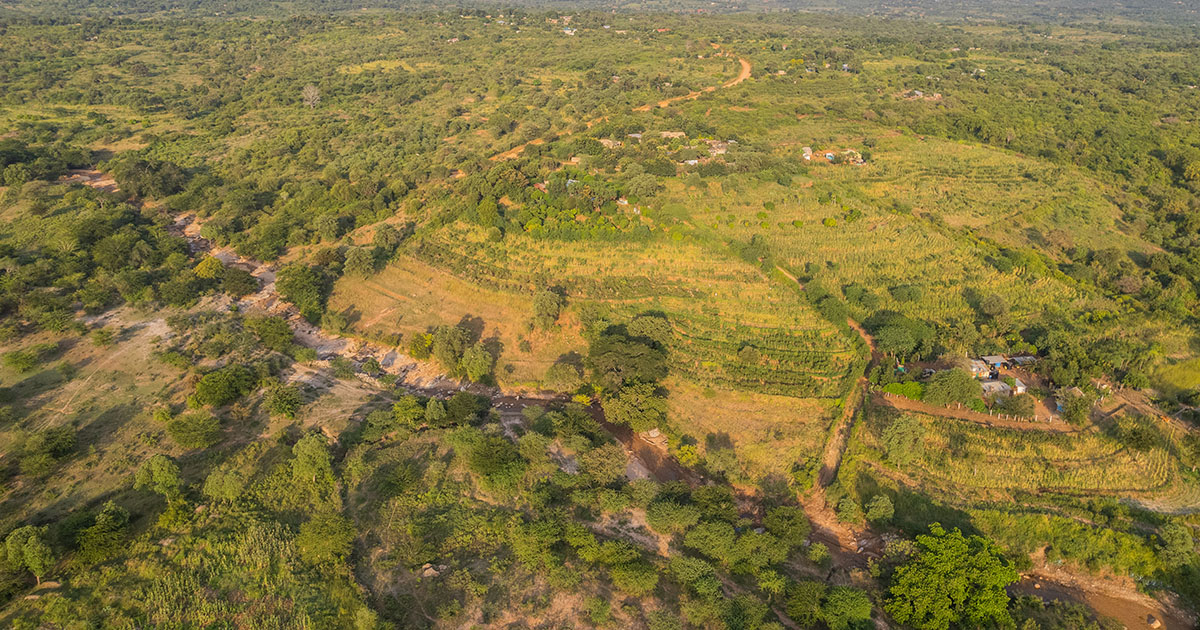







Recently, a number o scientist have offered new sstrategies that promote agroforestry as a means of improving local livelihoods while conserving important species and environmental functions. Brossiu and Russel (2003) have even proposed ''reinvent'' community based conservatio by suggesting the princibles of ''building assets across generations'' assets that can include natural,social and economics. Leakey and Tchoundjeu(2001);Tchoundjeu et al (1999), have also made first rate progress in domestication and marketting science of indigenous fruit trees in humid tropics of West and Central Africa, thus supporting conservation in agroforestry landscape mosaics through use. Schroth and colleagues (2004) recently authorised a synthesis of the benefits that agroforestry can offer biodiversity conservation in tropical landscapes. They identified three hypotheses around how agroforestry can contribute to conservation: protection by reducing pressure to deforets land, provide habitat for native plant and animal species ,and serv as a benighn matrixs land use for fragmented landscapes. However they also state that intergrating and managing agroforestry with conservation is a major policy, institutional and technical challenge.This recognition of the multifunctional nature os especially forested landscapes has thus recently being consolidated in the realization that, approaches to manage for intergrated conservation and human development would require the identifiaction and management of 'flows' of ecosystem functions (like food chains, gene flows, water flows, pollination, seed dissemination, soil formation, disease reguation, nutrient assimilation) across extensive interconnected geographic and economic contexts.
This work is licensed under CC-BY 4.0
This work is licensed under CC-BY 4.0
Export citation:
RIS (.ris)
TI  - Agroforestry landscape mosaics and challenges in information management and governance
AU  - Mbile, P.
AU  - Russell, D.
AU  - Steel, L.
AU  - Tchoundjeu, Z.
AU  - Degrande, A.
AB  - Recently, a number o scientist have offered new sstrategies that promote agroforestry as a means of improving local livelihoods while conserving important species and environmental functions. Brossiu and Russel (2003) have even proposed ''reinvent'' community based conservatio by suggesting the princibles of ''building assets across generations'' assets that can include natural,social and economics. Leakey and Tchoundjeu(2001);Tchoundjeu et al (1999), have also made first rate progress in domestication and marketting science of indigenous fruit trees in humid tropics of West and Central Africa, thus supporting conservation in agroforestry landscape mosaics through use. Schroth and colleagues (2004) recently authorised a synthesis of the benefits that agroforestry can offer biodiversity conservation in tropical landscapes. They identified three hypotheses around how agroforestry can contribute to conservation: protection by reducing pressure to deforets land, provide habitat for native plant and animal species ,and serv as a benighn matrixs land use for fragmented landscapes. However they also state that intergrating and managing agroforestry with conservation is a major policy, institutional and technical challenge.This recognition of the multifunctional nature os especially forested landscapes has thus recently being consolidated in the realization that, approaches to manage for intergrated conservation and human development would require the identifiaction and management of 'flows' of ecosystem functions (like food chains, gene flows, water flows, pollination, seed dissemination, soil formation, disease reguation, nutrient assimilation) across extensive interconnected geographic and economic contexts.
PY  - 2005
UR  - https://www.cifor-icraf.org/knowledge/publication/27877/
KW  - agroforestry, governance, information management, landscape, spatial information
ER  -
Endnote (.ciw)
%T Agroforestry landscape mosaics and challenges in information management and governance
%A Mbile, P.
%A Russell, D.
%A Steel, L.
%A Tchoundjeu, Z.
%A Degrande, A.
%D 2005
%U https://www.cifor-icraf.org/knowledge/publication/27877/
%X Recently, a number o scientist have offered new sstrategies that promote agroforestry as a means of improving local livelihoods while conserving important species and environmental functions. Brossiu and Russel (2003) have even proposed ''reinvent'' community based conservatio by suggesting the princibles of ''building assets across generations'' assets that can include natural,social and economics. Leakey and Tchoundjeu(2001);Tchoundjeu et al (1999), have also made first rate progress in domestication and marketting science of indigenous fruit trees in humid tropics of West and Central Africa, thus supporting conservation in agroforestry landscape mosaics through use. Schroth and colleagues (2004) recently authorised a synthesis of the benefits that agroforestry can offer biodiversity conservation in tropical landscapes. They identified three hypotheses around how agroforestry can contribute to conservation: protection by reducing pressure to deforets land, provide habitat for native plant and animal species ,and serv as a benighn matrixs land use for fragmented landscapes. However they also state that intergrating and managing agroforestry with conservation is a major policy, institutional and technical challenge.This recognition of the multifunctional nature os especially forested landscapes has thus recently being consolidated in the realization that, approaches to manage for intergrated conservation and human development would require the identifiaction and management of 'flows' of ecosystem functions (like food chains, gene flows, water flows, pollination, seed dissemination, soil formation, disease reguation, nutrient assimilation) across extensive interconnected geographic and economic contexts.
%K agroforestry
%K governance
%K information management
%K landscape
%K spatial information
Publication year
2005
Authors
Mbile, P.; Russell, D.; Steel, L.; Tchoundjeu, Z.; Degrande, A.
Language
English
Keywords
agroforestry, governance, information management, landscape, spatial information
Source
Paper presented at the 'Mapping for change' International Conference on Participatory Information Management and Communication, Nairobi, Kenya, 7-10 September, 2005. :