


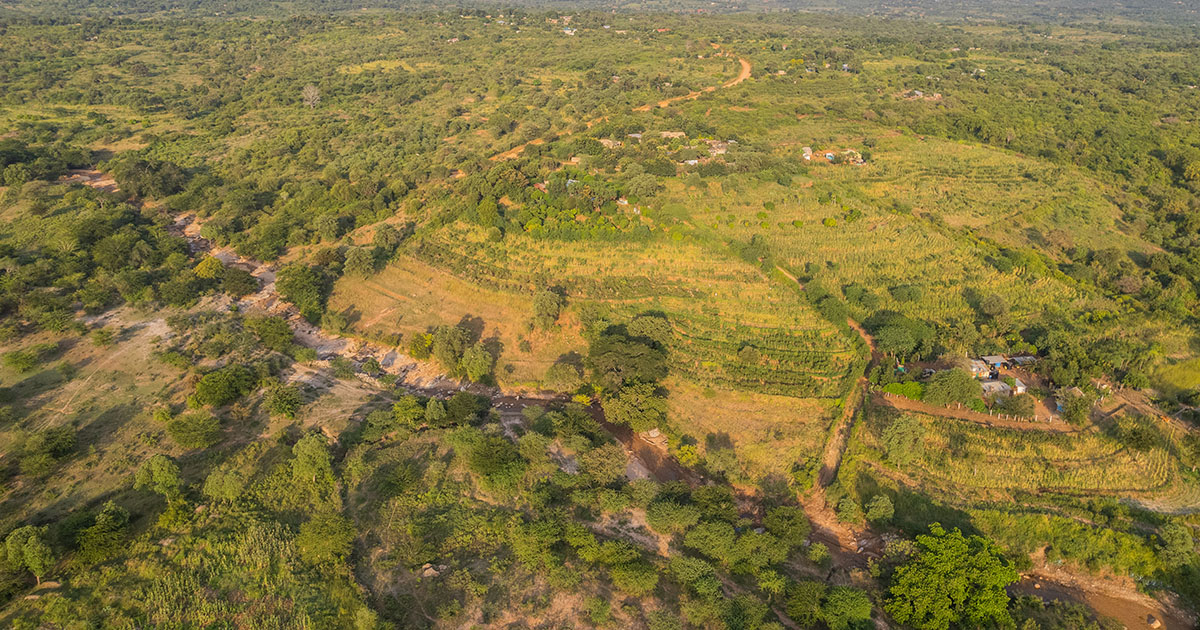






Old-growth TROPICAL FORESTS provide several major ‘watershed functions’ essential to human survival and local livelihoods. They hold soil in place and help maintain the productivity of the land. They also regulate the quantity and timing of water flows, control sediment loads and so protect water quality. Cutting down tropical forests undermines these valued functions. But hydrological patterns on the land vary widely from one catchment area to another and between sites or plots within the same catchment. They depend not only on the extent of natural tree cover, but also on a host of other factors. These include rainfall, topography (especially slope), geology, soil type, the area and distribution of food and forage crops, leaf litter over soil, the extent of compaction from livestock and machinery, and the presence of impervious surfaces such as roads and buildings. Some non- forested landscapes have no major problems with watershed functions – so strictly speaking they don’t need ‘forest’ to maintain their water flows. Thus, a web of human and other factors determines how land will process rainfall and whether the net result will present hazards for local and downstream people. To blame local water-related hazards solely on ‘deforestation’, while ignoring other key parameters influenced by post- forest land management, is to severely limit one’s options in the search for balanced solutions
Export citation:
RIS (.ris)
TI  - Deforestation and the multiple functions of tropical watersheds: are tropical forests indispensable for regulating rainfall and ensuring clean and reliable water supplies?
AU  - Bruijnzeel, S.L.A.
AU  - van Noordwijk, M.
AB  - Old-growth TROPICAL FORESTS provide several major ‘watershed functions’ essential to human survival and local livelihoods. They hold soil in place and help maintain the productivity of the land. They also regulate the quantity and timing of water flows, control sediment loads and so protect water quality. Cutting down tropical forests undermines these valued functions. But hydrological patterns on the land vary widely from one catchment area to another and between sites or plots within the same catchment. They depend not only on the extent of natural tree cover, but also on a host of other factors. These include rainfall, topography (especially slope), geology, soil type, the area and distribution of food and forage crops, leaf litter over soil, the extent of compaction from livestock and machinery, and the presence of impervious surfaces such as roads and buildings. Some non- forested landscapes have no major problems with watershed functions – so strictly speaking they don’t need ‘forest’ to maintain their water flows. Thus, a web of human and other factors determines how land will process rainfall and whether the net result will present hazards for local and downstream people. To blame local water-related hazards solely on ‘deforestation’, while ignoring other key parameters influenced by post- forest land management, is to severely limit one’s options in the search for balanced solutions
PY  - 2008
PB  - ASB Partnerships for the Tropical Forest Magins
PP  - Nairobi, Kenya
UR  - https://www.cifor-icraf.org/knowledge/publication/28375/
KW  - carbon, climate change, developing countries, forests, landscape
ER  -
Endnote (.ciw)
%T Deforestation and the multiple functions of tropical watersheds: are tropical forests indispensable for regulating rainfall and ensuring clean and reliable water supplies?
%A Bruijnzeel, S.L.A.
%A van Noordwijk, M.
%D 2008
%I ASB Partnerships for the Tropical Forest Magins
%C Nairobi, Kenya
%U https://www.cifor-icraf.org/knowledge/publication/28375/
%X Old-growth TROPICAL FORESTS provide several major ‘watershed functions’ essential to human survival and local livelihoods. They hold soil in place and help maintain the productivity of the land. They also regulate the quantity and timing of water flows, control sediment loads and so protect water quality. Cutting down tropical forests undermines these valued functions. But hydrological patterns on the land vary widely from one catchment area to another and between sites or plots within the same catchment. They depend not only on the extent of natural tree cover, but also on a host of other factors. These include rainfall, topography (especially slope), geology, soil type, the area and distribution of food and forage crops, leaf litter over soil, the extent of compaction from livestock and machinery, and the presence of impervious surfaces such as roads and buildings. Some non- forested landscapes have no major problems with watershed functions – so strictly speaking they don’t need ‘forest’ to maintain their water flows. Thus, a web of human and other factors determines how land will process rainfall and whether the net result will present hazards for local and downstream people. To blame local water-related hazards solely on ‘deforestation’, while ignoring other key parameters influenced by post- forest land management, is to severely limit one’s options in the search for balanced solutions
%K carbon
%K climate change
%K developing countries
%K forests
%K landscape
Publisher
ASB Partnerships for the Tropical Forest Magins: Nairobi, Kenya
Publication year
2008
Authors
Bruijnzeel, S.L.A.; van Noordwijk, M.
Language
English
Keywords
carbon, climate change, developing countries, forests, landscape
Geographic
Indonesia