

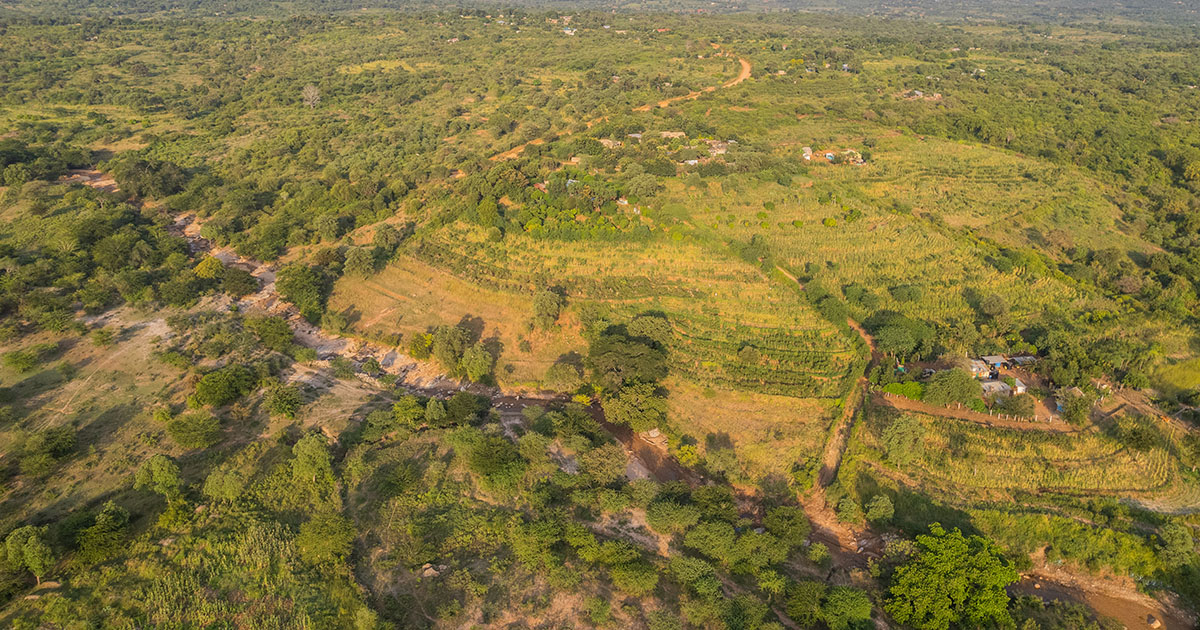







Crop productivity is improved by ecosystem services, including pollination, but this should be set in the context of trade-offs among multiple management practices.We investigated the impact of pollination services on coffee production, considering variation in fertilization, irrigation, shade cover, and environmental variables such as rainfall (which stimulates coffee flowering across all plantations), soil pH, and nitrogen availability. After accounting for management interventions, bee abundance improved coffee production (number of berries harvested). Some management interventions, such as irrigation, used once to trigger asynchronous flowering, dramatically increased bee abundance at coffee trees. Others, such as the extent and type of tree cover, revealed interacting effects on pollination and, ultimately, crop production. The effects of management interventions, notably irrigation and addition of lime, had, however, far more substantial positive effects on coffee production than tree cover. These results suggest that pollination services matter, but managing the asynchrony of flowering was a more effective tool for securing good pollination than maintaining high shade tree densities as pollinator habitat. Complex interactions across farm and landscape scales, including both management practices and environmental conditions, shape pollination outcomes. Effective production systems therefore require the integrated consideration of management practices in the context of the surrounding habitat structure. This paper points toward a more strategic use of ecosystem services in agricultural systems, where ecosystem services are shaped by the coupling of management interventions and environmental variables.
This work is licensed under CC-BY 4.0

This work is licensed under CC-BY 4.0
DOI:
https://doi.org/10.1073/pnas.1210590110Altmetric score:
Dimensions Citation Count:
Export citation:
RIS (.ris)
TI  - Interactive effects among ecosystem services and management practices on crop production: pollination in coffee agroforestry systems
AU  - Boreux, V.
AU  - Kushalappa, C.G.
AU  - Ghazoul, J.
AU  - Vaast, P.
AB  - Crop productivity is improved by ecosystem services, including pollination, but this should be set in the context of trade-offs among multiple management practices.We investigated the impact of pollination services on coffee production, considering variation in fertilization, irrigation, shade cover, and environmental variables such as rainfall (which stimulates coffee flowering across all plantations), soil pH, and nitrogen availability. After accounting for management interventions, bee abundance improved coffee production (number of berries harvested). Some management interventions, such as irrigation, used once to trigger asynchronous flowering, dramatically increased bee abundance at coffee trees. Others, such as the extent and type of tree cover, revealed interacting effects on pollination and, ultimately, crop production. The effects of management interventions, notably irrigation and addition of lime, had, however, far more substantial positive effects on coffee production than tree cover. These results suggest that pollination services matter, but managing the asynchrony of flowering was a more effective tool for securing good pollination than maintaining high shade tree densities as pollinator habitat. Complex interactions across farm and landscape scales, including both management practices and environmental conditions, shape pollination outcomes. Effective production systems therefore require the integrated consideration of management practices in the context of the surrounding habitat structure. This paper points toward a more strategic use of ecosystem services in agricultural systems, where ecosystem services are shaped by the coupling of management interventions and environmental variables.
PY  - 2013
UR  - https://www.cifor-icraf.org/knowledge/publication/32776/
DO  - https://doi.org/10.1073/pnas.1210590110
KW  - apis, biodiversity, coffea canephora, conservation, ecosystems, india, livestock, tetragonula, tourism
ER  -
Endnote (.ciw)
%T Interactive effects among ecosystem services and management practices on crop production: pollination in coffee agroforestry systems
%A Boreux, V.
%A Kushalappa, C.G.
%A Ghazoul, J.
%A Vaast, P.
%D 2013
%U https://www.cifor-icraf.org/knowledge/publication/32776/
%R https://doi.org/10.1073/pnas.1210590110
%X Crop productivity is improved by ecosystem services, including pollination, but this should be set in the context of trade-offs among multiple management practices.We investigated the impact of pollination services on coffee production, considering variation in fertilization, irrigation, shade cover, and environmental variables such as rainfall (which stimulates coffee flowering across all plantations), soil pH, and nitrogen availability. After accounting for management interventions, bee abundance improved coffee production (number of berries harvested). Some management interventions, such as irrigation, used once to trigger asynchronous flowering, dramatically increased bee abundance at coffee trees. Others, such as the extent and type of tree cover, revealed interacting effects on pollination and, ultimately, crop production. The effects of management interventions, notably irrigation and addition of lime, had, however, far more substantial positive effects on coffee production than tree cover. These results suggest that pollination services matter, but managing the asynchrony of flowering was a more effective tool for securing good pollination than maintaining high shade tree densities as pollinator habitat. Complex interactions across farm and landscape scales, including both management practices and environmental conditions, shape pollination outcomes. Effective production systems therefore require the integrated consideration of management practices in the context of the surrounding habitat structure. This paper points toward a more strategic use of ecosystem services in agricultural systems, where ecosystem services are shaped by the coupling of management interventions and environmental variables.
%K apis
%K biodiversity
%K coffea canephora
%K conservation
%K ecosystems
%K india
%K livestock
%K tetragonula
%K tourism
Publication year
2013
ISSN
1091-6490
Authors
Boreux, V.; Kushalappa, C.G.; Ghazoul, J.; Vaast, P.
Language
English
Keywords
apis, biodiversity, coffea canephora, conservation, ecosystems, india, livestock, tetragonula, tourism
Source
Proceedings of the National Academy of Sciences (PNAS). 110(21): 8387-8392
Geographic
India