


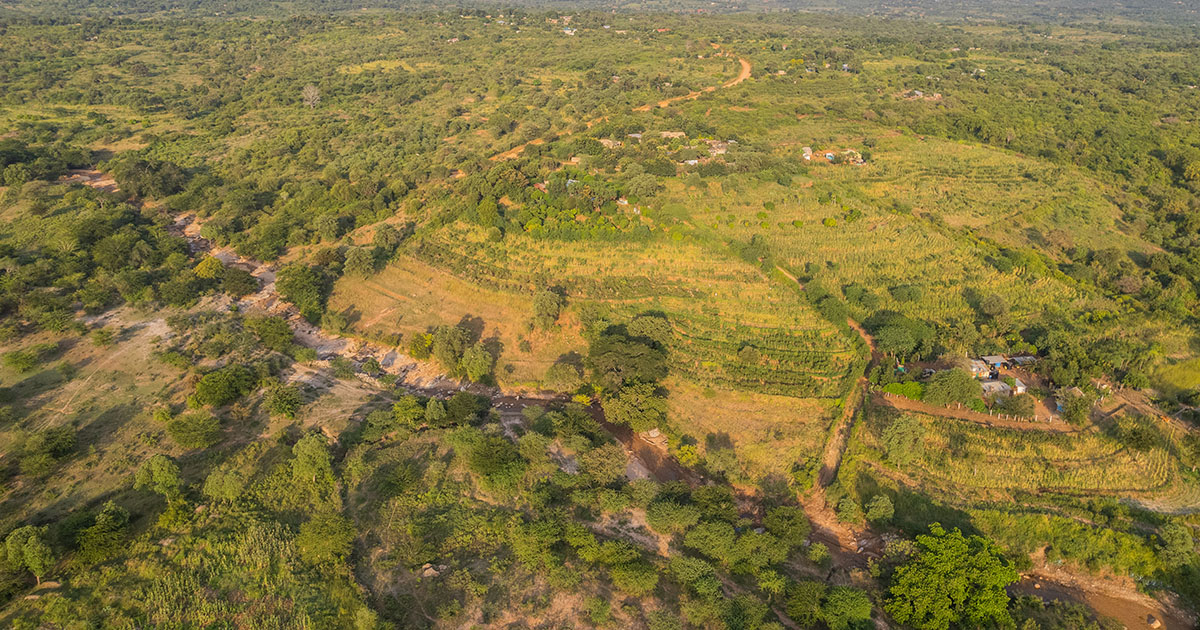







Landscape labelling is a new Payment for Ecosystem Services (PES) concept that seeks to combine elements of PES with product certification at a landscape scales. Landscape labelling proposes that managed rural landscapes which deliver valuable ecosystem services be awarded a ‘landscape label', by which products derived from this landscape could be differentiated and value added, in the global market. A principal objective of landscape labelling is to deliver benefits to communities, rather than individual landowners, based on the continued delivery of ecosystem services as evaluated at landscape scales, rather than at the scale of private landholdings. In so doing, landscape labelling also seeks to overcome some of the existing challenges to the implementation of PES schemes, including evaluating opportunity costs and ecosystem service delivery, high transaction costs, difficulties in ensuring conditionality and limited inclusivity leading to inequitable distribution of benefits. The global export trade in many agricultural commodities derived from tropical smallholdings (including coffee, cacao and rubber) offers opportunities for the implementation of landscape labelling that is specifically targeted to benefit smallholders within a landscape mosaic. As such, landscape labelling would provide management with incentives to continue to meet the ecosystem service criteria required for certification. The label, with its associated conditionality criteria, could serve as a mechanism for securing additional payments for ecosystem services, which, under a landscape certification scheme, would be delivered to community-based organizations for inv estment incommunity and social projects that would benefit a far wider range of people than is possible in the current PES model.
Export citation:
RIS (.ris)
TI  - Landscape labeling approaches to PES: Bundling services, products and stewards
AU  - Ghazoul, J.
AU  - Garcia, C.A.
AU  - Kushalappa, C.G.
AB  - Landscape labelling is a new Payment for Ecosystem Services (PES) concept that seeks to combine elements of PES with product certification at a landscape scales. Landscape labelling proposes that managed rural landscapes which deliver valuable ecosystem services be awarded a ‘landscape label', by which products derived from this landscape could be differentiated and value added, in the global market. A principal objective of landscape labelling is to deliver benefits to communities, rather than individual landowners, based on the continued delivery of ecosystem services as evaluated at landscape scales, rather than at the scale of private landholdings. In so doing, landscape labelling also seeks to overcome some of the existing challenges to the implementation of PES schemes, including evaluating opportunity costs and ecosystem service delivery, high transaction costs, difficulties in ensuring  conditionality and limited inclusivity leading to inequitable distribution of benefits. The global export trade in many agricultural commodities derived from tropical smallholdings (including coffee, cacao and rubber) offers opportunities for the implementation of landscape labelling that is specifically targeted to benefit smallholders within a landscape mosaic. As such, landscape labelling would provide management with incentives to continue to meet the ecosystem service criteria required for certification. The label, with its associated conditionality criteria, could serve as a mechanism for securing additional payments for ecosystem services, which, under a landscape certification scheme, would be delivered to community-based organizations for inv estment incommunity and social projects that would benefit a far wider range of people than is possible in the current PES model.
PY  - 2011
PB  - Food and Agriculture Organization on the United Nations (FAO)
PP  - Rome, Italy
UR  - https://www.cifor-icraf.org/knowledge/publication/3544/
KW  - coffee, coffee agroforestry, ecosystem services, equity, landscape mosaics, payments for environmental services, plantation crops, poverty alleviation
ER  -
Endnote (.ciw)
%T Landscape labeling approaches to PES: Bundling services, products and stewards
%A Ghazoul, J.
%A Garcia, C.A.
%A Kushalappa, C.G.
%D 2011
%I Food and Agriculture Organization on the United Nations (FAO)
%C Rome, Italy
%U https://www.cifor-icraf.org/knowledge/publication/3544/
%X Landscape labelling is a new Payment for Ecosystem Services (PES) concept that seeks to combine elements of PES with product certification at a landscape scales. Landscape labelling proposes that managed rural landscapes which deliver valuable ecosystem services be awarded a ‘landscape label', by which products derived from this landscape could be differentiated and value added, in the global market. A principal objective of landscape labelling is to deliver benefits to communities, rather than individual landowners, based on the continued delivery of ecosystem services as evaluated at landscape scales, rather than at the scale of private landholdings. In so doing, landscape labelling also seeks to overcome some of the existing challenges to the implementation of PES schemes, including evaluating opportunity costs and ecosystem service delivery, high transaction costs, difficulties in ensuring  conditionality and limited inclusivity leading to inequitable distribution of benefits. The global export trade in many agricultural commodities derived from tropical smallholdings (including coffee, cacao and rubber) offers opportunities for the implementation of landscape labelling that is specifically targeted to benefit smallholders within a landscape mosaic. As such, landscape labelling would provide management with incentives to continue to meet the ecosystem service criteria required for certification. The label, with its associated conditionality criteria, could serve as a mechanism for securing additional payments for ecosystem services, which, under a landscape certification scheme, would be delivered to community-based organizations for inv estment incommunity and social projects that would benefit a far wider range of people than is possible in the current PES model.
%K coffee
%K coffee agroforestry
%K ecosystem services
%K equity
%K landscape mosaics
%K payments for environmental services
%K plantation crops
%K poverty alleviation
Publication year
2011
ISBN
978-92-5-106796-3
Authors
Ghazoul, J.; Garcia, C.A.; Kushalappa, C.G.
Language
English
Keywords
coffee, coffee agroforestry, ecosystem services, equity, landscape mosaics, payments for environmental services, plantation crops, poverty alleviation
Source
Payments for ecosystem services and food security. Food and Agriculture Organization on the United Nations (FAO): Rome, Italy
Geographic
India