







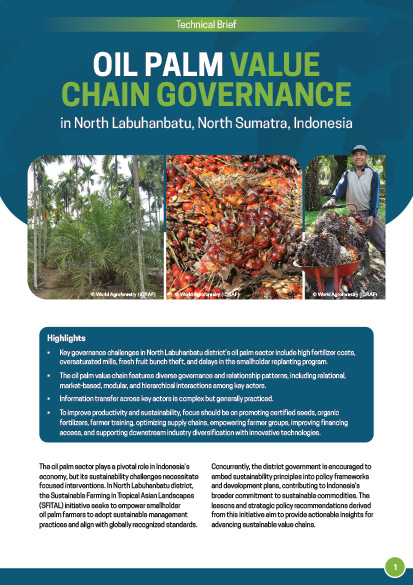


This brief analyzes the governance and interaction patterns within the oil palm value chain in North Labuhanbatu District, North Sumatra, as part of the Sustainable Farming in Tropical Asian Landscapes (SFITAL) initiative. The sector faces several critical challenges, including unaffordable fertilizer prices leading to suboptimal maintenance, an overcapacity of mills compared to fruit supply, frequent fresh fruit bunch (FFB) theft, and delays in smallholder replanting programs. By identifying nine key actors—ranging from harvest workers and smallholder farmers to delivery order (DO) holders and large-scale CPO processing companies—the study maps the complex flow of commodities and the varying degrees of coordination and power asymmetry across the supply chain.
The research identifies four distinct governance patterns: relational governance, which is prevalent and based on long-standing trust, kinship, and social proximity among farmers, brokers, and ramps; market-based governance, involving simple transactions between mills and processing companies; modular governance, observed in easily codifiable transactions between brokers and mills; and hierarchical governance, characterized by vertically integrated top-down control within corporate structures. To enhance sector productivity and sustainability, the brief recommends improving seed quality and certification, promoting the use of organic fertilizers, strengthening farmer capacity through field schools, and streamlining supply chains to ensure traceable and transparent marketing.
This work is licensed under CC-BY 4.0
This work is licensed under CC-BY 4.0
Export citation:
RIS (.ris)
TI  - Oil palm value chain governance in North Labuhanbatu, North Sumatra, Indonesia
AU  - Mujio, M.
AU  - Supijatno, S.
AU  - Ermyanyla, M.
AU  - Prawira, T.
AU  - Fauziah, P.D.
AU  - Perdana, A.
AB  - This brief analyzes the governance and interaction patterns within the oil palm value chain in North Labuhanbatu District, North Sumatra, as part of the Sustainable Farming in Tropical Asian Landscapes (SFITAL) initiative. The sector faces several critical challenges, including unaffordable fertilizer prices leading to suboptimal maintenance, an overcapacity of mills compared to fruit supply, frequent fresh fruit bunch (FFB) theft, and delays in smallholder replanting programs. By identifying nine key actors—ranging from harvest workers and smallholder farmers to delivery order (DO) holders and large-scale CPO processing companies—the study maps the complex flow of commodities and the varying degrees of coordination and power asymmetry across the supply chain.

The research identifies four distinct governance patterns: relational governance, which is prevalent and based on long-standing trust, kinship, and social proximity among farmers, brokers, and ramps; market-based governance, involving simple transactions between mills and processing companies; modular governance, observed in easily codifiable transactions between brokers and mills; and hierarchical governance, characterized by vertically integrated top-down control within corporate structures. To enhance sector productivity and sustainability, the brief recommends improving seed quality and certification, promoting the use of organic fertilizers, strengthening farmer capacity through field schools, and streamlining supply chains to ensure traceable and transparent marketing.
PY  - 2024
PB  - World Agroforestry (ICRAF)
PP  - Bogor, Indonesia
UR  - https://www.cifor-icraf.org/knowledge/publication/36677/
KW  - certification, oil palms, smallholders, sustainability, value chains
ER  -
Endnote (.ciw)
%T Oil palm value chain governance in North Labuhanbatu, North Sumatra, Indonesia
%A Mujio, M.
%A Supijatno, S.
%A Ermyanyla, M.
%A Prawira, T.
%A Fauziah, P.D.
%A Perdana, A.
%D 2024
%I World Agroforestry (ICRAF)
%C Bogor, Indonesia
%U https://www.cifor-icraf.org/knowledge/publication/36677/
%X This brief analyzes the governance and interaction patterns within the oil palm value chain in North Labuhanbatu District, North Sumatra, as part of the Sustainable Farming in Tropical Asian Landscapes (SFITAL) initiative. The sector faces several critical challenges, including unaffordable fertilizer prices leading to suboptimal maintenance, an overcapacity of mills compared to fruit supply, frequent fresh fruit bunch (FFB) theft, and delays in smallholder replanting programs. By identifying nine key actors—ranging from harvest workers and smallholder farmers to delivery order (DO) holders and large-scale CPO processing companies—the study maps the complex flow of commodities and the varying degrees of coordination and power asymmetry across the supply chain.

The research identifies four distinct governance patterns: relational governance, which is prevalent and based on long-standing trust, kinship, and social proximity among farmers, brokers, and ramps; market-based governance, involving simple transactions between mills and processing companies; modular governance, observed in easily codifiable transactions between brokers and mills; and hierarchical governance, characterized by vertically integrated top-down control within corporate structures. To enhance sector productivity and sustainability, the brief recommends improving seed quality and certification, promoting the use of organic fertilizers, strengthening farmer capacity through field schools, and streamlining supply chains to ensure traceable and transparent marketing.
%K certification
%K oil palms
%K smallholders
%K sustainability
%K value chains
Publisher
World Agroforestry (ICRAF): Bogor, Indonesia
Publication year
2024
Authors
Mujio, M.; Supijatno, S.; Ermyanyla, M.; Prawira, T.; Fauziah, P.D.; Perdana, A.
Language
English
Keywords
certification, oil palms, smallholders, sustainability, value chains
Geographic
Indonesia