
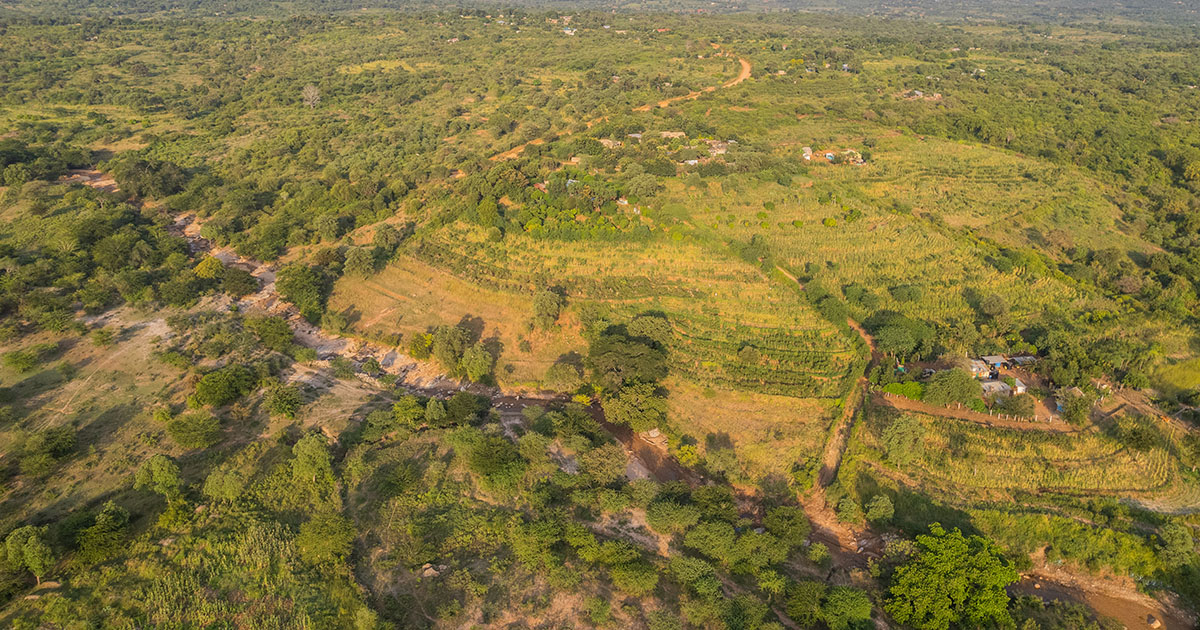






Agroforestry is widely promoted across Sub-Saharan Africa as a strategy for restoring degraded landscapes and enhancing livelihoods, with strong potential to support Sustainable Development Goals (SDGs)—especially SDG 15 (Life on Land) and SDG 2 (Zero Hunger). However, despite significant investments in agroforestry initiatives, there is limited evidence on their effectiveness in driving adoption at scale. This study employs the augmented inverse probability weighting method to assess how exposure to agroforestry practices influences tree planting adoption and intensity, using panel household data from Eastern Rwanda. Findings indicate that exposure increased adoption probability by 7% (p = 0.03). Households exposed both before and after the baseline period demonstrated a higher adoption probability (15%, p = 0.01), suggesting that cumulative exposure has a lasting impact. While exposure modestly improved tree diversity and increased the number of trees in cropping fields, farmers primarily adopted exotic species over indigenous ones. Moreover, the study found that male household exposure correlated with higher adoption probability and greater tree numbers, and seedling provision positively influenced tree numbers and species diversity among adopters. The findings highlight the importance of sustained farmer engagement, targeted gender-sensitive interventions, and structured training programs. Additionally, policies should prioritize seedling availability and establish an enabling policy environment to maximize adoption and agroforestry impact.
This work is licensed under CC-BY 4.0

This work is licensed under CC-BY 4.0
DOI:
https://doi.org/10.1007/s10457-025-01197-6Altmetric score:
Dimensions Citation Count:
Export citation:
RIS (.ris)
TI  - Role of exposure in adoption and intensity of tree planting practices among smallholder households in Rwanda
AU  - Kegode, H.
AU  - Jourdain, D.
AU  - Woldeyohanes, T.
AU  - Hughes, K.
AU  - Karuaihe, S.T.
AB  - Agroforestry is widely promoted across Sub-Saharan Africa as a strategy for restoring degraded landscapes and enhancing livelihoods, with strong potential to support Sustainable Development Goals (SDGs)—especially SDG 15 (Life on Land) and SDG 2 (Zero Hunger). However, despite significant investments in agroforestry initiatives, there is limited evidence on their effectiveness in driving adoption at scale. This study employs the augmented inverse probability weighting method to assess how exposure to agroforestry practices influences tree planting adoption and intensity, using panel household data from Eastern Rwanda. Findings indicate that exposure increased adoption probability by 7% (p = 0.03). Households exposed both before and after the baseline period demonstrated a higher adoption probability (15%, p = 0.01), suggesting that cumulative exposure has a lasting impact. While exposure modestly improved tree diversity and increased the number of trees in cropping fields, farmers primarily adopted exotic species over indigenous ones. Moreover, the study found that male household exposure correlated with higher adoption probability and greater tree numbers, and seedling provision positively influenced tree numbers and species diversity among adopters. The findings highlight the importance of sustained farmer engagement, targeted gender-sensitive interventions, and structured training programs. Additionally, policies should prioritize seedling availability and establish an enabling policy environment to maximize adoption and agroforestry impact.
PY  - 2025
UR  - https://www.cifor-icraf.org/knowledge/publication/44567/
DO  - https://doi.org/10.1007/s10457-025-01197-6
KW  - adoption, agroforestry, gender analysis, households, land management, livelihoods, seedlings, smallholders, tree planting
ER  -
Endnote (.ciw)
%T Role of exposure in adoption and intensity of tree planting practices among smallholder households in Rwanda
%A Kegode, H.
%A Jourdain, D.
%A Woldeyohanes, T.
%A Hughes, K.
%A Karuaihe, S.T.
%D 2025
%U https://www.cifor-icraf.org/knowledge/publication/44567/
%R https://doi.org/10.1007/s10457-025-01197-6
%X Agroforestry is widely promoted across Sub-Saharan Africa as a strategy for restoring degraded landscapes and enhancing livelihoods, with strong potential to support Sustainable Development Goals (SDGs)—especially SDG 15 (Life on Land) and SDG 2 (Zero Hunger). However, despite significant investments in agroforestry initiatives, there is limited evidence on their effectiveness in driving adoption at scale. This study employs the augmented inverse probability weighting method to assess how exposure to agroforestry practices influences tree planting adoption and intensity, using panel household data from Eastern Rwanda. Findings indicate that exposure increased adoption probability by 7% (p = 0.03). Households exposed both before and after the baseline period demonstrated a higher adoption probability (15%, p = 0.01), suggesting that cumulative exposure has a lasting impact. While exposure modestly improved tree diversity and increased the number of trees in cropping fields, farmers primarily adopted exotic species over indigenous ones. Moreover, the study found that male household exposure correlated with higher adoption probability and greater tree numbers, and seedling provision positively influenced tree numbers and species diversity among adopters. The findings highlight the importance of sustained farmer engagement, targeted gender-sensitive interventions, and structured training programs. Additionally, policies should prioritize seedling availability and establish an enabling policy environment to maximize adoption and agroforestry impact.
%K adoption
%K agroforestry
%K gender analysis
%K households
%K land management
%K livelihoods
%K seedlings
%K smallholders
%K tree planting
Publication year
2025
ISSN
0167-4366
Authors
Kegode, H.; Jourdain, D.; Woldeyohanes, T.; Hughes, K.; Karuaihe, S.T.
Language
English
Keywords
adoption, agroforestry, gender analysis, households, land management, livelihoods, seedlings, smallholders, tree planting
Source
Agroforestry Systems. 99: 104
Geographic
Rwanda