


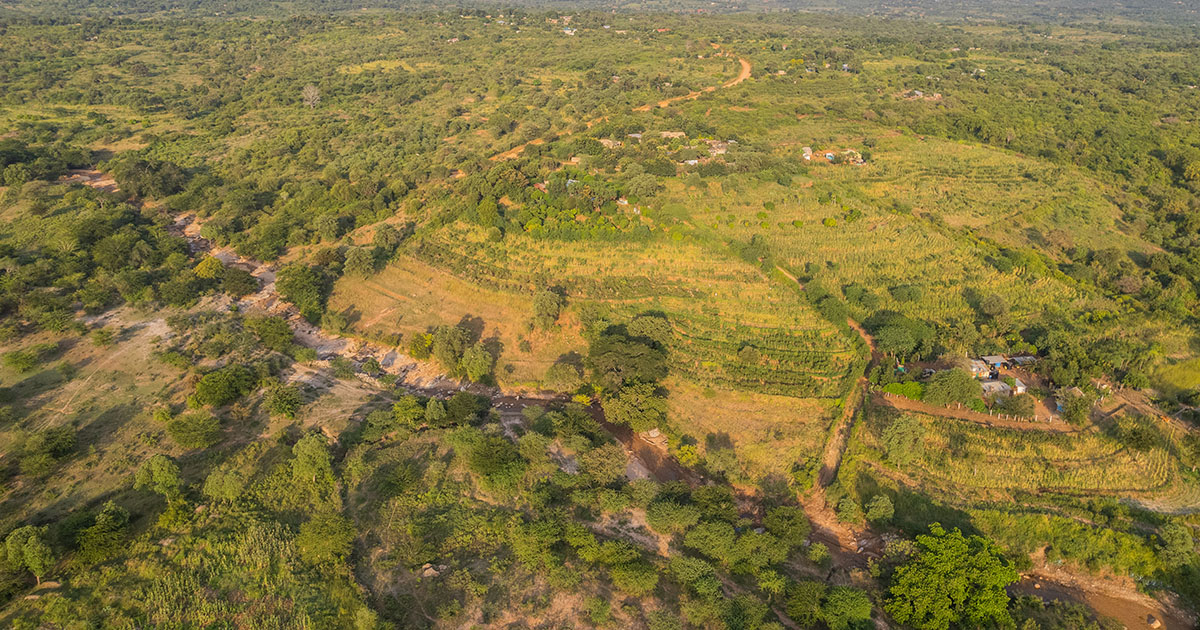








Many rural areas in the tropics are characterized by smallholder families. Technical assistance is considered crucial for improving local livelihoods and increasing production potential. However, rural development interventions suffer from a lack of financial and human resources and have undesirable social and environmental impacts. Targeted changes in critical contextual factors can be an effective and low-cost option to facilitate sustainable farmer responses. Empirical studies analyzing these dynamics are scarce. To better understand contextual changes and local responses leading to tangible landscape-level outcomes, we conducted an in-depth case study in the districts of Soritor and Jepelacio, in the northwestern part of the San Martin region of Peru, a typical forest frontier area where smallholder farmers have settled over the last 40 years. The study shows that villages followed a standard development trajectory characterized by quantitative and qualitative improvements in infrastructure and services, leading to market integration and better quality of life. These improvements correlate with the specialization and intensification of farmers' production systems, along with increased pressure on forests due to the influx of new settlers. Consolidation was observed three to four decades after settlement began. While the study sheds light on the relationships between contextual changes, farmer responses, and impacts over space and time, it also makes clear the difficulties to influence the observed development pathway. The results support the promotion of extension, financial, logistical, and legal instruments tailored to local realities, to facilitate local action for sustainable development and avoid the negative social and environmental consequences of economic growth.
This work is licensed under CC-BY 4.0

This work is licensed under CC-BY 4.0
DOI:
https://doi.org/10.3389/ffgc.2025.1647001Altmetric score:
Dimensions Citation Count:
Export citation:
RIS (.ris)
TI  - Development pathways in forest frontiers: contextual changes and local responses of small-scale farmers in the Peruvian amazon
AU  - Undurraga, J.T.
AU  - Pokorny, B.
AU  - Vargas, R.
AU  - Reyes, M.
AU  - De Jong, W.
AU  - Robiglio, V.
AB  - Many rural areas in the tropics are characterized by smallholder families. Technical assistance is considered crucial for improving local livelihoods and increasing production potential. However, rural development interventions suffer from a lack of financial and human resources and have undesirable social and environmental impacts. Targeted changes in critical contextual factors can be an effective and low-cost option to facilitate sustainable farmer responses. Empirical studies analyzing these dynamics are scarce. To better understand contextual changes and local responses leading to tangible landscape-level outcomes, we conducted an in-depth case study in the districts of Soritor and Jepelacio, in the northwestern part of the San Martin region of Peru, a typical forest frontier area where smallholder farmers have settled over the last 40 years. The study shows that villages followed a standard development trajectory characterized by quantitative and qualitative improvements in infrastructure and services, leading to market integration and better quality of life. These improvements correlate with the specialization and intensification of farmers' production systems, along with increased pressure on forests due to the influx of new settlers. Consolidation was observed three to four decades after settlement began. While the study sheds light on the relationships between contextual changes, farmer responses, and impacts over space and time, it also makes clear the difficulties to influence the observed development pathway. The results support the promotion of extension, financial, logistical, and legal instruments tailored to local realities, to facilitate local action for sustainable development and avoid the negative social and environmental consequences of economic growth.
PY  - 2025
UR  - https://www.cifor-icraf.org/knowledge/publication/46151/
DO  - https://doi.org/10.3389/ffgc.2025.1647001
KW  - agricultural development, forest conservation, infrastructure, intensification, livelihoods, market access, rural development, small scale farming, smallholders, sustainable development
ER  -
Endnote (.ciw)
%T Development pathways in forest frontiers: contextual changes and local responses of small-scale farmers in the Peruvian amazon
%A Undurraga, J.T.
%A Pokorny, B.
%A Vargas, R.
%A Reyes, M.
%A De Jong, W.
%A Robiglio, V.
%D 2025
%U https://www.cifor-icraf.org/knowledge/publication/46151/
%R https://doi.org/10.3389/ffgc.2025.1647001
%X Many rural areas in the tropics are characterized by smallholder families. Technical assistance is considered crucial for improving local livelihoods and increasing production potential. However, rural development interventions suffer from a lack of financial and human resources and have undesirable social and environmental impacts. Targeted changes in critical contextual factors can be an effective and low-cost option to facilitate sustainable farmer responses. Empirical studies analyzing these dynamics are scarce. To better understand contextual changes and local responses leading to tangible landscape-level outcomes, we conducted an in-depth case study in the districts of Soritor and Jepelacio, in the northwestern part of the San Martin region of Peru, a typical forest frontier area where smallholder farmers have settled over the last 40 years. The study shows that villages followed a standard development trajectory characterized by quantitative and qualitative improvements in infrastructure and services, leading to market integration and better quality of life. These improvements correlate with the specialization and intensification of farmers' production systems, along with increased pressure on forests due to the influx of new settlers. Consolidation was observed three to four decades after settlement began. While the study sheds light on the relationships between contextual changes, farmer responses, and impacts over space and time, it also makes clear the difficulties to influence the observed development pathway. The results support the promotion of extension, financial, logistical, and legal instruments tailored to local realities, to facilitate local action for sustainable development and avoid the negative social and environmental consequences of economic growth.
%K agricultural development
%K forest conservation
%K infrastructure
%K intensification
%K livelihoods
%K market access
%K rural development
%K small scale farming
%K smallholders
%K sustainable development
Publication year
2025
ISSN
2624-893X
Authors
Undurraga, J.T.; Pokorny, B.; Vargas, R.; Reyes, M.; De Jong, W.; Robiglio, V.
Language
English
Keywords
agricultural development, forest conservation, infrastructure, intensification, livelihoods, market access, rural development, small scale farming, smallholders, sustainable development
Source
Frontiers in Forests and Global Change. 8: 1647001
Geographic
Peru