
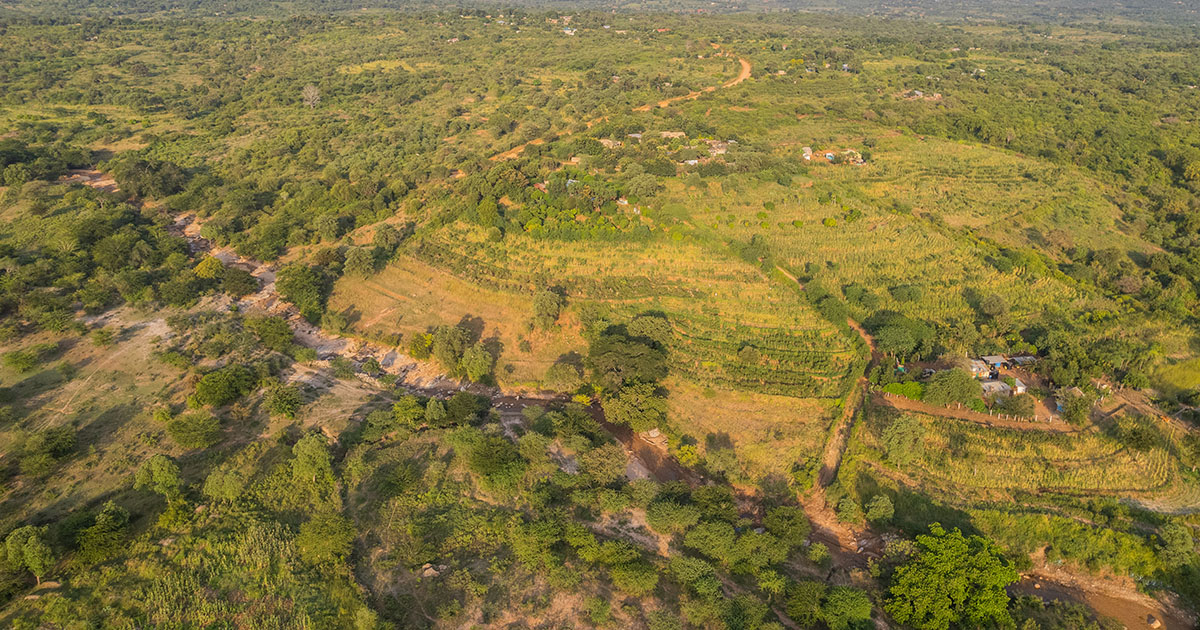






The poverty and environmental degradation vicious circle hypothesis considers the poor as agents and victims of environmentally degrading activities. Despite some studies, however, there still has not been a sufficient empirical examination of the poverty-environment nexus. Based on participatory poverty assessment (PPA) methods with two hundred farm households categorized by wealth status in southern Burkina Faso, six indicators of environmental degradation and a set of land management practices were examined to answer the following questions: (i) Which households (non-poor, fairly-poor, or poorest) are responsible for environmental degradation? (ii) Does poverty constrain adoption of land management practices considered to improve the land? Results indicate deforestation is highest for non-poor farmers, and non-poor and fairly-poor farmers have higher rates of overgrazing. In addition, the entire non-poor group, mainly recent migrants to the area, occupy borrowed lands with tenure perceived as insecure, considered by farmers to be a disincentive for assisted natural regeneration of vegetation. Thus, non-poor and fairly-poor farmers participate most in activities locally identified as environmentally degrading, and the former contribute more than the latter. On the other hand, adoption of land management practices considered to improve the land is relatively low amongst the poorest farmers.
This work is licensed under CC-BY 4.0

Download:

This work is licensed under CC-BY 4.0
DOI:
https://doi.org/10.3390/land5030020Altmetric score:
Dimensions Citation Count:
Export citation:
RIS (.ris)
TI  - Poverty and Environmental Degradation in Southern Burkina Faso: An Assessment Based on Participatory Methods
AU  - Etongo, D.
AU  - Djenontin, I.N.S.
AU  - Kanninen, M.
AB  - The poverty and environmental degradation vicious circle hypothesis considers the poor as agents and victims of environmentally degrading activities. Despite some studies, however, there still has not been a sufficient empirical examination of the poverty-environment nexus. Based on participatory poverty assessment (PPA) methods with two hundred farm households categorized by wealth status in southern Burkina Faso, six indicators of environmental degradation and a set of land management practices were examined to answer the following questions: (i) Which households (non-poor, fairly-poor, or poorest) are responsible for environmental degradation? (ii) Does poverty constrain adoption of land management practices considered to improve the land? Results indicate deforestation is highest for non-poor farmers, and non-poor and fairly-poor farmers have higher rates of overgrazing. In addition, the entire non-poor group, mainly recent migrants to the area, occupy borrowed lands with tenure perceived as insecure, considered by farmers to be a disincentive for assisted natural regeneration of vegetation. Thus, non-poor and fairly-poor farmers participate most in activities locally identified as environmentally degrading, and the former contribute more than the latter. On the other hand, adoption of land management practices considered to improve the land is relatively low amongst the poorest farmers.
PY  - 2016
UR  - https://www.cifor-icraf.org/knowledge/publication/6165/
DO  - https://doi.org/10.3390/land5030020
KW  - land management, poverty, tenure
ER  -
Endnote (.ciw)
%T Poverty and Environmental Degradation in Southern Burkina Faso: An Assessment Based on Participatory Methods
%A Etongo, D.
%A Djenontin, I.N.S.
%A Kanninen, M.
%D 2016
%U https://www.cifor-icraf.org/knowledge/publication/6165/
%R https://doi.org/10.3390/land5030020
%X The poverty and environmental degradation vicious circle hypothesis considers the poor as agents and victims of environmentally degrading activities. Despite some studies, however, there still has not been a sufficient empirical examination of the poverty-environment nexus. Based on participatory poverty assessment (PPA) methods with two hundred farm households categorized by wealth status in southern Burkina Faso, six indicators of environmental degradation and a set of land management practices were examined to answer the following questions: (i) Which households (non-poor, fairly-poor, or poorest) are responsible for environmental degradation? (ii) Does poverty constrain adoption of land management practices considered to improve the land? Results indicate deforestation is highest for non-poor farmers, and non-poor and fairly-poor farmers have higher rates of overgrazing. In addition, the entire non-poor group, mainly recent migrants to the area, occupy borrowed lands with tenure perceived as insecure, considered by farmers to be a disincentive for assisted natural regeneration of vegetation. Thus, non-poor and fairly-poor farmers participate most in activities locally identified as environmentally degrading, and the former contribute more than the latter. On the other hand, adoption of land management practices considered to improve the land is relatively low amongst the poorest farmers.
%K land management
%K poverty
%K tenure
Publication year
2016
ISSN
2073-445X
Authors
Etongo, D.; Djenontin, I.N.S.; Kanninen, M.
Language
English
Keywords
land management, poverty, tenure
Source
Land. 5(3): 20
Geographic
Burkina Faso