
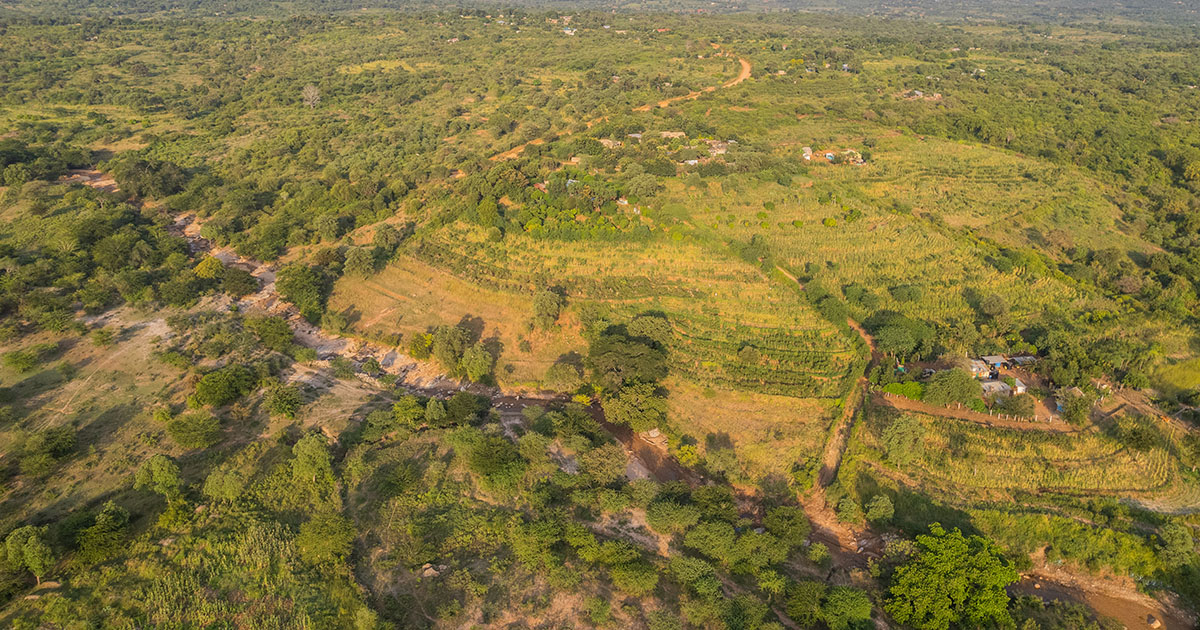






Agroforestry involves the integration and use of trees in crop fields, farms and across agricultural landscapes. Trees buffer climate change impacts and variability and diversify land use and farming systems, providing additional livelihood and environmental benefits not delivered through land management without trees. There is huge scope to increase and better manage tree cover on farms and across agricultural landscapes. Implementing agroforestry involves promoting a diverse set of options (comprising innovation in technology, markets and policy) that need to be matched to variation in environmental and social context. Options range from intensification of extensive parkland systems in the Sahel and fertilizer trees across East and Southern Africa, to multi-strata tree-cropping including coffee, cocoa, and rubber (see Case study 1) and home gardens in more humid zones, and silvopastoral systems that integrate trees with livestock on rangelands.
This work is licensed under CC-BY 4.0
Download:

This work is licensed under CC-BY 4.0
Export citation:
RIS (.ris)
TI  - Agroforestry to diversify farms and enhance resilience
AU  - Sinclair, F.
AU  - Rosenstock, T.S.
AU  - Gitz, V.
AU  - Wollenberg, L.
AB  - Agroforestry involves the integration and use of trees in crop fields, farms and across agricultural landscapes. Trees buffer climate change impacts and variability and diversify land use and farming systems, providing additional livelihood and environmental benefits not delivered through land management without trees. There is huge scope to increase and better manage tree cover on farms and across agricultural landscapes. Implementing agroforestry involves promoting a diverse set of options (comprising innovation in technology, markets and policy) that need to be matched to variation in environmental and social context. Options range from intensification of extensive parkland systems in the Sahel and fertilizer trees across East and Southern Africa, to multi-strata tree-cropping including coffee, cocoa, and rubber (see Case study 1) and home gardens in more humid zones, and silvopastoral systems that integrate trees with livestock on rangelands.
PY  - 2017
PB  - CGIAR Research Program on Climate Change, Agriculture and Food Security (CCAFS)
PP  - Wageningen, The Netherlands
UR  - https://www.cifor-icraf.org/knowledge/publication/7155/
KW  - agriculture, agroforestry, landscape, trees
ER  -
Endnote (.ciw)
%T Agroforestry to diversify farms and enhance resilience
%A Sinclair, F.
%A Rosenstock, T.S.
%A Gitz, V.
%A Wollenberg, L.
%D 2017
%I CGIAR Research Program on Climate Change, Agriculture and Food Security (CCAFS)
%C Wageningen, The Netherlands
%U https://www.cifor-icraf.org/knowledge/publication/7155/
%X Agroforestry involves the integration and use of trees in crop fields, farms and across agricultural landscapes. Trees buffer climate change impacts and variability and diversify land use and farming systems, providing additional livelihood and environmental benefits not delivered through land management without trees. There is huge scope to increase and better manage tree cover on farms and across agricultural landscapes. Implementing agroforestry involves promoting a diverse set of options (comprising innovation in technology, markets and policy) that need to be matched to variation in environmental and social context. Options range from intensification of extensive parkland systems in the Sahel and fertilizer trees across East and Southern Africa, to multi-strata tree-cropping including coffee, cocoa, and rubber (see Case study 1) and home gardens in more humid zones, and silvopastoral systems that integrate trees with livestock on rangelands.
%K agriculture
%K agroforestry
%K landscape
%K trees
Publication year
2017
Authors
Sinclair, F.; Rosenstock, T.S.; Gitz, V.; Wollenberg, L.
Language
English
Keywords
agriculture, agroforestry, landscape, trees