
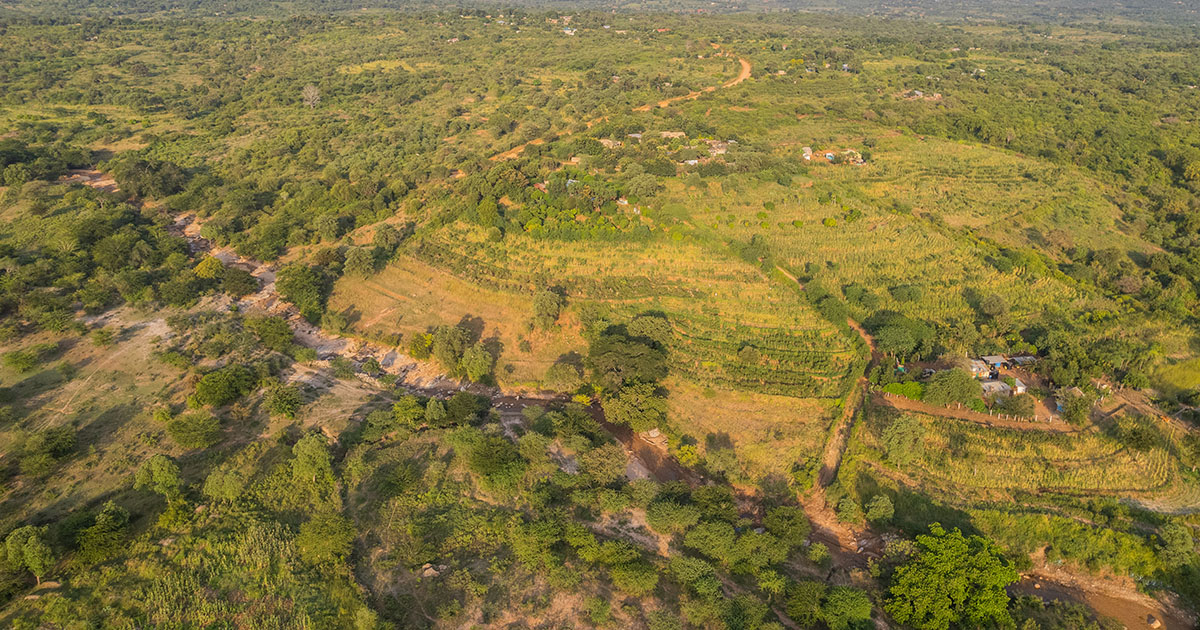






Cocoa agroforestry has evolved into an accepted natural resource conservation strategy in the tropics. It is regularly proposed as one of the main uses for REDD+ projects (Reducing Emissions from Deforestation and forest Degradation and the role of conservation, sustainable management of forests, and enhancement of forest carbon stocks in developing countries) in the Democratic Republic of the Congo. However, few studies have characterized the cocoa agroforestry systems in this country. Hence, this research proposes to determine the impact of distance from Kisangani (the unique city in the landscape) and land-use intensity on the floristic composition of cocoa agroforests in Bengamisa-Yangambi forest landscape in the Congo Basin. The results revealed that species diversity and density of plants associated with cocoa are influenced by the distance from Kisangani (the main city in the landscape and province). Farmers maintain/introduce trees that play one or more of several roles. They may host caterpillars, provide food, medicine, or timber, or deliver other functions such as providing shade to the cocoa tree. Farmers maintain plants with edible products (mainly oil palms) in their agroforests more than other plants. Thus, these agroforests play key roles in conserving the floristic diversity of degraded areas. As cocoa agroforestry has greater potential for production, biodiversity conservation, and environmental protection, it should be used to slow down or even stop deforestation and forest degradation.
This work is licensed under CC-BY 4.0

Download:

This work is licensed under CC-BY 4.0
DOI:
https://doi.org/10.3390/f11101096Altmetric score:
Dimensions Citation Count:
Export citation:
RIS (.ris)
TI  - Biodiversity of the cocoa agroforests of the Bengamisa-Yangambi Forest Landscape in the Democratic Republic of the Congo (DRC)
AU  - Batsi, G.
AU  - Sonwa, D.J.
AU  - Mangaza, L.
AU  - Ebuy, J.
AU  - Kahindo, J.-M.
AB  - Cocoa agroforestry has evolved into an accepted natural resource conservation strategy in the tropics. It is regularly proposed as one of the main uses for REDD+ projects (Reducing Emissions from Deforestation and forest Degradation and the role of conservation, sustainable management of forests, and enhancement of forest carbon stocks in developing countries) in the Democratic Republic of the Congo. However, few studies have characterized the cocoa agroforestry systems in this country. Hence, this research proposes to determine the impact of distance from Kisangani (the unique city in the landscape) and land-use intensity on the floristic composition of cocoa agroforests in Bengamisa-Yangambi forest landscape in the Congo Basin. The results revealed that species diversity and density of plants associated with cocoa are influenced by the distance from Kisangani (the main city in the landscape and province). Farmers maintain/introduce trees that play one or more of several roles. They may host caterpillars, provide food, medicine, or timber, or deliver other functions such as providing shade to the cocoa tree. Farmers maintain plants with edible products (mainly oil palms) in their agroforests more than other plants. Thus, these agroforests play key roles in conserving the floristic diversity of degraded areas. As cocoa agroforestry has greater potential for production, biodiversity conservation, and environmental protection, it should be used to slow down or even stop deforestation and forest degradation.
PY  - 2020
UR  - https://www.cifor-icraf.org/knowledge/publication/7902/
DO  - https://doi.org/10.3390/f11101096
KW  - agroforestry, biodiversity, cocoa, conservation, forest management, landscape
ER  -
Endnote (.ciw)
%T Biodiversity of the cocoa agroforests of the Bengamisa-Yangambi Forest Landscape in the Democratic Republic of the Congo (DRC)
%A Batsi, G.
%A Sonwa, D.J.
%A Mangaza, L.
%A Ebuy, J.
%A Kahindo, J.-M.
%D 2020
%U https://www.cifor-icraf.org/knowledge/publication/7902/
%R https://doi.org/10.3390/f11101096
%X Cocoa agroforestry has evolved into an accepted natural resource conservation strategy in the tropics. It is regularly proposed as one of the main uses for REDD+ projects (Reducing Emissions from Deforestation and forest Degradation and the role of conservation, sustainable management of forests, and enhancement of forest carbon stocks in developing countries) in the Democratic Republic of the Congo. However, few studies have characterized the cocoa agroforestry systems in this country. Hence, this research proposes to determine the impact of distance from Kisangani (the unique city in the landscape) and land-use intensity on the floristic composition of cocoa agroforests in Bengamisa-Yangambi forest landscape in the Congo Basin. The results revealed that species diversity and density of plants associated with cocoa are influenced by the distance from Kisangani (the main city in the landscape and province). Farmers maintain/introduce trees that play one or more of several roles. They may host caterpillars, provide food, medicine, or timber, or deliver other functions such as providing shade to the cocoa tree. Farmers maintain plants with edible products (mainly oil palms) in their agroforests more than other plants. Thus, these agroforests play key roles in conserving the floristic diversity of degraded areas. As cocoa agroforestry has greater potential for production, biodiversity conservation, and environmental protection, it should be used to slow down or even stop deforestation and forest degradation.
%K agroforestry
%K biodiversity
%K cocoa
%K conservation
%K forest management
%K landscape
Publication year
2020
ISSN
1999-4907
Authors
Batsi, G.; Sonwa, D.J.; Mangaza, L.; Ebuy, J.; Kahindo, J.-M.
Language
English
Keywords
agroforestry, biodiversity, cocoa, conservation, forest management, landscape
Source
Forests. 11(10): 1096
Geographic
Democratic Republic of the Congo