


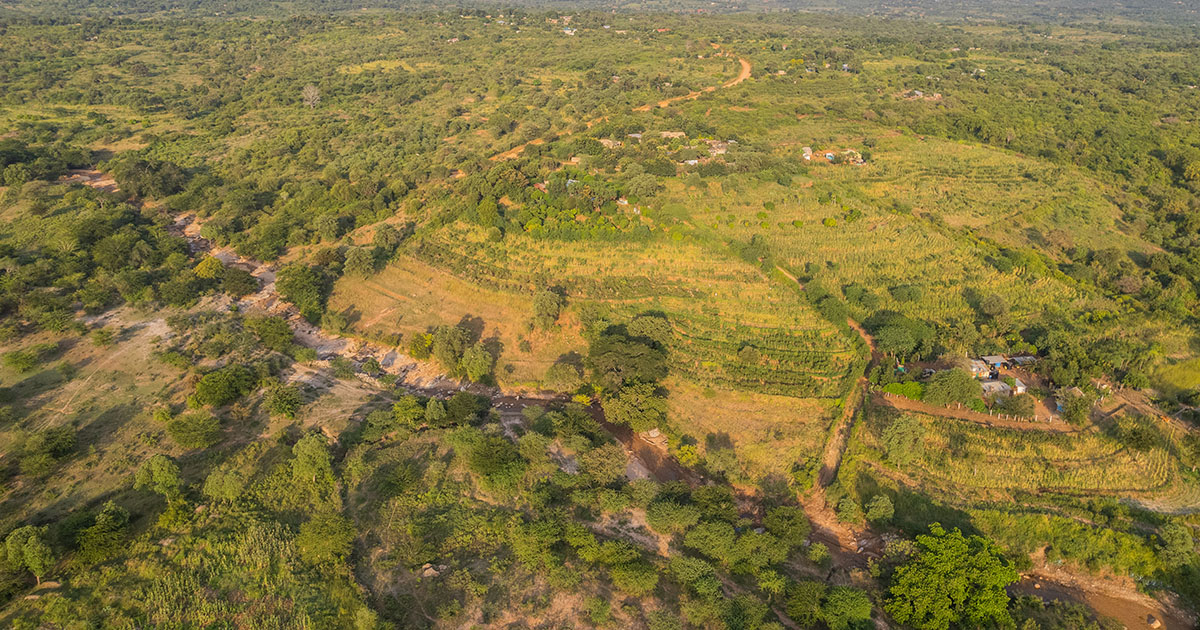







In recent years, agroforestry has gained increasing attention as an option to simultaneously alleviate poverty, provide ecological benefits, and mitigate climate change. The present study simulates small-scale farmers’ agroforestry adoption decisions to investigate the consequences for livelihoods and the environment over time. To explore the interdependencies between agroforestry adoption, livelihoods, and the environment, an agent-based model adjusted to a case study area in rural Indonesia was implemented. Thereby, the model compares different scenarios, including a climate change scenario. The agroforestry system under investigation consists of an illipe (Shorea stenoptera) rubber (Hevea brasiliensis) mix, which are both locally valued tree species. The simulations reveal that farmers who adopt agroforestry diversify their livelihood portfolio while increasing income. Additionally, the model predicts environmental benefits: enhanced biodiversity and higher carbon sequestration in the landscape. The benefits of agroforestry for livelihoods and nature gain particular importance in the climate change scenario. The results therefore provide policy-makers and practitioners with insights into the dynamic economic and environmental advantages of promoting agroforestry.
This work is licensed under CC-BY 4.0

Download:

This work is licensed under CC-BY 4.0
DOI:
https://doi.org/10.3390/land10040385Altmetric score:
Dimensions Citation Count:
Export citation:
RIS (.ris)
TI  - Simulating Agroforestry Adoption in Rural Indonesia: The Potential of Trees on Farms for Livelihoods and Environment
AU  - Nöldeke, B.
AU  - Winter, E.
AU  - Laumonier, Y.
AU  - Simamora, T.I.
AB  - In recent years, agroforestry has gained increasing attention as an option to simultaneously alleviate poverty, provide ecological benefits, and mitigate climate change. The present study simulates small-scale farmers’ agroforestry adoption decisions to investigate the consequences for livelihoods and the environment over time. To explore the interdependencies between agroforestry adoption, livelihoods, and the environment, an agent-based model adjusted to a case study area in rural Indonesia was implemented. Thereby, the model compares different scenarios, including a climate change scenario. The agroforestry system under investigation consists of an illipe (Shorea stenoptera) rubber (Hevea brasiliensis) mix, which are both locally valued tree species. The simulations reveal that farmers who adopt agroforestry diversify their livelihood portfolio while increasing income. Additionally, the model predicts environmental benefits: enhanced biodiversity and higher carbon sequestration in the landscape. The benefits of agroforestry for livelihoods and nature gain particular importance in the climate change scenario. The results therefore provide policy-makers and practitioners with insights into the dynamic economic and environmental advantages of promoting agroforestry.
PY  - 2021
UR  - https://www.cifor-icraf.org/knowledge/publication/8024/
DO  - https://doi.org/10.3390/land10040385
KW  - adoption, agroforestry, climate change, ecosystem services, livelihoods, rural development
ER  -
Endnote (.ciw)
%T Simulating Agroforestry Adoption in Rural Indonesia: The Potential of Trees on Farms for Livelihoods and Environment
%A Nöldeke, B.
%A Winter, E.
%A Laumonier, Y.
%A Simamora, T.I.
%D 2021
%U https://www.cifor-icraf.org/knowledge/publication/8024/
%R https://doi.org/10.3390/land10040385
%X In recent years, agroforestry has gained increasing attention as an option to simultaneously alleviate poverty, provide ecological benefits, and mitigate climate change. The present study simulates small-scale farmers’ agroforestry adoption decisions to investigate the consequences for livelihoods and the environment over time. To explore the interdependencies between agroforestry adoption, livelihoods, and the environment, an agent-based model adjusted to a case study area in rural Indonesia was implemented. Thereby, the model compares different scenarios, including a climate change scenario. The agroforestry system under investigation consists of an illipe (Shorea stenoptera) rubber (Hevea brasiliensis) mix, which are both locally valued tree species. The simulations reveal that farmers who adopt agroforestry diversify their livelihood portfolio while increasing income. Additionally, the model predicts environmental benefits: enhanced biodiversity and higher carbon sequestration in the landscape. The benefits of agroforestry for livelihoods and nature gain particular importance in the climate change scenario. The results therefore provide policy-makers and practitioners with insights into the dynamic economic and environmental advantages of promoting agroforestry.
%K adoption
%K agroforestry
%K climate change
%K ecosystem services
%K livelihoods
%K rural development
Publication year
2021
ISSN
2073-445X
Authors
Nöldeke, B.; Winter, E.; Laumonier, Y.; Simamora, T.I.
Language
English
Keywords
adoption, agroforestry, climate change, ecosystem services, livelihoods, rural development
Source
Land. 10(4): 385
Geographic
Indonesia