


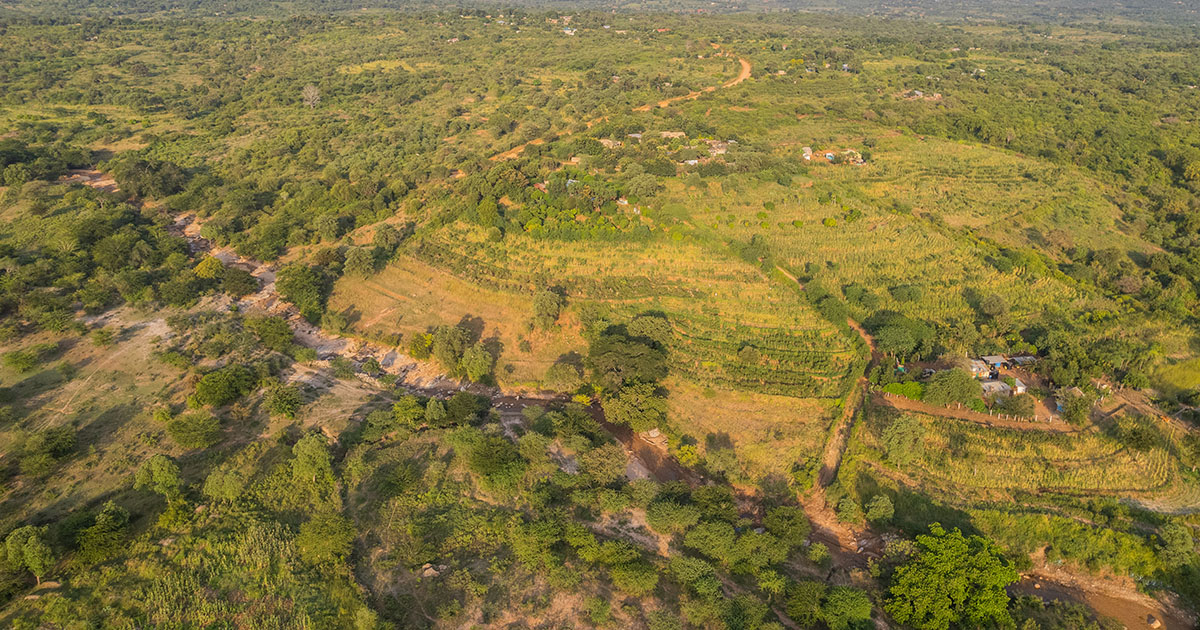







When restoring degraded landscapes, approaches capable of striking a balance between improving environmental services and enhancing human wellbeing need to be considered. Agroforestry is an important option for restoring degraded land and associated ecosystem functions. Using survey, key informant interview and rapid carbon stock appraisal (RaCSA) methods, this study was conducted in five districts in West Java province to examine potential carbon stock in agroforestry systems practiced by smallholder farmers on degraded landscapes. Six agroforestry systems with differing carbon stocks were identified: gmelina (Gmelina arborea Roxb.) + cardamom (Amomum compactum); manglid (Magnolia champaca (L.) Baill. ex Pierre) + cardamom; caddam (Neolamarckiacadamba (Roxb.) Bosser) + cardamom; caddam + elephant grass (Pennisetum purpureum Schumach.); mixed-tree + fishpond; and mixed-tree lots. Compared to other systems, mixed-tree lots had the highest carbon stock at 108.9 Mg ha−1. Carbon stock variations related to species density and diversity. Farmers from research sites said these systems also prevent soil erosion and help to restore degraded land. Farmers’ adoption of agroforestry can be enhanced by the implementation of supportive policies and measures, backed by scientific research.
This work is licensed under CC-BY 4.0

Download:

This work is licensed under CC-BY 4.0
DOI:
https://doi.org/10.3390/f12060714Altmetric score:
Dimensions Citation Count:
Export citation:
RIS (.ris)
TI  - Carbon Sequestration Potential of Agroforestry Systems in Degraded Landscapes in West Java, Indonesia
AU  - Siarudin, M.
AU  - Rahman, S.A.
AU  - Artati, Y.
AU  - Indrajaya, Y.
AU  - Narulita, S.
AU  - Ardha, M.J.
AU  - Larjavaara, M.
AB  - When restoring degraded landscapes, approaches capable of striking a balance between improving environmental services and enhancing human wellbeing need to be considered. Agroforestry is an important option for restoring degraded land and associated ecosystem functions. Using survey, key informant interview and rapid carbon stock appraisal (RaCSA) methods, this study was conducted in five districts in West Java province to examine potential carbon stock in agroforestry systems practiced by smallholder farmers on degraded landscapes. Six agroforestry systems with differing carbon stocks were identified: gmelina (Gmelina arborea Roxb.) + cardamom (Amomum compactum); manglid (Magnolia champaca (L.) Baill. ex Pierre) + cardamom; caddam (Neolamarckiacadamba (Roxb.) Bosser) + cardamom; caddam + elephant grass (Pennisetum purpureum Schumach.); mixed-tree + fishpond; and mixed-tree lots. Compared to other systems, mixed-tree lots had the highest carbon stock at 108.9 Mg ha−1. Carbon stock variations related to species density and diversity. Farmers from research sites said these systems also prevent soil erosion and help to restore degraded land. Farmers’ adoption of agroforestry can be enhanced by the implementation of supportive policies and measures, backed by scientific research.
PY  - 2021
UR  - https://www.cifor-icraf.org/knowledge/publication/8050/
DO  - https://doi.org/10.3390/f12060714
KW  - agroforestry, carbon sequestration, degraded land, ecological restoration, land degradation, small scal farming
ER  -
Endnote (.ciw)
%T Carbon Sequestration Potential of Agroforestry Systems in Degraded Landscapes in West Java, Indonesia
%A Siarudin, M.
%A Rahman, S.A.
%A Artati, Y.
%A Indrajaya, Y.
%A Narulita, S.
%A Ardha, M.J.
%A Larjavaara, M.
%D 2021
%U https://www.cifor-icraf.org/knowledge/publication/8050/
%R https://doi.org/10.3390/f12060714
%X When restoring degraded landscapes, approaches capable of striking a balance between improving environmental services and enhancing human wellbeing need to be considered. Agroforestry is an important option for restoring degraded land and associated ecosystem functions. Using survey, key informant interview and rapid carbon stock appraisal (RaCSA) methods, this study was conducted in five districts in West Java province to examine potential carbon stock in agroforestry systems practiced by smallholder farmers on degraded landscapes. Six agroforestry systems with differing carbon stocks were identified: gmelina (Gmelina arborea Roxb.) + cardamom (Amomum compactum); manglid (Magnolia champaca (L.) Baill. ex Pierre) + cardamom; caddam (Neolamarckiacadamba (Roxb.) Bosser) + cardamom; caddam + elephant grass (Pennisetum purpureum Schumach.); mixed-tree + fishpond; and mixed-tree lots. Compared to other systems, mixed-tree lots had the highest carbon stock at 108.9 Mg ha−1. Carbon stock variations related to species density and diversity. Farmers from research sites said these systems also prevent soil erosion and help to restore degraded land. Farmers’ adoption of agroforestry can be enhanced by the implementation of supportive policies and measures, backed by scientific research.
%K agroforestry
%K carbon sequestration
%K degraded land
%K ecological restoration
%K land degradation
%K small scal farming
Publication year
2021
ISSN
1999-4907
Authors
Siarudin, M.; Rahman, S.A.; Artati, Y.; Indrajaya, Y.; Narulita, S.; Ardha, M.J.; Larjavaara, M.
Language
English
Keywords
agroforestry, carbon sequestration, degraded land, ecological restoration, land degradation, small scal farming
Source
Forests. 12(6): 714
Geographic
Indonesia