


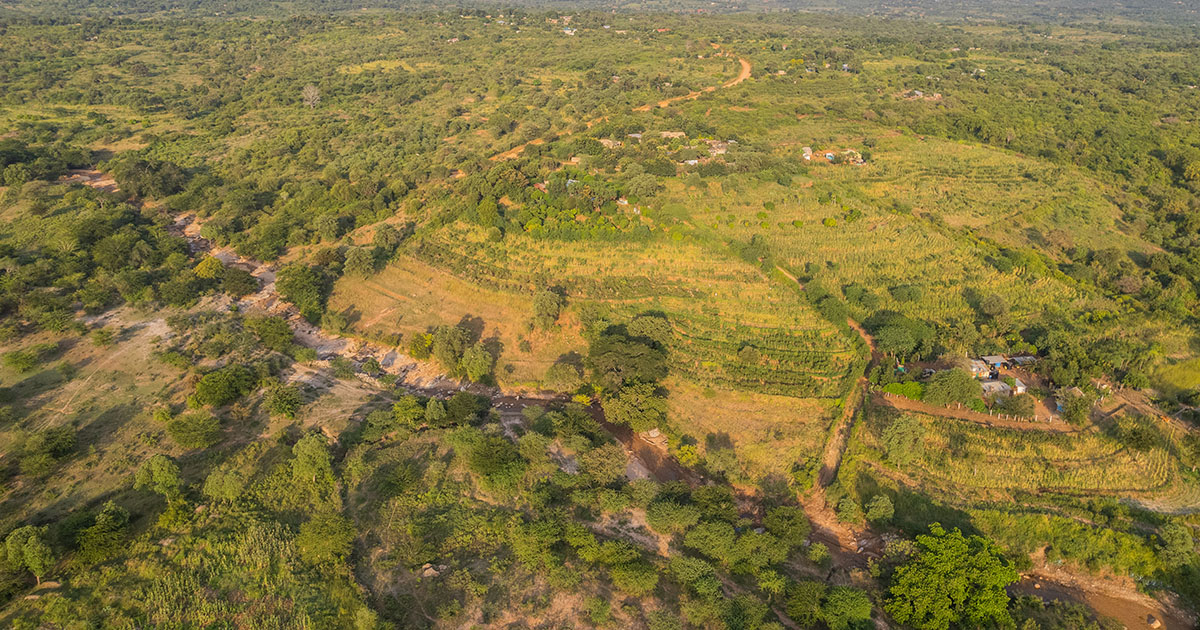







Environmental policies ought to be integrated into economic sectors for successful outcomes. We assess to what extent Reducing Emissions from Deforestation and forest Degradation (REDD +) is integrated into land-use sectors driving deforestation in Cameroon. REDD + governance has been extensively examined, including the challenges of a multisectoral approach to tackle the drivers of deforestation, especially those lying outside the forestry sector. Yet, these studies have focussed on cross-sectoral coordination, giving little attention to factors such as political will and the adequacy of policy instruments for integration. We amend and apply an innovative framework for environmental policy integration to conduct a comprehensive assessment of REDD + policy integration in Cameroon, a Congo Basin country experiencing increasing deforestation rates due to agriculture, husbandry, infrastructure development and mining. Drawing from policy documents and in-depth interviews with key informants, we found out that territorial battles between ministries, insecurity about their understanding of forest matters in different land-use sectors, and dysfunctional policy instruments have undermined REDD + policy integration. Our study suggests that REDD + integration into land-use sectors would be enhanced by informing stakeholders about their roles in the REDD + process, completing and legitimising the forest zoning plan, addressing loopholes in environmental assessment regulations, and alleviating inconsistencies in land-use rules. These instruments would be reinforced with an economic tool internalising carbon costs in projects generating forest emissions.

DOI:
https://doi.org/10.1007/s10668-023-03791-zAltmetric score:
Dimensions Citation Count:
Export citation:
RIS (.ris)
TI  - To what extent is REDD + integrated into land-use sectors driving deforestation? Insights from Cameroon
AU  - Gakou-Kakeu, J.
AU  - Di Gregorio, M.
AU  - Paavola, J.
AU  - Sonwa, D.J.
AB  - Environmental policies ought to be integrated into economic sectors for successful outcomes. We assess to what extent Reducing Emissions from Deforestation and forest Degradation (REDD +) is integrated into land-use sectors driving deforestation in Cameroon. REDD + governance has been extensively examined, including the challenges of a multisectoral approach to tackle the drivers of deforestation, especially those lying outside the forestry sector. Yet, these studies have focussed on cross-sectoral coordination, giving little attention to factors such as political will and the adequacy of policy instruments for integration. We amend and apply an innovative framework for environmental policy integration to conduct a comprehensive assessment of REDD + policy integration in Cameroon, a Congo Basin country experiencing increasing deforestation rates due to agriculture, husbandry, infrastructure development and mining. Drawing from policy documents and in-depth interviews with key informants, we found out that territorial battles between ministries, insecurity about their understanding of forest matters in different land-use sectors, and dysfunctional policy instruments have undermined REDD + policy integration. Our study suggests that REDD + integration into land-use sectors would be enhanced by informing stakeholders about their roles in the REDD + process, completing and legitimising the forest zoning plan, addressing loopholes in environmental assessment regulations, and alleviating inconsistencies in land-use rules. These instruments would be reinforced with an economic tool internalising carbon costs in projects generating forest emissions.
PY  - 2023
UR  - https://www.cifor-icraf.org/knowledge/publication/8993/
DO  - https://doi.org/10.1007/s10668-023-03791-z
KW  - climate change, deforestation, environmental policy, governance, land use, mitigation, policy analysis
ER  -
Endnote (.ciw)
%T To what extent is REDD + integrated into land-use sectors driving deforestation? Insights from Cameroon
%A Gakou-Kakeu, J.
%A Di Gregorio, M.
%A Paavola, J.
%A Sonwa, D.J.
%D 2023
%U https://www.cifor-icraf.org/knowledge/publication/8993/
%R https://doi.org/10.1007/s10668-023-03791-z
%X Environmental policies ought to be integrated into economic sectors for successful outcomes. We assess to what extent Reducing Emissions from Deforestation and forest Degradation (REDD +) is integrated into land-use sectors driving deforestation in Cameroon. REDD + governance has been extensively examined, including the challenges of a multisectoral approach to tackle the drivers of deforestation, especially those lying outside the forestry sector. Yet, these studies have focussed on cross-sectoral coordination, giving little attention to factors such as political will and the adequacy of policy instruments for integration. We amend and apply an innovative framework for environmental policy integration to conduct a comprehensive assessment of REDD + policy integration in Cameroon, a Congo Basin country experiencing increasing deforestation rates due to agriculture, husbandry, infrastructure development and mining. Drawing from policy documents and in-depth interviews with key informants, we found out that territorial battles between ministries, insecurity about their understanding of forest matters in different land-use sectors, and dysfunctional policy instruments have undermined REDD + policy integration. Our study suggests that REDD + integration into land-use sectors would be enhanced by informing stakeholders about their roles in the REDD + process, completing and legitimising the forest zoning plan, addressing loopholes in environmental assessment regulations, and alleviating inconsistencies in land-use rules. These instruments would be reinforced with an economic tool internalising carbon costs in projects generating forest emissions.
%K climate change
%K deforestation
%K environmental policy
%K governance
%K land use
%K mitigation
%K policy analysis
Publication year
2023
ISSN
1387-585X
Authors
Gakou-Kakeu, J.; Di Gregorio, M.; Paavola, J.; Sonwa, D.J.
Language
English
Keywords
climate change, deforestation, environmental policy, governance, land use, mitigation, policy analysis
Source
Environment, Development and Sustainability. :
Geographic
Cameroon