






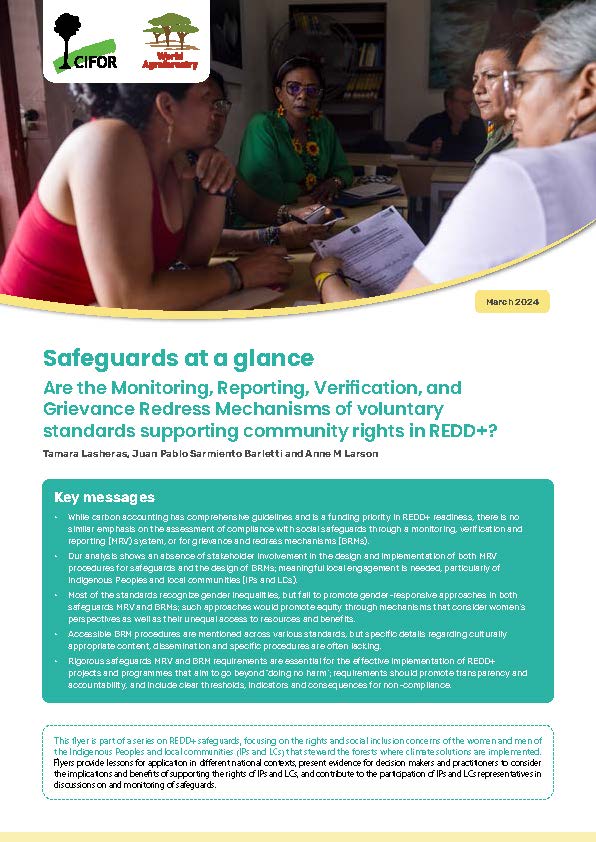


Key messages
- While carbon accounting has comprehensive guidelines and is a funding priority in REDD+ readiness, there is no similar emphasis on the assessment of compliance with social safeguards through a monitoring, verification and reporting (MRV) system, or for grievance and redress mechanisms (GRMs).
- Our analysis shows an absence of stakeholder involvement in the design and implementation of both MRV procedures for safeguards and the design of GRMs; meaningful local engagement is needed, particularly of Indigenous Peoples and local communities (IPs and LCs).
- Most of the standards recognize gender inequalities, but fail to promote gender-responsive approaches in both safeguards MRV and GRMs; such approaches would promote equity through mechanisms that consider women’s perspectives as well as their unequal access to resources and benefits.
- Accessible GRM procedures are mentioned across various standards, but specific details regarding culturally appropriate content, dissemination and specific procedures are often lacking.
- Rigorous safeguards MRV and GRM requirements are essential for the effective implementation of REDD+ projects and programmes that aim to go beyond ‘doing no harm’; requirements should promote transparency and accountability, and include clear thresholds, indicators and consequences for non-compliance.
Download:

This work is licensed under CC-BY 4.0
Export citation:
RIS (.ris)
TI  - Safeguards at a glance: Are the Monitoring, Reporting, Verification, and Grievance Redress Mechanisms of voluntary standards supporting community rights in REDD+?
AU  - Lasheras, T.
AU  - Sarmiento Barletti, J.P.
AU  - Larson, A.M.
AB  - Key messagesWhile carbon accounting has comprehensive guidelines and is a funding priority in REDD+ readiness, there is no similar emphasis on the assessment of compliance with social safeguards through a monitoring, verification and reporting (MRV) system, or for grievance and redress mechanisms (GRMs).Our analysis shows an absence of stakeholder involvement in the design and implementation of both MRV procedures for safeguards and the design of GRMs; meaningful local engagement is needed, particularly of Indigenous Peoples and local communities (IPs and LCs).Most of the standards recognize gender inequalities, but fail to promote gender-responsive approaches in both safeguards MRV and GRMs; such approaches would promote equity through mechanisms that consider women’s perspectives as well as their unequal access to resources and benefits.Accessible GRM procedures are mentioned across various standards, but specific details regarding culturally appropriate content, dissemination and specific procedures are often lacking.Rigorous safeguards MRV and GRM requirements are essential for the effective implementation of REDD+ projects and programmes that aim to go beyond ‘doing no harm’; requirements should promote transparency and accountability, and include clear thresholds, indicators and consequences for non-compliance.
PY  - 2024
PB  - CIFOR-ICRAF
PP  - Bogor, Indonesia and Nairobi, Kenya
UR  - https://www.cifor-icraf.org/knowledge/publication/9122/
KW  - climate change, community forestry, development policy, indigenous people, local community, mitigation, standards, sustainable development
ER  -
Endnote (.ciw)
%T Safeguards at a glance: Are the Monitoring, Reporting, Verification, and Grievance Redress Mechanisms of voluntary standards supporting community rights in REDD+?
%A Lasheras, T.
%A Sarmiento Barletti, J.P.
%A Larson, A.M.
%D 2024
%I CIFOR-ICRAF
%C Bogor, Indonesia and Nairobi, Kenya
%U https://www.cifor-icraf.org/knowledge/publication/9122/
%X Key messagesWhile carbon accounting has comprehensive guidelines and is a funding priority in REDD+ readiness, there is no similar emphasis on the assessment of compliance with social safeguards through a monitoring, verification and reporting (MRV) system, or for grievance and redress mechanisms (GRMs).Our analysis shows an absence of stakeholder involvement in the design and implementation of both MRV procedures for safeguards and the design of GRMs; meaningful local engagement is needed, particularly of Indigenous Peoples and local communities (IPs and LCs).Most of the standards recognize gender inequalities, but fail to promote gender-responsive approaches in both safeguards MRV and GRMs; such approaches would promote equity through mechanisms that consider women’s perspectives as well as their unequal access to resources and benefits.Accessible GRM procedures are mentioned across various standards, but specific details regarding culturally appropriate content, dissemination and specific procedures are often lacking.Rigorous safeguards MRV and GRM requirements are essential for the effective implementation of REDD+ projects and programmes that aim to go beyond ‘doing no harm’; requirements should promote transparency and accountability, and include clear thresholds, indicators and consequences for non-compliance.
%K climate change
%K community forestry
%K development policy
%K indigenous people
%K local community
%K mitigation
%K standards
%K sustainable development
Publisher
CIFOR-ICRAF: Bogor, Indonesia and Nairobi, Kenya
Publication year
2024
Authors
Lasheras, T.; Sarmiento Barletti, J.P.; Larson, A.M.
Language
English
Keywords
climate change, community forestry, development policy, indigenous people, local community, mitigation, standards, sustainable development