








Key messages
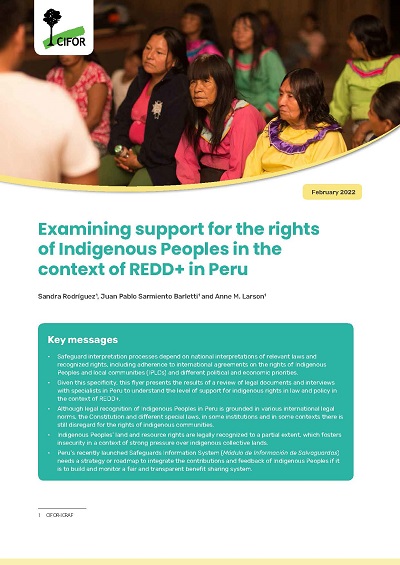
- Safeguard interpretation processes depend on national interpretations of relevant laws and recognized rights, including adherence to international agreements on the rights of Indigenous Peoples and local communities (IPLCs) and different political and economic priorities.
- Given this specificity, this flyer presents the results of a review of legal documents and interviews with specialists in Peru to understand the level of support for indigenous rights in law and policy in the context of REDD+.
- Although legal recognition of Indigenous Peoples in Peru is grounded in various international legal norms, the Constitution and different special laws, in some institutions and in some contexts there is still disregard for the rights of indigenous communities.
- Indigenous Peoples’ land and resource rights are legally recognized to a partial extent, which fosters insecurity in a context of strong pressure over indigenous collective lands.
- Peru’s recently launched Safeguards Information System (Módulo de Información de Salvaguardas) needs a strategy or roadmap to integrate the contributions and feedback of Indigenous Peoples if it is to build and monitor a fair and transparent benefit sharing system.
Download:

This work is licensed under CC-BY 4.0
Export citation:
RIS (.ris)
TI  - Examining support for the rights of Indigenous Peoples in the context of REDD+ in Peru
AU  - Rodríguez, S.
AU  - Sarmiento Barletti, J.P.
AU  - Larson, A.M.
AB  - Key messagesSafeguard interpretation processes depend on national interpretations of relevant laws and recognized rights, including adherence to international agreements on the rights of Indigenous Peoples and local communities (IPLCs) and different political and economic priorities.Given this specificity, this flyer presents the results of a review of legal documents and interviews with specialists in Peru to understand the level of support for indigenous rights in law and policy in the context of REDD+.Although legal recognition of Indigenous Peoples in Peru is grounded in various international legal norms, the Constitution and different special laws, in some institutions and in some contexts there is still disregard for the rights of indigenous communities.Indigenous Peoples’ land and resource rights are legally recognized to a partial extent, which fosters insecurity in a context of strong pressure over indigenous collective lands.Peru’s recently launched Safeguards Information System (Módulo de Información de Salvaguardas) needs a strategy or roadmap to integrate the contributions and feedback of Indigenous Peoples if it is to build and monitor a fair and transparent benefit sharing system.
PY  - 2022
PB  - CIFOR-ICRAF
PP  - Bogor, Indonesia and Nairobi, Kenya
UR  - https://www.cifor-icraf.org/knowledge/publication/8473/
KW  - community forestry, development policy, indigenous people, local community, sustainable development
ER  -
Endnote (.ciw)
%T Examining support for the rights of Indigenous Peoples in the context of REDD+ in Peru
%A Rodríguez, S.
%A Sarmiento Barletti, J.P.
%A Larson, A.M.
%D 2022
%I CIFOR-ICRAF
%C Bogor, Indonesia and Nairobi, Kenya
%U https://www.cifor-icraf.org/knowledge/publication/8473/
%X Key messagesSafeguard interpretation processes depend on national interpretations of relevant laws and recognized rights, including adherence to international agreements on the rights of Indigenous Peoples and local communities (IPLCs) and different political and economic priorities.Given this specificity, this flyer presents the results of a review of legal documents and interviews with specialists in Peru to understand the level of support for indigenous rights in law and policy in the context of REDD+.Although legal recognition of Indigenous Peoples in Peru is grounded in various international legal norms, the Constitution and different special laws, in some institutions and in some contexts there is still disregard for the rights of indigenous communities.Indigenous Peoples’ land and resource rights are legally recognized to a partial extent, which fosters insecurity in a context of strong pressure over indigenous collective lands.Peru’s recently launched Safeguards Information System (Módulo de Información de Salvaguardas) needs a strategy or roadmap to integrate the contributions and feedback of Indigenous Peoples if it is to build and monitor a fair and transparent benefit sharing system.
%K community forestry
%K development policy
%K indigenous people
%K local community
%K sustainable development
Publisher
CIFOR-ICRAF: Bogor, Indonesia and Nairobi, Kenya
Publication year
2022
Authors
Rodríguez, S.; Sarmiento Barletti, J.P.; Larson, A.M.
Language
English
Keywords
community forestry, development policy, indigenous people, local community, sustainable development
Geographic
Peru