





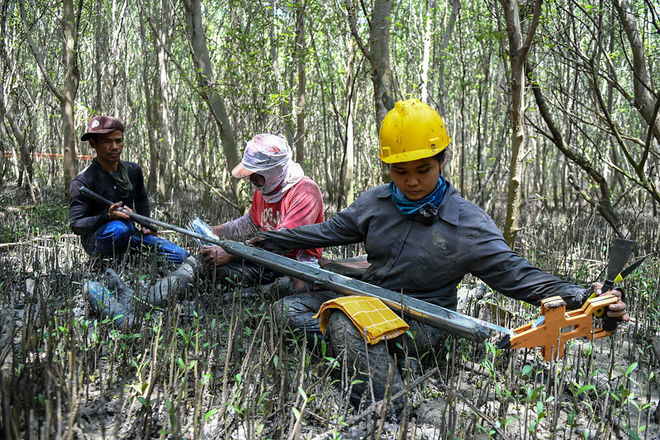
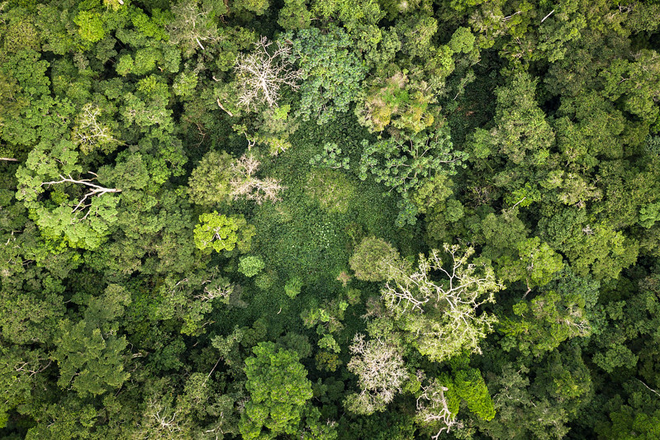



Understanding how species assemblages are structured in relation to environmental variation is a central issue in community ecology. However, factors that create regional variation in relative species abundances have been little studied due to the rarity of large-scale datasets. Here, we investigated a large dataset (30 180 0.5-ha plots spread over 1 600 000 ha) gathered from forest planning inventories in the semi-deciduous forest of the south western Central African Republic. We used Correspondence Analysis and Non-Symmetric Correspondence Analysis on Instrumental Variables to analyse variation in the abundance of 73 common tree species in relation to soil type, rainfall and proximity to villages. Together, environmental variables explained 10.3% of multi-species floristic variation among plots, and the regional spatial structure almost disappeared when the effects of these variables were removed. A Trend Surface Analysis using a third order polynomial function of the geographical coordinates of the plots explained 14.5% of the floristic variation and more than 75% of this variation was explained by environmental variables. Sandy soil was the most influential factor affecting floristic composition. Residual spatial variation not explained by the environmental variables probably reflects the natural and anthropogenic history of the vegetation.

DOI:
https://doi.org/10.1017/S0266467408005506Skor altmetrik:
Jumlah Kutipan Dimensi:
Ekspor kutipan:
RIS (.ris)
TI  - Regional variation in tropical forest tree species composition in the Central African Republic: an assessment based on inventories by forest companies
AU  - Réjou-Méchain, M
AU  - Pelissier, R.
AU  - Gourlet-Fleury, S.
AU  - Couteron, P
AU  - Nasi, R.
AU  - Thompson, J.D.
AB  - Understanding how species assemblages are structured in relation to environmental variation is a central issue in community ecology. However, factors that create regional variation in relative species abundances have been little studied due to the rarity of large-scale datasets. Here, we investigated a large dataset (30 180 0.5-ha plots spread over 1 600 000 ha) gathered from forest planning inventories in the semi-deciduous forest of the south western Central African Republic. We used Correspondence Analysis and Non-Symmetric Correspondence Analysis on Instrumental Variables to analyse variation in the abundance of 73 common tree species in relation to soil type, rainfall and proximity to villages. Together, environmental variables explained 10.3% of multi-species floristic variation among plots, and the regional spatial structure almost disappeared when the effects of these variables were removed. A Trend Surface Analysis using a third order polynomial function of the geographical coordinates of the plots explained 14.5% of the floristic variation and more than 75% of this variation was explained by environmental variables. Sandy soil was the most influential factor affecting floristic composition. Residual spatial variation not explained by the environmental variables probably reflects the natural and anthropogenic history of the vegetation.
PY  - 2008
UR  - https://www.cifor-icraf.org/knowledge/publication/4579/
DO  - https://doi.org/10.1017/S0266467408005506
KW  - biology, climate, community ecology, forest ecology, forests, meterology soil morphology biological resources botanical composition sandy soils vegetation types, plant communities, plantation, soil properties, spatial variation, tropical forests
ER  -
Endnote (.ciw)
%T Regional variation in tropical forest tree species composition in the Central African Republic: an assessment based on inventories by forest companies
%A Réjou-Méchain, M
%A Pelissier, R.
%A Gourlet-Fleury, S.
%A Couteron, P
%A Nasi, R.
%A Thompson, J.D.
%D 2008
%U https://www.cifor-icraf.org/knowledge/publication/4579/
%R https://doi.org/10.1017/S0266467408005506
%X Understanding how species assemblages are structured in relation to environmental variation is a central issue in community ecology. However, factors that create regional variation in relative species abundances have been little studied due to the rarity of large-scale datasets. Here, we investigated a large dataset (30 180 0.5-ha plots spread over 1 600 000 ha) gathered from forest planning inventories in the semi-deciduous forest of the south western Central African Republic. We used Correspondence Analysis and Non-Symmetric Correspondence Analysis on Instrumental Variables to analyse variation in the abundance of 73 common tree species in relation to soil type, rainfall and proximity to villages. Together, environmental variables explained 10.3% of multi-species floristic variation among plots, and the regional spatial structure almost disappeared when the effects of these variables were removed. A Trend Surface Analysis using a third order polynomial function of the geographical coordinates of the plots explained 14.5% of the floristic variation and more than 75% of this variation was explained by environmental variables. Sandy soil was the most influential factor affecting floristic composition. Residual spatial variation not explained by the environmental variables probably reflects the natural and anthropogenic history of the vegetation.
%K biology
%K climate
%K community ecology
%K forest ecology
%K forests
%K meterology soil morphology biological resources botanical composition sandy soils vegetation types
%K plant communities
%K plantation
%K soil properties
%K spatial variation
%K tropical forests
Tahun publikasi
2008
ISSN
0564-3295
Penulis
Réjou-Méchain, M; Pelissier, R.; Gourlet-Fleury, S.; Couteron, P; Nasi, R.; Thompson, J.D.
Bahasa
English
Kata kunci
biology, climate, community ecology, forest ecology, forests, meterology soil morphology biological resources botanical composition sandy soils vegetation types, plant communities, plantation, soil properties, spatial variation, tropical forests
Source
Journal of Tropical Ecology. 24(6):