


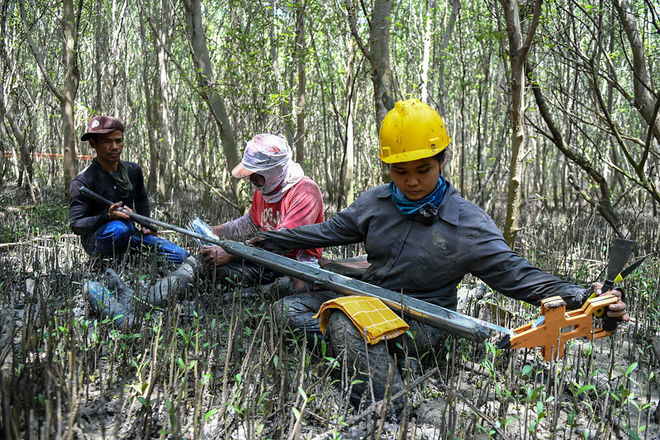
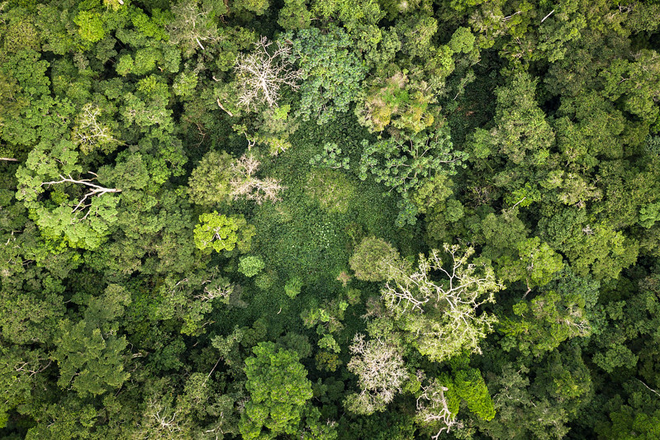



STREK is an acronym of "Development of Silvicultural Techniques for the Regeneration of logged-over rain forets in East Kalimantan". The objectives of this project were to develop management rules leading to sustained productivity of the forests in this area, which are the main suppliers of wood industry in Indonesia. This project was scheduled over seven-year period (1989-1996). In the Berau PT. INHUTANI I concession, two sites of 1 000 ha each were selected. On the first site, logged in 1978-1979, six plota of 4 ha each were set up. Two different silvicultural treatments were tested, with 2 control plots. On the second site, covered by primary forest until 1991, 12 plots of 4 ha each were set up. Three control plots marked out and three logging treatments with three replications were implemented: two Reduced-Impact Logging Techniques (RIL) with two diameter limits (>50 and >60 cm) and one called "conventionsl". In these plots, all tree dbh > 10 cm were measured, numbered and mapped on a scale of 1 : 200. A database comprising about 40 000 trees was set with botany, typology and pedology as well as silvicultural data, which is a prerequisite to carry out further and yield studies.
This work is licensed under CC-BY 4.0

Download:

This work is licensed under CC-BY 4.0
DOI:
https://doi.org/10.19182/bft1999.259.a20011Skor altmetrik:
Jumlah Kutipan Dimensi:
Ekspor kutipan:
RIS (.ris)
TI  - Sylviculture en forêt primaire à Dipterocarpacées en Indonésie. Objectifs et méthodologie du projet STREK
AU  - Bertault, J-G.
AU  - Sist, P.
AU  - Nguyen-the N.
AB  - STREK is an acronym of "Development of Silvicultural Techniques for the Regeneration of logged-over rain forets in East Kalimantan". The objectives of this project were to develop management rules leading to sustained productivity of the forests in this area, which are the main suppliers of wood industry in Indonesia. This project was scheduled over seven-year period (1989-1996). In the Berau PT. INHUTANI I concession, two sites of 1 000 ha each were selected. On the first site, logged in 1978-1979, six plota of 4 ha each were set up. Two different silvicultural treatments were tested, with 2 control plots. On the second site, covered by primary forest until 1991, 12 plots of 4 ha each were set up. Three control plots marked out and three logging treatments with three replications were implemented: two Reduced-Impact Logging Techniques (RIL) with two diameter limits (>50 and >60 cm) and one called "conventionsl". In these plots, all tree dbh > 10 cm were measured, numbered and mapped on a scale of 1 : 200. A database comprising about 40 000 trees was set with botany, typology and pedology as well as silvicultural data, which is a prerequisite to carry out further and yield studies.
PY  - 1999
UR  - https://www.cifor-icraf.org/knowledge/publication/576/
DO  - https://doi.org/10.19182/bft1999.259.a20011
KW  - databases, experimental design, methodology, methods, productivity, rain forests, regeneration, silviculture, sustainability, sustainable agriculture, sustainable land use, techniques, trees
ER  -
Endnote (.ciw)
%T Sylviculture en forêt primaire à Dipterocarpacées en Indonésie. Objectifs et méthodologie du projet STREK
%A Bertault, J-G.
%A Sist, P.
%A Nguyen-the N.
%D 1999
%U https://www.cifor-icraf.org/knowledge/publication/576/
%R https://doi.org/10.19182/bft1999.259.a20011
%X STREK is an acronym of "Development of Silvicultural Techniques for the Regeneration of logged-over rain forets in East Kalimantan". The objectives of this project were to develop management rules leading to sustained productivity of the forests in this area, which are the main suppliers of wood industry in Indonesia. This project was scheduled over seven-year period (1989-1996). In the Berau PT. INHUTANI I concession, two sites of 1 000 ha each were selected. On the first site, logged in 1978-1979, six plota of 4 ha each were set up. Two different silvicultural treatments were tested, with 2 control plots. On the second site, covered by primary forest until 1991, 12 plots of 4 ha each were set up. Three control plots marked out and three logging treatments with three replications were implemented: two Reduced-Impact Logging Techniques (RIL) with two diameter limits (>50 and >60 cm) and one called "conventionsl". In these plots, all tree dbh > 10 cm were measured, numbered and mapped on a scale of 1 : 200. A database comprising about 40 000 trees was set with botany, typology and pedology as well as silvicultural data, which is a prerequisite to carry out further and yield studies.
%K databases
%K experimental design
%K methodology
%K methods
%K productivity
%K rain forests
%K regeneration
%K silviculture
%K sustainability
%K sustainable agriculture
%K sustainable land use
%K techniques
%K trees
Tahun publikasi
1999
ISSN
0006-579X
Penulis
Bertault, J-G.; Sist, P.; Nguyen-the N.
Bahasa
French
Kata kunci
databases, experimental design, methodology, methods, productivity, rain forests, regeneration, silviculture, sustainability, sustainable agriculture, sustainable land use, techniques, trees
Source
Bois et Forêts des Tropiques. 259(1): 15-Jul
Geografis
Indonesia