




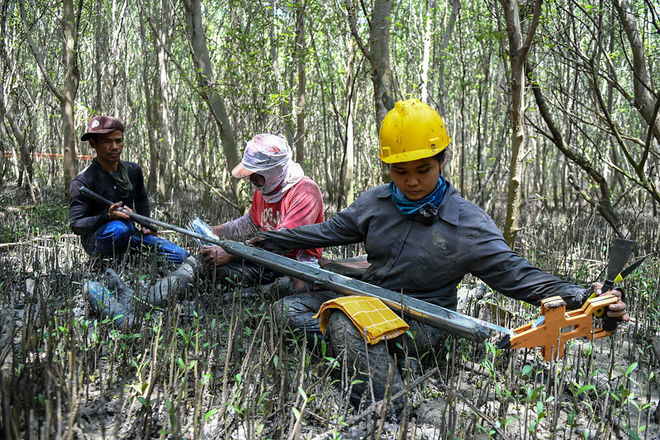
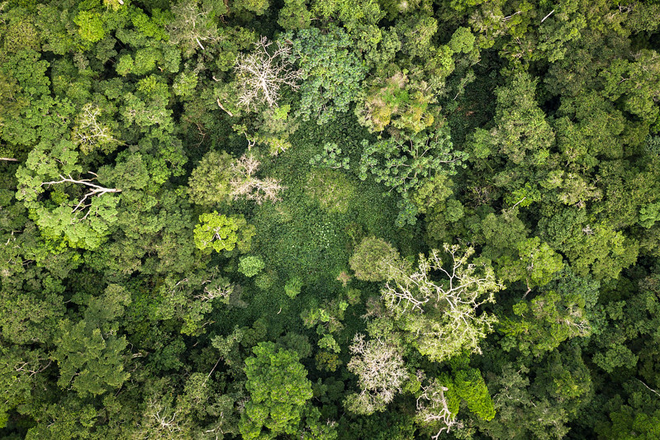



As part of the STREK project, forest dynamics were analysed to assess the impact of logging, especially relatively environment-friendly techniques, and the potential benefits of silvicultural regimes that favour the growth of commercial species. The study was mainly focused on growth and mortality rates, especially concerning species of the Dipterocarpaceae family, which represents 25% of the trees in the stand and literally all of the commercial species. Productivity of the primary forest was found to be lower than 1m3/ha/year. Dipterocarpaceae species had the highest growth rates. Growth and mortality rates were dependent on the stand density, tree diameterm the size and shape of the canopy, which is an indicator of between tree-competition. The conditions were most detrimental to small-diameter trees. Two years after logging, productivity in the logged plot was as low as in the primary forest. The reforestation process in not yet under way. However, forest degradation to the benefit of Dipterocarpaceae species prompted a productivity gain of 3 to 5 m3/ha/year. (O)
This work is licensed under CC-BY 4.0

Download:

This work is licensed under CC-BY 4.0
DOI:
https://doi.org/10.19182/bft1999.259.a20008Skor altmetrik:
Jumlah Kutipan Dimensi:
Ekspor kutipan:
RIS (.ris)
TI  - Dynamique de la forêt mixte à diptérocaroacées de basse altitude avant et après traitement sylvicole
AU  - Nguyen-The N
AU  - Favrichon, V.
AU  - Sist, P.
AU  - Houde, L.
AU  - Fauvet, N.
AB  - As part of the STREK project, forest dynamics were analysed to assess the impact of logging, especially relatively environment-friendly techniques, and the potential benefits of silvicultural regimes that favour the growth of commercial species. The study was mainly focused on growth and mortality rates, especially concerning species of the Dipterocarpaceae family, which represents 25% of the trees in the stand and literally all of the commercial species. Productivity of the primary forest was found to be lower than 1m3/ha/year. Dipterocarpaceae species had the highest growth rates. Growth and mortality rates were dependent on the stand density, tree diameterm the size and shape of the canopy, which is an indicator of between tree-competition. The conditions were most detrimental to small-diameter trees. Two years after logging, productivity in the logged plot was as low as in the primary forest. The reforestation process in not yet under way. However, forest degradation to the benefit of Dipterocarpaceae species prompted a productivity gain of 3 to 5 m3/ha/year. (O)
PY  - 1999
UR  - https://www.cifor-icraf.org/knowledge/publication/449/
DO  - https://doi.org/10.19182/bft1999.259.a20008
KW  - dipterocarpaceae, logging effects, mortality, productivity, timber extraction, timber harvesting
ER  -
Endnote (.ciw)
%T Dynamique de la forêt mixte à diptérocaroacées de basse altitude avant et après traitement sylvicole
%A Nguyen-The N
%A Favrichon, V.
%A Sist, P.
%A Houde, L.
%A Fauvet, N.
%D 1999
%U https://www.cifor-icraf.org/knowledge/publication/449/
%R https://doi.org/10.19182/bft1999.259.a20008
%X As part of the STREK project, forest dynamics were analysed to assess the impact of logging, especially relatively environment-friendly techniques, and the potential benefits of silvicultural regimes that favour the growth of commercial species. The study was mainly focused on growth and mortality rates, especially concerning species of the Dipterocarpaceae family, which represents 25% of the trees in the stand and literally all of the commercial species. Productivity of the primary forest was found to be lower than 1m3/ha/year. Dipterocarpaceae species had the highest growth rates. Growth and mortality rates were dependent on the stand density, tree diameterm the size and shape of the canopy, which is an indicator of between tree-competition. The conditions were most detrimental to small-diameter trees. Two years after logging, productivity in the logged plot was as low as in the primary forest. The reforestation process in not yet under way. However, forest degradation to the benefit of Dipterocarpaceae species prompted a productivity gain of 3 to 5 m3/ha/year. (O)
%K dipterocarpaceae
%K logging effects
%K mortality
%K productivity
%K timber extraction
%K timber harvesting
Tahun publikasi
1999
ISSN
0006-579X
Penulis
Nguyen-The N; Favrichon, V.; Sist, P.; Houde, L.; Fauvet, N.
Bahasa
French
Kata kunci
dipterocarpaceae, logging effects, mortality, productivity, timber extraction, timber harvesting
Source
Bois et Forêts des Tropiques. 259(1): 25-44
Geografis
Indonesia