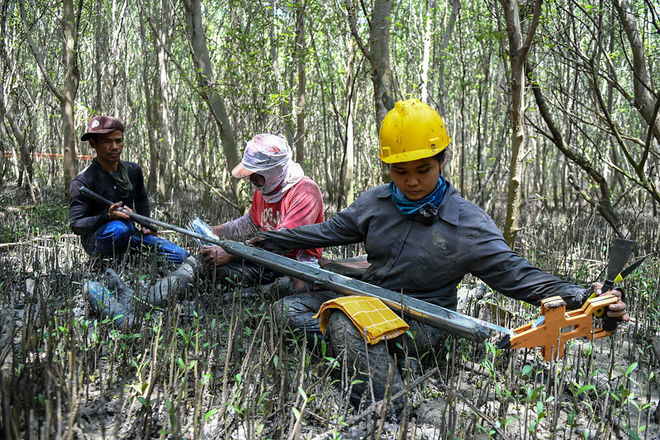




Extensive drainage of peatlands in the southeastern United States coastal plain for the purposes of agriculture and timber harvesting has led to large releases of soil carbon as carbon dioxide (CO2) due to enhanced peat decomposition. Growth in mechanisms that provide financial incentives for reducing emissions from land use and land-use change could increase funding for hydrological restoration that reduces peat CO2 emissions from these ecosystems. Measuring soil respiration and physical drivers across a range of site characteristics and land use histories is valuable for understanding how CO2 emissions from peat decomposition may respond to raising water table levels. We combined measurements of total soil respiration, depth to water table from soil surface, and soil temperature from drained and restored peatlands at three locations in eastern North Carolina and one location in southeastern Virginia to investigate relationships among total soil respiration and physical drivers, and to develop models relating total soil respiration to parameters that can be easily measured and monitored in the field.
Total soil respiration increased with deeper water tables and warmer soil temperatures in both drained and hydrologically restored peatlands. Variation in soil respiration was more strongly linked to soil temperature at drained (R2 = 0.57, p < 0.0001) than restored sites (R2 = 0.28, p < 0.0001).
The results suggest that drainage amplifies the impact of warming temperatures on peat decomposition. Proxy measurements for estimation of CO2 emissions from peat decomposition represent a considerable cost reduction compared to direct soil flux measurements for land managers contemplating the potential climate impact of restoring drained peatland sites. Research can help to increase understanding of factors influencing variation in soil respiration in addition to physical variables such as depth to water table and soil temperature.
This work is licensed under CC-BY 4.0

Total soil respiration increased with deeper water tables and warmer soil temperatures in both drained and hydrologically restored peatlands. Variation in soil respiration was more strongly linked to soil temperature at drained (R2 = 0.57, p < 0.0001) than restored sites (R2 = 0.28, p < 0.0001).
The results suggest that drainage amplifies the impact of warming temperatures on peat decomposition. Proxy measurements for estimation of CO2 emissions from peat decomposition represent a considerable cost reduction compared to direct soil flux measurements for land managers contemplating the potential climate impact of restoring drained peatland sites. Research can help to increase understanding of factors influencing variation in soil respiration in addition to physical variables such as depth to water table and soil temperature.
This work is licensed under CC-BY 4.0
DOI:
https://doi.org/10.1186/s13021-022-00219-5Score Altmetric:
Dimensions Nombre de citations:
Exporter la citation:
RIS (.ris)
TI  - Response of soil respiration to changes in soil temperature and water table level in drained and restored peatlands of the southeastern United States
AU  - Swails, E.
AB  - Extensive drainage of peatlands in the southeastern United States coastal plain for the purposes of agriculture and timber harvesting has led to large releases of soil carbon as carbon dioxide (CO2) due to enhanced peat decomposition. Growth in mechanisms that provide financial incentives for reducing emissions from land use and land-use change could increase funding for hydrological restoration that reduces peat CO2 emissions from these ecosystems. Measuring soil respiration and physical drivers across a range of site characteristics and land use histories is valuable for understanding how CO2 emissions from peat decomposition may respond to raising water table levels. We combined measurements of total soil respiration, depth to water table from soil surface, and soil temperature from drained and restored peatlands at three locations in eastern North Carolina and one location in southeastern Virginia to investigate relationships among total soil respiration and physical drivers, and to develop models relating total soil respiration to parameters that can be easily measured and monitored in the field.

Total soil respiration increased with deeper water tables and warmer soil temperatures in both drained and hydrologically restored peatlands. Variation in soil respiration was more strongly linked to soil temperature at drained (R2 = 0.57, p
PY  - 2022
UR  - https://www.cifor-icraf.org/knowledge/publication/27089/
DO  - https://doi.org/10.1186/s13021-022-00219-5
KW  - peatlands, soil respiration, water table
ER  -
Endnote (.ciw)
%T Response of soil respiration to changes in soil temperature and water table level in drained and restored peatlands of the southeastern United States
%A Swails, E.
%D 2022
%U https://www.cifor-icraf.org/knowledge/publication/27089/
%R https://doi.org/10.1186/s13021-022-00219-5
%X Extensive drainage of peatlands in the southeastern United States coastal plain for the purposes of agriculture and timber harvesting has led to large releases of soil carbon as carbon dioxide (CO2) due to enhanced peat decomposition. Growth in mechanisms that provide financial incentives for reducing emissions from land use and land-use change could increase funding for hydrological restoration that reduces peat CO2 emissions from these ecosystems. Measuring soil respiration and physical drivers across a range of site characteristics and land use histories is valuable for understanding how CO2 emissions from peat decomposition may respond to raising water table levels. We combined measurements of total soil respiration, depth to water table from soil surface, and soil temperature from drained and restored peatlands at three locations in eastern North Carolina and one location in southeastern Virginia to investigate relationships among total soil respiration and physical drivers, and to develop models relating total soil respiration to parameters that can be easily measured and monitored in the field.

Total soil respiration increased with deeper water tables and warmer soil temperatures in both drained and hydrologically restored peatlands. Variation in soil respiration was more strongly linked to soil temperature at drained (R2 = 0.57, p
%K peatlands
%K soil respiration
%K water table
Année de publication
2022
ISSN
1750-0680
Auteurs
Langue
English
Mots clés
peatlands, soil respiration, water table
Source
Carbon Balance and Management. 17: 18
Géographique
United States of America