

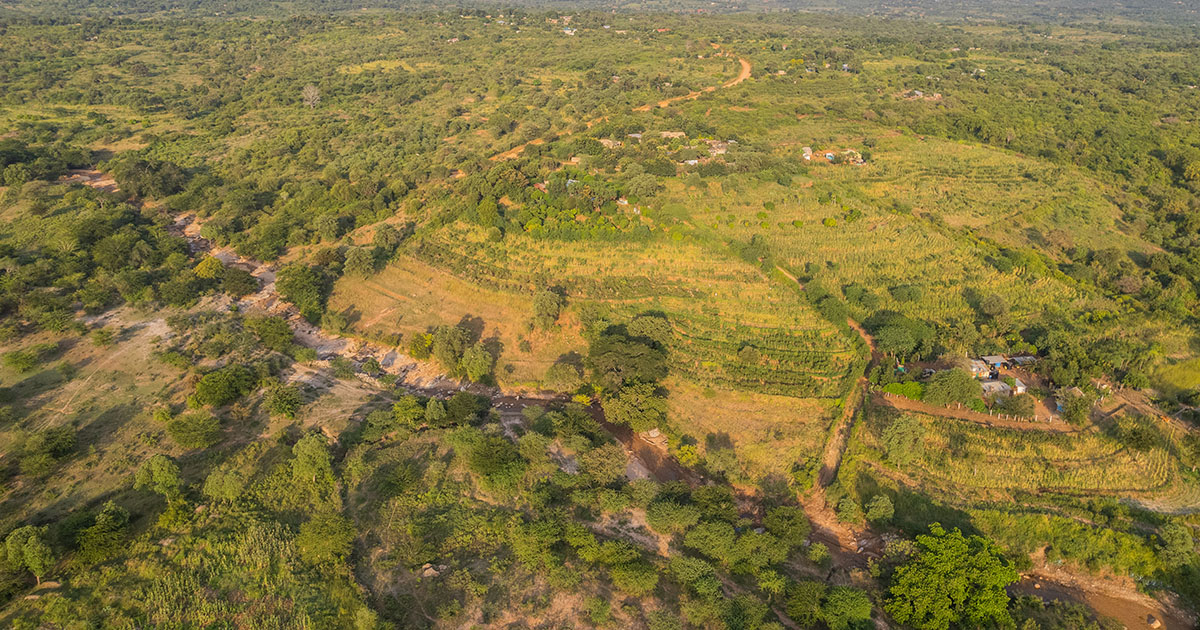









In Cameroon, the provisions of Decree No. 76-166 of 27 April 1976 to establish the terms and conditions for the management of national lands require that each national land recipient, whether held by grant or on lease, must pay annual fees. This revenue is apportioned to the State, the local council and village communities. However, the exact situation of the land fee payment and sharing has not been systematically documented. This article assesses the distribution of revenue generated from land fees and draws broad lessons on how benefits can be shared between actors involved in large-scale land-related investments. It establishes the socio-economic impacts and governance arrangements, and evaluates their effectiveness, efficiency and equity in delivering concrete benefits to local communities in 40 villages situated around five agro-industrial plantations. It shows that actual land benefit sharing does not fulfil the requirements for efficiency, effectiveness and equity and suggests some reforms.
This work is licensed under CC-BY 4.0

Download:

This work is licensed under CC-BY 4.0
DOI:
https://doi.org/10.1057/ejdr.2013.27Score Altmetric:
Dimensions Nombre de citations:
Exporter la citation:
RIS (.ris)
TI  - Assessment of the effectiveness, efficiency and equity of benefit-sharing schemes under large-scale agriculture: lessons from land fees in Cameroon
AU  - Assembe-Mvondo, S.
AU  - Brockhaus, M.
AU  - Lescuyer, G.
AB  - In Cameroon, the provisions of Decree No. 76-166 of 27 April 1976 to establish the terms and conditions for the management of national lands require that each national land recipient, whether held by grant or on lease, must pay annual fees. This revenue is apportioned to the State, the local council and village communities. However, the exact situation of the land fee payment and sharing has not been systematically documented. This article assesses the distribution of revenue generated from land fees and draws broad lessons on how benefits can be shared between actors involved in large-scale land-related investments. It establishes the socio-economic impacts and governance arrangements, and evaluates their effectiveness, efficiency and equity in delivering concrete benefits to local communities in 40 villages situated around five agro-industrial plantations. It shows that actual land benefit sharing does not fulfil the requirements for efficiency, effectiveness and equity and suggests some reforms.
PY  - 2013
UR  - https://www.cifor-icraf.org/knowledge/publication/4156/
DO  - https://doi.org/10.1057/ejdr.2013.27
KW  - agricultural production, agroforestry system, land policy, land tenure, plantations, socioeconomics
ER  -
Endnote (.ciw)
%T Assessment of the effectiveness, efficiency and equity of benefit-sharing schemes under large-scale agriculture: lessons from land fees in Cameroon
%A Assembe-Mvondo, S.
%A Brockhaus, M.
%A Lescuyer, G.
%D 2013
%U https://www.cifor-icraf.org/knowledge/publication/4156/
%R https://doi.org/10.1057/ejdr.2013.27
%X In Cameroon, the provisions of Decree No. 76-166 of 27 April 1976 to establish the terms and conditions for the management of national lands require that each national land recipient, whether held by grant or on lease, must pay annual fees. This revenue is apportioned to the State, the local council and village communities. However, the exact situation of the land fee payment and sharing has not been systematically documented. This article assesses the distribution of revenue generated from land fees and draws broad lessons on how benefits can be shared between actors involved in large-scale land-related investments. It establishes the socio-economic impacts and governance arrangements, and evaluates their effectiveness, efficiency and equity in delivering concrete benefits to local communities in 40 villages situated around five agro-industrial plantations. It shows that actual land benefit sharing does not fulfil the requirements for efficiency, effectiveness and equity and suggests some reforms.
%K agricultural production
%K agroforestry system
%K land policy
%K land tenure
%K plantations
%K socioeconomics
Année de publication
2013
ISSN
0957-8811
Auteurs
Assembe-Mvondo, S.; Brockhaus, M.; Lescuyer, G.
Langue
English
Mots clés
agricultural production, agroforestry system, land policy, land tenure, plantations, socioeconomics
Source
European Journal of Development Research. 25(4): 641-656
Géographique
Cameroon