

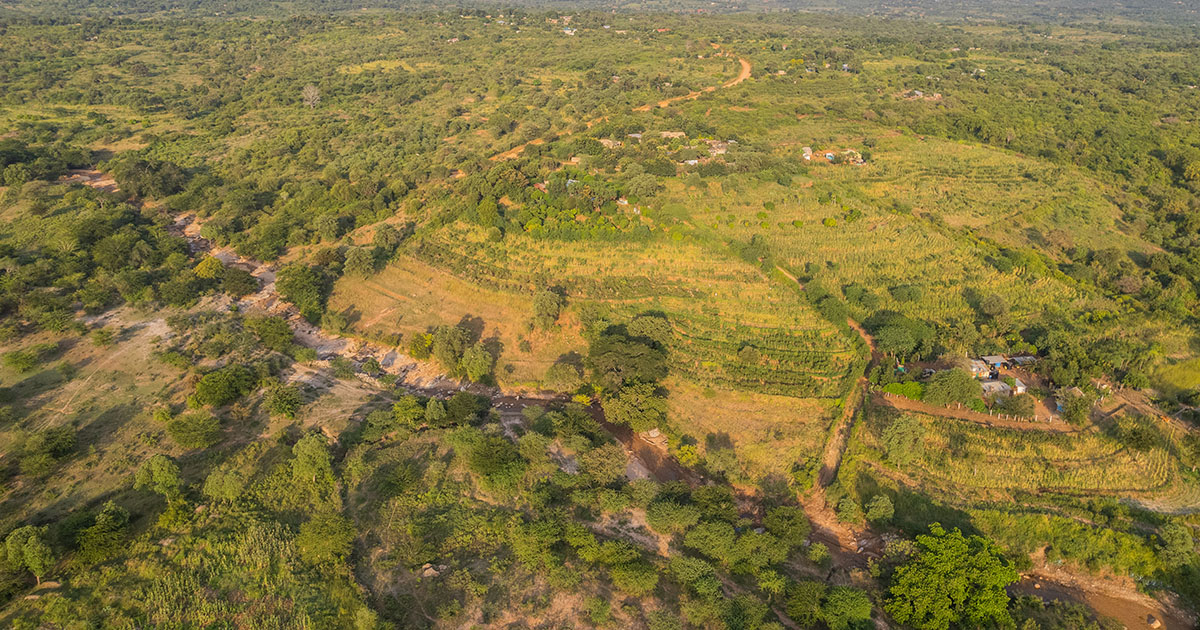







This paper presents a set of principles and operati onal cornerstones for R&D to address 14 natural resource management problems better. The wo rk is based on a series of workshops where 15 experts and practitioners distilled best practices. The principles and cornerstones, a number of 16 which relate to scaling issues, are illustrated wit h case studies from Zimbabwe and Indonesia. The 17 former incorporated catchment management for improv ed small-scale irrigation, while the latter 18 focused on work with communities that had confronte d logging companies, partly because of the 19 negative impact of logging on water quality. The pr inciples are grouped as follows: (a) 20 Commitment to action research, learning and experim enting among stakeholders. Considerable 21 experience of action research at the farm level exi sts, but much remains to be learned about its 22 application at the scale of socio-ecological system s (e.g. catchments). (b) Project flexibility and 23 adaptation to the types of action required. Analysi s and intervention must be at multiple scales, and 24 scaling-up and out must be planned from the outset . (c) New forms of organisation to implement
Export citation:
RIS (.ris)
TI  - What kind of research and development is needed for integrated natural resource management?
AU  - Campbell, B.
AU  - Hagmann, J.
AU  - Sayer, J.
AU  - Stroud, A.
AU  - Thomas, R.
AU  - Wollenberg, E.K.
AB  - This paper presents a set of principles and operati onal cornerstones for R&D to address 14 natural resource management problems better. The wo rk is based on a series of workshops where 15 experts and practitioners distilled best practices. The principles and cornerstones, a number of 16 which relate to scaling issues, are illustrated wit h case studies from Zimbabwe and Indonesia. The 17 former incorporated catchment management for improv ed small-scale irrigation, while the latter 18 focused on work with communities that had confronte d logging companies, partly because of the 19 negative impact of logging on water quality. The pr inciples are grouped as follows: (a) 20 Commitment to action research, learning and experim enting among stakeholders. Considerable 21 experience of action research at the farm level exi sts, but much remains to be learned about its 22 application at the scale of socio-ecological system s (e.g. catchments). (b) Project flexibility and 23 adaptation to the types of action required. Analysi s and intervention must be at multiple scales, and 24 scaling-up and out must be planned from the outset . (c) New forms of organisation to implement
PY  - 2007
PB  - Charles Darwin University
PP  - Darwin, Australia
UR  - https://www.cifor-icraf.org/knowledge/publication/30323/
KW  - development, innovation, natural resource management, partnerships, research, research and development, resource management, scales
ER  -
Endnote (.ciw)
%T What kind of research and development is needed for integrated natural resource management?
%A Campbell, B.
%A Hagmann, J.
%A Sayer, J.
%A Stroud, A.
%A Thomas, R.
%A Wollenberg, E.K.
%D 2007
%I Charles Darwin University
%C Darwin, Australia
%U https://www.cifor-icraf.org/knowledge/publication/30323/
%X This paper presents a set of principles and operati onal cornerstones for R&D to address 14 natural resource management problems better. The wo rk is based on a series of workshops where 15 experts and practitioners distilled best practices. The principles and cornerstones, a number of 16 which relate to scaling issues, are illustrated wit h case studies from Zimbabwe and Indonesia. The 17 former incorporated catchment management for improv ed small-scale irrigation, while the latter 18 focused on work with communities that had confronte d logging companies, partly because of the 19 negative impact of logging on water quality. The pr inciples are grouped as follows: (a) 20 Commitment to action research, learning and experim enting among stakeholders. Considerable 21 experience of action research at the farm level exi sts, but much remains to be learned about its 22 application at the scale of socio-ecological system s (e.g. catchments). (b) Project flexibility and 23 adaptation to the types of action required. Analysi s and intervention must be at multiple scales, and 24 scaling-up and out must be planned from the outset . (c) New forms of organisation to implement
%K development
%K innovation
%K natural resource management
%K partnerships
%K research
%K research and development
%K resource management
%K scales
Publisher
Charles Darwin University: Darwin, Australia
Publication year
2007
Authors
Campbell, B.; Hagmann, J.; Sayer, J.; Stroud, A.; Thomas, R.; Wollenberg, E.K.
Language
English
Keywords
development, innovation, natural resource management, partnerships, research, research and development, resource management, scales
Geographic
Indonesia, Zimbabwe