
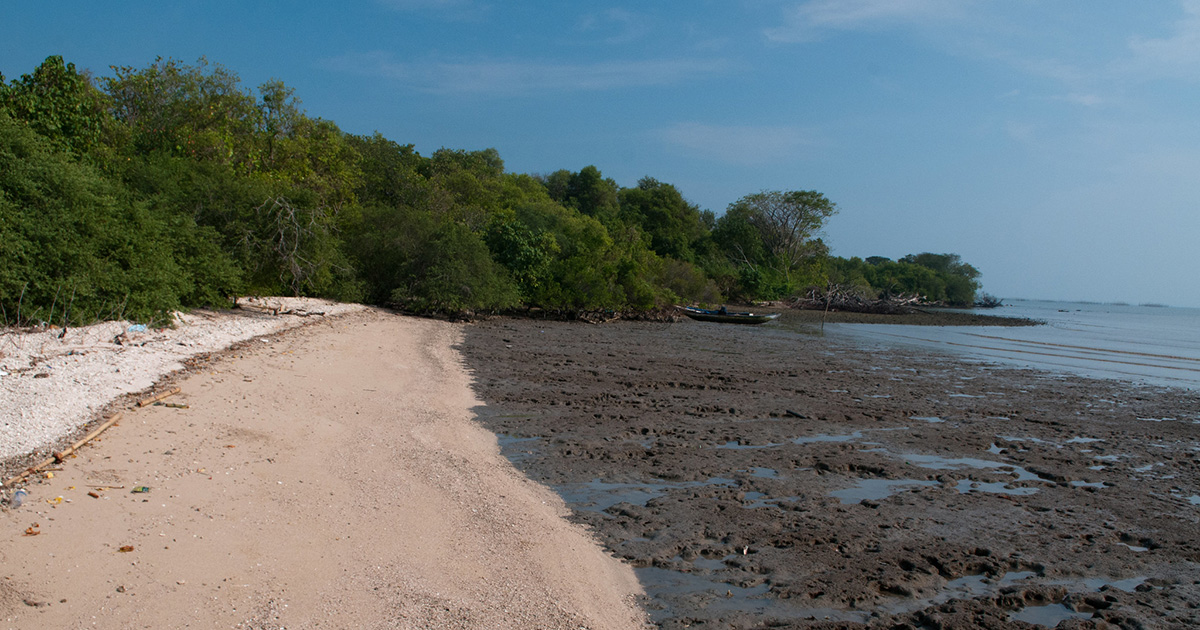





Mangroves are one of the most efficient organic carbon sink ecosystems which occur along intertidal coastal areas of tropical and subtropical regions. Together with other coastal wetlands such as saltmarsh and seagrass, mangroves have been termed ‘blue carbon’ ecosystems due to their substantial capacity for carbon storage and sequestration. Consequently, policymakers and stakeholders promote mangroves for natural-based climate change mitigation. However, many mangroves across the world are being altered by anthropogenic disturbances including land-use and land-cover change (LULCC). Large-scale LULCC will inevitably affect the magnitude and direction (loss or gain) of the carbon cycle in mangroves.
This work is licensed under CC-BY 4.0

Download:

This work is licensed under CC-BY 4.0
DOI:
https://doi.org/10.25913/5h5y-9x04Altmetric score:
Dimensions Citation Count:
Export citation:
RIS (.ris)
TI  - Mangrove blue carbon dynamics in Papua, Indonesia: effects of hydro-geomorphic setting and land-use change
AU  - Sasmito, S.D.
AB  - Mangroves are one of the most efficient organic carbon sink ecosystems which occur along intertidal coastal areas of tropical and subtropical regions. Together with other coastal wetlands such as saltmarsh and seagrass, mangroves have been termed ‘blue carbon’ ecosystems due to their substantial capacity for carbon storage and sequestration. Consequently, policymakers and stakeholders promote mangroves for natural-based climate change mitigation. However, many mangroves across the world are being altered by anthropogenic disturbances including land-use and land-cover change (LULCC). Large-scale LULCC will inevitably affect the magnitude and direction (loss or gain) of the carbon cycle in mangroves.
PY  - 2020
PB  - Charles Darwin University
PP  - Australia
UR  - https://www.cifor-icraf.org/knowledge/publication/5804/
DO  - https://doi.org/10.25913/5h5y-9x04
KW  - carbon sequestration, climate change, geomorphology, mangroves, mitigation
ER  -
Endnote (.ciw)
%T Mangrove blue carbon dynamics in Papua, Indonesia: effects of hydro-geomorphic setting and land-use change
%A Sasmito, S.D.
%D 2020
%I Charles Darwin University
%C Australia
%U https://www.cifor-icraf.org/knowledge/publication/5804/
%R https://doi.org/10.25913/5h5y-9x04
%X Mangroves are one of the most efficient organic carbon sink ecosystems which occur along intertidal coastal areas of tropical and subtropical regions. Together with other coastal wetlands such as saltmarsh and seagrass, mangroves have been termed ‘blue carbon’ ecosystems due to their substantial capacity for carbon storage and sequestration. Consequently, policymakers and stakeholders promote mangroves for natural-based climate change mitigation. However, many mangroves across the world are being altered by anthropogenic disturbances including land-use and land-cover change (LULCC). Large-scale LULCC will inevitably affect the magnitude and direction (loss or gain) of the carbon cycle in mangroves.
%K carbon sequestration
%K climate change
%K geomorphology
%K mangroves
%K mitigation
Publisher
Charles Darwin University: Australia
Publication year
2020
Authors
Language
English
Keywords
carbon sequestration, climate change, geomorphology, mangroves, mitigation
Geographic
Indonesia