
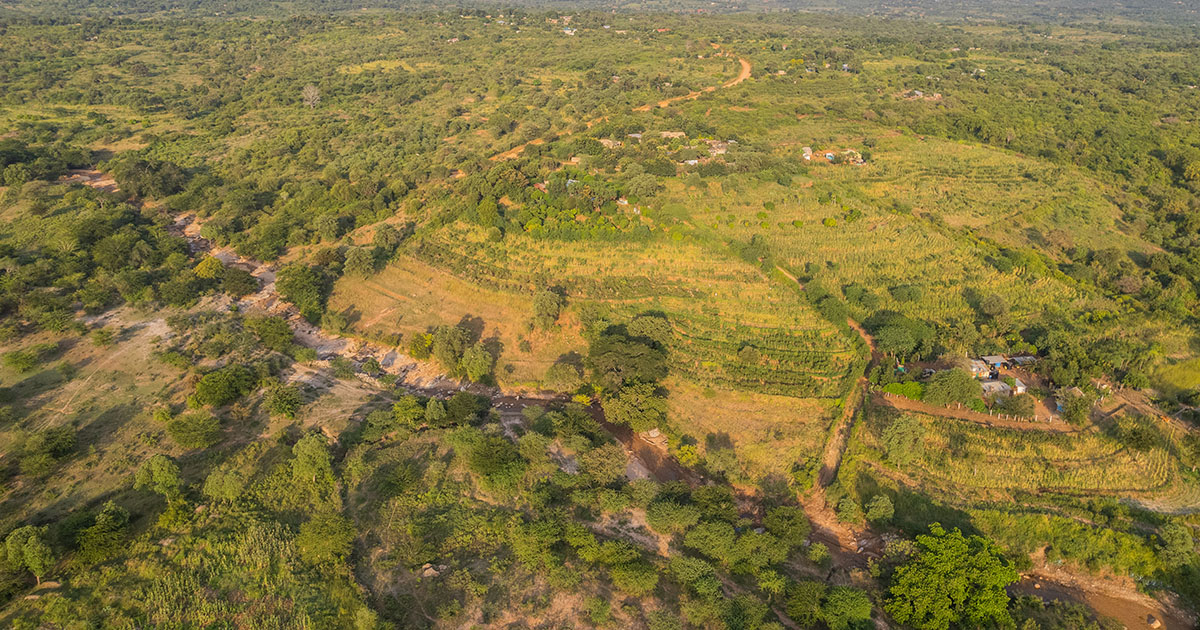




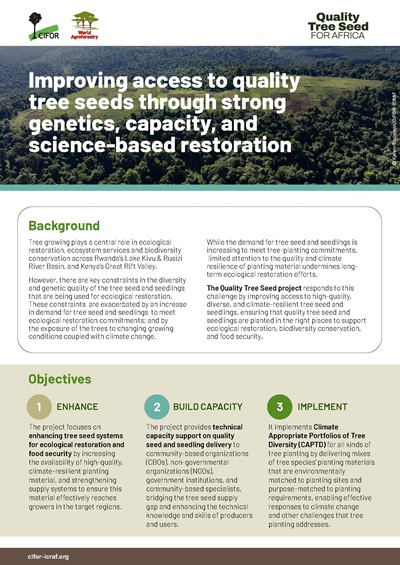


Tree growing plays a central role in ecological restoration, ecosystem services and biodiversity conservation across Rwanda’s Lake Kivu & Rusizi River Basin, and Kenya’s Great Rift Valley. However, there are key constraints in the diversity and genetic quality of the tree seed and seedlings that are being used for ecological restoration. These constraints are exacerbated by an increase in demand for tree seed and seedlings to meet ecological restoration commitments; and by the exposure of the trees to changing growing conditions coupled with climate change. While the demand for tree seed and seedlings is increasing to meet tree-planting commitments, limited attention to the quality and climate resilience of planting material undermines long- term ecological restoration efforts. The Quality Tree Seed project responds to this challenge by improving access to high-quality, diverse, and climate-resilient tree seed and seedlings, ensuring that quality tree seed and seedlings are planted in the right places to support ecological restoration, biodiversity conservation, and food security.
This work is licensed under CC-BY 4.0
This work is licensed under CC-BY 4.0
Exporter la citation:
RIS (.ris)
TI  - Improving access to quality tree seeds through strong genetics, capacity, and science-based restoration
AU  - CIFOR-ICRAF
AB  - Tree growing plays a central role in ecological restoration, ecosystem services and biodiversity conservation across Rwanda’s Lake Kivu & Rusizi River Basin, and Kenya’s Great Rift Valley. However, there are key constraints in the diversity and genetic quality of the tree seed and seedlings that are being used for ecological restoration. These constraints are exacerbated by an increase in demand for tree seed and seedlings to meet ecological restoration commitments; and by the exposure of the trees to changing growing conditions coupled with climate change. While the demand for tree seed and seedlings is increasing to meet tree-planting commitments, limited attention to the quality and climate resilience of planting material undermines long- term ecological restoration efforts. The Quality Tree Seed project responds to this challenge by improving access to high-quality, diverse, and climate-resilient tree seed and seedlings, ensuring that quality tree seed and seedlings are planted in the right places to support ecological restoration, biodiversity conservation, and food security.
PY  - 2026
PB  - CIFOR-ICRAF
PP  - Bogor, Indonesia and Nairobi, Kenya
UR  - https://www.cifor-icraf.org/knowledge/publication/46382/
KW  - agroforestry, biodiversity conservation, forest trees, genetic resources, restoration, seedlings, seeds
ER  -
Endnote (.ciw)
%T Improving access to quality tree seeds through strong genetics, capacity, and science-based restoration
%A CIFOR-ICRAF
%D 2026
%I CIFOR-ICRAF
%C Bogor, Indonesia and Nairobi, Kenya
%U https://www.cifor-icraf.org/knowledge/publication/46382/
%X Tree growing plays a central role in ecological restoration, ecosystem services and biodiversity conservation across Rwanda’s Lake Kivu & Rusizi River Basin, and Kenya’s Great Rift Valley. However, there are key constraints in the diversity and genetic quality of the tree seed and seedlings that are being used for ecological restoration. These constraints are exacerbated by an increase in demand for tree seed and seedlings to meet ecological restoration commitments; and by the exposure of the trees to changing growing conditions coupled with climate change. While the demand for tree seed and seedlings is increasing to meet tree-planting commitments, limited attention to the quality and climate resilience of planting material undermines long- term ecological restoration efforts. The Quality Tree Seed project responds to this challenge by improving access to high-quality, diverse, and climate-resilient tree seed and seedlings, ensuring that quality tree seed and seedlings are planted in the right places to support ecological restoration, biodiversity conservation, and food security.
%K agroforestry
%K biodiversity conservation
%K forest trees
%K genetic resources
%K restoration
%K seedlings
%K seeds
Publisher
CIFOR-ICRAF: Bogor, Indonesia and Nairobi, Kenya
Année de publication
2026
Auteurs
Langue
English
Mots clés
agroforestry, biodiversity conservation, forest trees, genetic resources, restoration, seedlings, seeds