
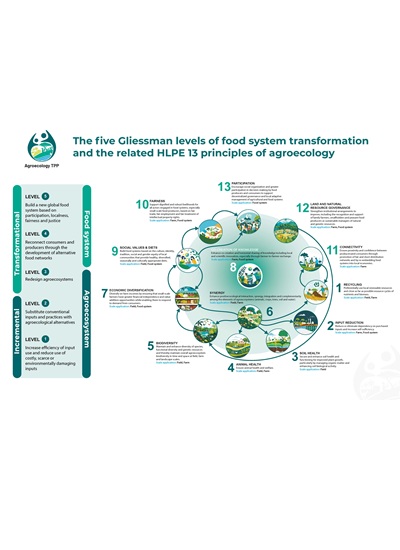


The agroecology transition framework outlines a stepwise transformation of food systems from input efficiency (Level 1) to building a new global food system rooted in fairness and justice (Level 5). Supporting principles include recycling local nutrients, soil health management, animal welfare, economic diversification, social values and diets, connectivity, land and resource governance, participation, and fairness. Together, these actions scale from field to farm to food system, embedding agroecology into both production and governance.
This work is licensed under CC-BY 4.0
This work is licensed under CC-BY 4.0
Exporter la citation:
RIS (.ris)
TI  - The five Gliessman levels of food system transformation and the related HLPE 13 principles of agroecology
AU  - Agroecology TPP
AB  - The agroecology transition framework outlines a stepwise transformation of food systems from input efficiency (Level 1) to building a new global food system rooted in fairness and justice (Level 5). Supporting principles include recycling local nutrients, soil health management, animal welfare, economic diversification, social values and diets, connectivity, land and resource governance, participation, and fairness. Together, these actions scale from field to farm to food system, embedding agroecology into both production and governance.
PY  - 2026
PB  - CIFOR-ICRAF
PP  - Bogor, Indonesia and Nairobi, Kenya
UR  - https://www.cifor-icraf.org/knowledge/publication/46395/
KW  - agroecology, diversification, economic development, food systems, land management, nutrients, participatory approaches, social aspects, soil management
ER  -
Endnote (.ciw)
%T The five Gliessman levels of food system transformation and the related HLPE 13 principles of agroecology
%A Agroecology TPP
%D 2026
%I CIFOR-ICRAF
%C Bogor, Indonesia and Nairobi, Kenya
%U https://www.cifor-icraf.org/knowledge/publication/46395/
%X The agroecology transition framework outlines a stepwise transformation of food systems from input efficiency (Level 1) to building a new global food system rooted in fairness and justice (Level 5). Supporting principles include recycling local nutrients, soil health management, animal welfare, economic diversification, social values and diets, connectivity, land and resource governance, participation, and fairness. Together, these actions scale from field to farm to food system, embedding agroecology into both production and governance.
%K agroecology
%K diversification
%K economic development
%K food systems
%K land management
%K nutrients
%K participatory approaches
%K social aspects
%K soil management
Publisher
CIFOR-ICRAF: Bogor, Indonesia and Nairobi, Kenya
Année de publication
2026
Auteurs
Langue
English
Mots clés
agroecology, diversification, economic development, food systems, land management, nutrients, participatory approaches, social aspects, soil management