








Certificate holders commit to conformance with the relevant national FSC Forest Stewardship Standards, which prescribe best practices in production, measures to limit or mitigate environmental impacts, and the generation of net social benefits for workers and local communities including traditional and Indigenous Peoples. The theory of change presented in this report assumes that certificate holders fully and effectively conform with all FSC indicators. Even with this assumption, conformance with these standards cannot be automatically attributed to certification. One reason is that the standards are designed to be partially redundant with the national legal framework, both through the first principle on compliance with laws, and through other principles that reinforce or extend existing national regulations. A second reason is that the firms that choose to obtain FSC certification may be more likely than other firms to operate consistently with FSC standards regardless of certification. The potential causal effect of certification are shaped by both the overlap between FSC standards and the existing legal framework, and the self-selection of firms into FSC certification.
This report is part of a study that employs impact evaluation methods to attribute social outcomes to FSC certification. These methods are applied to the case of Brazil, which had more than 9.5 million hectares certified by over 150 certificate holders as of July 2024, including both natural forest (around 25 percent of certificate holders) under FSC standard FSC STD-BRA-01-01-2001, and plantation forest (around 75 percent of certificate holders) under FSC standard FSC-STD-BRA-01-01-2014. Following a review of the Institutional and Legal Contexts of FSC Certification in Natural and Plantation Forestry in Brazil (CIFOR-ICRAF Working Paper 67), this report describes the theory of change and possible methods for evaluating the social impacts of certification of management units under these standards. The Theory of Change identifies two pathways, each with two mechanisms, that link certification to social impacts, leading to our key hypotheses about how certification may generate social benefits for people who work for and live near certified forestry operations.
This work is licensed under CC-BY 4.0

This report is part of a study that employs impact evaluation methods to attribute social outcomes to FSC certification. These methods are applied to the case of Brazil, which had more than 9.5 million hectares certified by over 150 certificate holders as of July 2024, including both natural forest (around 25 percent of certificate holders) under FSC standard FSC STD-BRA-01-01-2001, and plantation forest (around 75 percent of certificate holders) under FSC standard FSC-STD-BRA-01-01-2014. Following a review of the Institutional and Legal Contexts of FSC Certification in Natural and Plantation Forestry in Brazil (CIFOR-ICRAF Working Paper 67), this report describes the theory of change and possible methods for evaluating the social impacts of certification of management units under these standards. The Theory of Change identifies two pathways, each with two mechanisms, that link certification to social impacts, leading to our key hypotheses about how certification may generate social benefits for people who work for and live near certified forestry operations.
This work is licensed under CC-BY 4.0
DOI:
https://doi.org/10.17528/cifor-icraf/009446Score Altmetric:
Dimensions Nombre de citations:
Exporter la citation:
RIS (.ris)
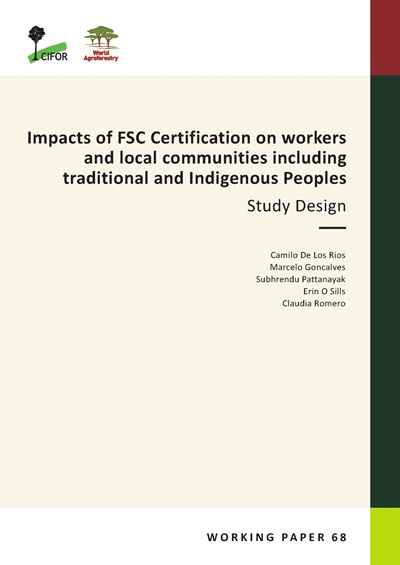
TI  - Impacts of FSC Certification on workers and local communities including traditional and Indigenous Peoples: Study Design
AU  - De Los Rios, C.
AU  - Goncalves, M.
AU  - Pattanayak, S.
AU  - Sills, E.O.
AU  - Romero, C.
AB  - Certificate holders commit to conformance with the relevant national FSC Forest Stewardship Standards, which prescribe best practices in production, measures to limit or mitigate environmental impacts, and the generation of net social benefits for workers and local communities including traditional and Indigenous Peoples. The theory of change presented in this report assumes that certificate holders fully and effectively conform with all FSC indicators. Even with this assumption, conformance with these standards cannot be automatically attributed to certification. One reason is that the standards are designed to be partially redundant with the national legal framework, both through the first principle on compliance with laws, and through other principles that reinforce or extend existing national regulations. A second reason is that the firms that choose to obtain FSC certification may be more likely than other firms to operate consistently with FSC standards regardless of certification. The potential causal effect of certification are shaped by both the overlap between FSC standards and the existing legal framework, and the self-selection of firms into FSC certification.This report is part of a study that employs impact evaluation methods to attribute social outcomes to FSC certification. These methods are applied to the case of Brazil, which had more than 9.5 million hectares certified by over 150 certificate holders as of July 2024, including both natural forest (around 25 percent of certificate holders) under FSC standard FSC STD-BRA-01-01-2001, and plantation forest (around 75 percent of certificate holders) under FSC standard FSC-STD-BRA-01-01-2014. Following a review of the Institutional and Legal Contexts of FSC Certification in Natural and Plantation Forestry in Brazil (CIFOR-ICRAF Working Paper 67), this report describes the theory of change and possible methods for evaluating the social impacts of certification of management units under these standards. The Theory of Change identifies two pathways, each with two mechanisms, that link certification to social impacts, leading to our key hypotheses about how certification may generate social benefits for people who work for and live near certified forestry operations.
PY  - 2026
PB  - CIFOR-ICRAF
PP  - Bogor, Indonesia and Nairobi, Kenya
UR  - https://www.cifor-icraf.org/knowledge/publication/9446/
DO  - https://doi.org/10.17528/cifor-icraf/009446
KW  - certification, evaluation, forest management, forest plantations, impact assessment, indigenous peoples, legal rights, local communities, natural resources management, social change, theory of change
ER  -
Endnote (.ciw)
%T Impacts of FSC Certification on workers and local communities including traditional and Indigenous Peoples: Study Design
%A De Los Rios, C.
%A Goncalves, M.
%A Pattanayak, S.
%A Sills, E.O.
%A Romero, C.
%D 2026
%I CIFOR-ICRAF
%C Bogor, Indonesia and Nairobi, Kenya
%U https://www.cifor-icraf.org/knowledge/publication/9446/
%R https://doi.org/10.17528/cifor-icraf/009446
%X Certificate holders commit to conformance with the relevant national FSC Forest Stewardship Standards, which prescribe best practices in production, measures to limit or mitigate environmental impacts, and the generation of net social benefits for workers and local communities including traditional and Indigenous Peoples. The theory of change presented in this report assumes that certificate holders fully and effectively conform with all FSC indicators. Even with this assumption, conformance with these standards cannot be automatically attributed to certification. One reason is that the standards are designed to be partially redundant with the national legal framework, both through the first principle on compliance with laws, and through other principles that reinforce or extend existing national regulations. A second reason is that the firms that choose to obtain FSC certification may be more likely than other firms to operate consistently with FSC standards regardless of certification. The potential causal effect of certification are shaped by both the overlap between FSC standards and the existing legal framework, and the self-selection of firms into FSC certification.This report is part of a study that employs impact evaluation methods to attribute social outcomes to FSC certification. These methods are applied to the case of Brazil, which had more than 9.5 million hectares certified by over 150 certificate holders as of July 2024, including both natural forest (around 25 percent of certificate holders) under FSC standard FSC STD-BRA-01-01-2001, and plantation forest (around 75 percent of certificate holders) under FSC standard FSC-STD-BRA-01-01-2014. Following a review of the Institutional and Legal Contexts of FSC Certification in Natural and Plantation Forestry in Brazil (CIFOR-ICRAF Working Paper 67), this report describes the theory of change and possible methods for evaluating the social impacts of certification of management units under these standards. The Theory of Change identifies two pathways, each with two mechanisms, that link certification to social impacts, leading to our key hypotheses about how certification may generate social benefits for people who work for and live near certified forestry operations.
%K certification
%K evaluation
%K forest management
%K forest plantations
%K impact assessment
%K indigenous peoples
%K legal rights
%K local communities
%K natural resources management
%K social change
%K theory of change
Publisher
CIFOR-ICRAF: Bogor, Indonesia and Nairobi, Kenya
Année de publication
2026
Auteurs
De Los Rios, C.; Goncalves, M.; Pattanayak, S.; Sills, E.O.; Romero, C.
Langue
English
Mots clés
certification, evaluation, forest management, forest plantations, impact assessment, indigenous peoples, legal rights, local communities, natural resources management, social change, theory of change
Géographique
Brazil