




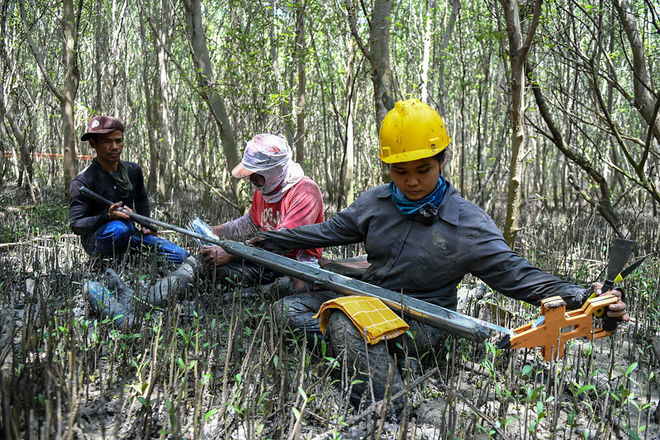
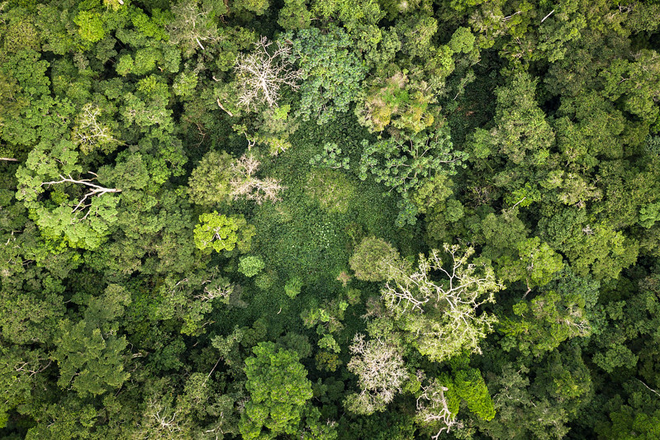



Currently there is limited information to estimate accurate and reliable mangrove forest area in Cambodia. Previous estimates did not explicitly illustrate the spatial distribution of mangrove for the entire country however, according to Global Forest Resource Assessment 2010, Cambodia's mangrove area cover in 1990 and 2010 was calculated at 79,638 ha and 55,704 ha, respectively using extrapolation of 1992-1996 (original data from Remote Sensing of forest cover 1992/93 and 1996/97) for 1990 and extrapolation of 1996-2002 (original data from Remote Sensing of forest cover 1996/97 and 2002) for 2010. This study mapped the spatial distribution of Cambodia's mangrove forest derived from 30 m × 30 m spatial resolution and polygon spatial extent from Landsat 8 (L8) image. Publicly available Landsat data was acquired from Google Earth Engine (GEE) Explorer including the Landsat Surface Reflectance-Landsat 8 (L8) OLI/TIRS; Top-Of-Atmosphere (TOA) L8 32-Day Reflectance Composite; Landsat Archive Pre-Collection from US Geological Survey (USGS, 2015); VHR Google-derived images (Collin et al. 2014) and field data collection from 63 plots representing the entire Cambodia of Surface Water Ambient Monitoring Program (SWAMP) to create a Google Fusion Table aiming at mapping the spatial resolution and extent. Random Forest (RF) Classifier, a supervised classification technique, was applied to three L8 images Archive Pre-Collection Level-1 (L8 OLI/TIRS) collected in December 2014, February 2015 and April 2015. Statistical analysis indicates the total area of mangrove forest cover reached 73,240ha with overall classification accuracy of 98.2%, 97.9% and 99.5% for three periods and the validation overall accuracy were 91.5%, 89.1% and 97.6%, respectively. Our findings suggest that L8 imagery and Google Earth Engine algorithm can be used to estimate area changes of mangrove forests in Cambodia with higher accuracy. The results of this study may be useful to assist decision making in planning for mangrove ecosystem restoration activities, evaluation of ecological services and in better estimation of carbon stock in mangrove forest. (Tier 1- default emission or Tier 3- plot data are more related to emission factor).
This work is licensed under CC-BY 4.0

This work is licensed under CC-BY 4.0
DOI:
https://doi.org/10.1088/1755-1315/266/1/012010Score Altmetric:
Dimensions Nombre de citations:
Exporter la citation:
RIS (.ris)
TI  - Mapping mangrove forest cover using Landsat-8 imagery, Sentinel-2, Very High Resolution Images and Google Earth Engine algorithm for entire Cambodia
AU  - Tieng, T.
AU  - Sharma, S.
AU  - MacKenzie, R.A.
AU  - Venkattappa, M.
AU  - Sasaki, N.K.
AU  - Collin, A.
AB  - Currently there is limited information to estimate accurate and reliable mangrove forest area in Cambodia. Previous estimates did not explicitly illustrate the spatial distribution of mangrove for the entire country however, according to Global Forest Resource Assessment 2010, Cambodia's mangrove area cover in 1990 and 2010 was calculated at 79,638 ha and 55,704 ha, respectively using extrapolation of 1992-1996 (original data from Remote Sensing of forest cover 1992/93 and 1996/97) for 1990 and extrapolation of 1996-2002 (original data from Remote Sensing of forest cover 1996/97 and 2002) for 2010. This study mapped the spatial distribution of Cambodia's mangrove forest derived from 30 m × 30 m spatial resolution and polygon spatial extent from Landsat 8 (L8) image. Publicly available Landsat data was acquired from Google Earth Engine (GEE) Explorer including the Landsat Surface Reflectance-Landsat 8 (L8) OLI/TIRS; Top-Of-Atmosphere (TOA) L8 32-Day Reflectance Composite; Landsat Archive Pre-Collection from US Geological Survey (USGS, 2015); VHR Google-derived images (Collin et al. 2014) and field data collection from 63 plots representing the entire Cambodia of Surface Water Ambient Monitoring Program (SWAMP) to create a Google Fusion Table aiming at mapping the spatial resolution and extent. Random Forest (RF) Classifier, a supervised classification technique, was applied to three L8 images Archive Pre-Collection Level-1 (L8 OLI/TIRS) collected in December 2014, February 2015 and April 2015. Statistical analysis indicates the total area of mangrove forest cover reached 73,240ha with overall classification accuracy of 98.2%, 97.9% and 99.5% for three periods and the validation overall accuracy were 91.5%, 89.1% and 97.6%, respectively. Our findings suggest that L8 imagery and Google Earth Engine algorithm can be used to estimate area changes of mangrove forests in Cambodia with higher accuracy. The results of this study may be useful to assist decision making in planning for mangrove ecosystem restoration activities, evaluation of ecological services and in better estimation of carbon stock in mangrove forest. (Tier 1- default emission or Tier 3- plot data are more related to emission factor).
PY  - 2019
UR  - https://www.cifor-icraf.org/knowledge/publication/5328/
DO  - https://doi.org/10.1088/1755-1315/266/1/012010
KW  - mangroves, remote sensing
ER  -
Endnote (.ciw)
%T Mapping mangrove forest cover using Landsat-8 imagery, Sentinel-2, Very High Resolution Images and Google Earth Engine algorithm for entire Cambodia
%A Tieng, T.
%A Sharma, S.
%A MacKenzie, R.A.
%A Venkattappa, M.
%A Sasaki, N.K.
%A Collin, A.
%D 2019
%U https://www.cifor-icraf.org/knowledge/publication/5328/
%R https://doi.org/10.1088/1755-1315/266/1/012010
%X Currently there is limited information to estimate accurate and reliable mangrove forest area in Cambodia. Previous estimates did not explicitly illustrate the spatial distribution of mangrove for the entire country however, according to Global Forest Resource Assessment 2010, Cambodia's mangrove area cover in 1990 and 2010 was calculated at 79,638 ha and 55,704 ha, respectively using extrapolation of 1992-1996 (original data from Remote Sensing of forest cover 1992/93 and 1996/97) for 1990 and extrapolation of 1996-2002 (original data from Remote Sensing of forest cover 1996/97 and 2002) for 2010. This study mapped the spatial distribution of Cambodia's mangrove forest derived from 30 m × 30 m spatial resolution and polygon spatial extent from Landsat 8 (L8) image. Publicly available Landsat data was acquired from Google Earth Engine (GEE) Explorer including the Landsat Surface Reflectance-Landsat 8 (L8) OLI/TIRS; Top-Of-Atmosphere (TOA) L8 32-Day Reflectance Composite; Landsat Archive Pre-Collection from US Geological Survey (USGS, 2015); VHR Google-derived images (Collin et al. 2014) and field data collection from 63 plots representing the entire Cambodia of Surface Water Ambient Monitoring Program (SWAMP) to create a Google Fusion Table aiming at mapping the spatial resolution and extent. Random Forest (RF) Classifier, a supervised classification technique, was applied to three L8 images Archive Pre-Collection Level-1 (L8 OLI/TIRS) collected in December 2014, February 2015 and April 2015. Statistical analysis indicates the total area of mangrove forest cover reached 73,240ha with overall classification accuracy of 98.2%, 97.9% and 99.5% for three periods and the validation overall accuracy were 91.5%, 89.1% and 97.6%, respectively. Our findings suggest that L8 imagery and Google Earth Engine algorithm can be used to estimate area changes of mangrove forests in Cambodia with higher accuracy. The results of this study may be useful to assist decision making in planning for mangrove ecosystem restoration activities, evaluation of ecological services and in better estimation of carbon stock in mangrove forest. (Tier 1- default emission or Tier 3- plot data are more related to emission factor).
%K mangroves
%K remote sensing
Année de publication
2019
ISSN
1755-1315
Auteurs
Tieng, T.; Sharma, S.; MacKenzie, R.A.; Venkattappa, M.; Sasaki, N.K.; Collin, A.
Langue
English
Mots clés
mangroves, remote sensing
Source
IOP Conference Series: Earth and Environmental Science. 266(1): 12010
Géographique
Cambodia