

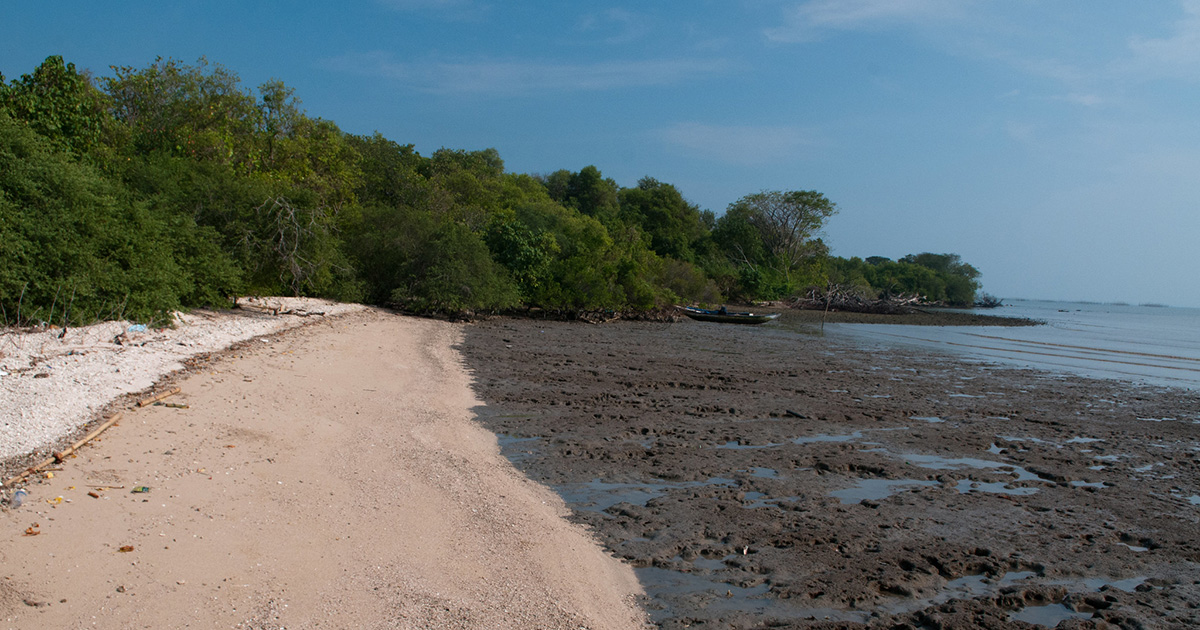



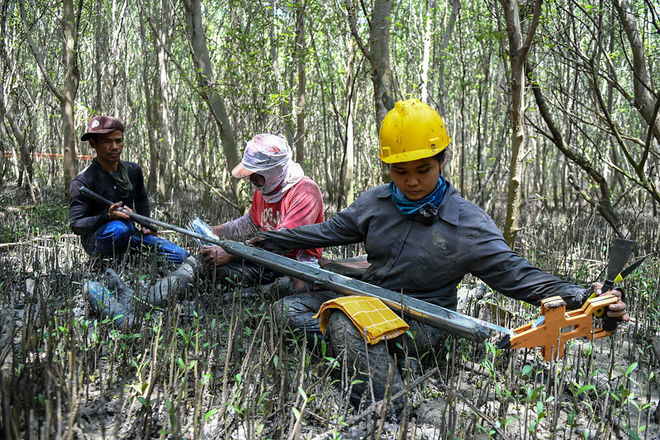



Mangroves restoration plays a vital role in climate change mitigation, with carbon sequestration capability as a key indicator. However, most existing allometric models used for biomass estimation are developed from mature trees and are unsuitable for young mangroves due to limitations in the availability of predictor variables. These models rely on diameter at breast height (DBH) to predict biomass, making them inapplicable for young mangroves in the early restoration phase, which do not yet have a measurable DBH. This study develops species-specific allometric equations for estimating aboveground (AGB) and belowground biomass (BGB) of young mangroves across four species: Bruguiera gymnorrhiza, Kandelia candel, Rhizophora apiculata, and Rhizophora mucronata. Samples were collected using destructive methods along with structural measurement to develop species-specific allometric models using simple power equation and compared with existing models. Biomass distribution was highest in the stem, followed by branches and stilt-roots, then lowest in roots. Carbon content was relatively uniform among different tree components, except for lower values in roots. AGB proportion generally exceeded BGB, except in R. apiculata, with root-to-shoot ratios ranging from 0.43 to 1.31. The best AGB and BGB models showed high goodness of fit (Adj R² = 0.94–0.95 and 0.83–0.97, respectively). Validation showed species-specific performance varied among AGB models (RMSE = 0.07–0.20; MAPE = 0.15–0.25) and among BGB models (RMSE = 0.04–0.43; MAPE = 0.13–0.40). Compared to existing allometric models for mangrove saplings, these new models enhance biomass estimation accuracy for young mangroves that are essential in restoration monitoring and complement existing equations suited for mature trees. Notably, this study provides the first allometric model for K. candel in Indonesia and includes BGB estimates, which are still limited in mangroves research.
This work is licensed under CC-BY 4.0

This work is licensed under CC-BY 4.0
DOI:
https://doi.org/10.1016/j.gecco.2026.e04155Score Altmetric:
Dimensions Nombre de citations:
Exporter la citation:
RIS (.ris)
TI  - New species-specific allometric models for above- and below-ground biomass and carbon content of young mangroves
AU  - Okarda, B.
AU  - Purnomo, H.
AU  - Muchlish, Z.R.
AU  - Shuhada, I.M.
AU  - Kusumadewi, S.D.
AB  - Mangroves restoration plays a vital role in climate change mitigation, with carbon sequestration capability as a key indicator. However, most existing allometric models used for biomass estimation are developed from mature trees and are unsuitable for young mangroves due to limitations in the availability of predictor variables. These models rely on diameter at breast height (DBH) to predict biomass, making them inapplicable for young mangroves in the early restoration phase, which do not yet have a measurable DBH. This study develops species-specific allometric equations for estimating aboveground (AGB) and belowground biomass (BGB) of young mangroves across four species: Bruguiera gymnorrhiza, Kandelia candel, Rhizophora apiculata, and Rhizophora mucronata. Samples were collected using destructive methods along with structural measurement to develop species-specific allometric models using simple power equation and compared with existing models. Biomass distribution was highest in the stem, followed by branches and stilt-roots, then lowest in roots. Carbon content was relatively uniform among different tree components, except for lower values in roots. AGB proportion generally exceeded BGB, except in R. apiculata, with root-to-shoot ratios ranging from 0.43 to 1.31. The best AGB and BGB models showed high goodness of fit (Adj R² = 0.94–0.95 and 0.83–0.97, respectively). Validation showed species-specific performance varied among AGB models (RMSE = 0.07–0.20; MAPE = 0.15–0.25) and among BGB models (RMSE = 0.04–0.43; MAPE = 0.13–0.40). Compared to existing allometric models for mangrove saplings, these new models enhance biomass estimation accuracy for young mangroves that are essential in restoration monitoring and complement existing equations suited for mature trees. Notably, this study provides the first allometric model for K. candel in Indonesia and includes BGB estimates, which are still limited in mangroves research.
PY  - 2026
UR  - https://www.cifor-icraf.org/knowledge/publication/46414/
DO  - https://doi.org/10.1016/j.gecco.2026.e04155
KW  - allometric equation, biomass, carbon, carbon sequestration, climate change mitigation, mangroves, monitoring, restoration, species
ER  -
Endnote (.ciw)
%T New species-specific allometric models for above- and below-ground biomass and carbon content of young mangroves
%A Okarda, B.
%A Purnomo, H.
%A Muchlish, Z.R.
%A Shuhada, I.M.
%A Kusumadewi, S.D.
%D 2026
%U https://www.cifor-icraf.org/knowledge/publication/46414/
%R https://doi.org/10.1016/j.gecco.2026.e04155
%X Mangroves restoration plays a vital role in climate change mitigation, with carbon sequestration capability as a key indicator. However, most existing allometric models used for biomass estimation are developed from mature trees and are unsuitable for young mangroves due to limitations in the availability of predictor variables. These models rely on diameter at breast height (DBH) to predict biomass, making them inapplicable for young mangroves in the early restoration phase, which do not yet have a measurable DBH. This study develops species-specific allometric equations for estimating aboveground (AGB) and belowground biomass (BGB) of young mangroves across four species: Bruguiera gymnorrhiza, Kandelia candel, Rhizophora apiculata, and Rhizophora mucronata. Samples were collected using destructive methods along with structural measurement to develop species-specific allometric models using simple power equation and compared with existing models. Biomass distribution was highest in the stem, followed by branches and stilt-roots, then lowest in roots. Carbon content was relatively uniform among different tree components, except for lower values in roots. AGB proportion generally exceeded BGB, except in R. apiculata, with root-to-shoot ratios ranging from 0.43 to 1.31. The best AGB and BGB models showed high goodness of fit (Adj R² = 0.94–0.95 and 0.83–0.97, respectively). Validation showed species-specific performance varied among AGB models (RMSE = 0.07–0.20; MAPE = 0.15–0.25) and among BGB models (RMSE = 0.04–0.43; MAPE = 0.13–0.40). Compared to existing allometric models for mangrove saplings, these new models enhance biomass estimation accuracy for young mangroves that are essential in restoration monitoring and complement existing equations suited for mature trees. Notably, this study provides the first allometric model for K. candel in Indonesia and includes BGB estimates, which are still limited in mangroves research.
%K allometric equation
%K biomass
%K carbon
%K carbon sequestration
%K climate change mitigation
%K mangroves
%K monitoring
%K restoration
%K species
Année de publication
2026
ISSN
2351-9894
Auteurs
Okarda, B.; Purnomo, H.; Muchlish, Z.R.; Shuhada, I.M.; Kusumadewi, S.D.
Langue
English
Mots clés
allometric equation, biomass, carbon, carbon sequestration, climate change mitigation, mangroves, monitoring, restoration, species
Source
Global Ecology and Conservation. 67: e04155
Géographique
Indonesia