

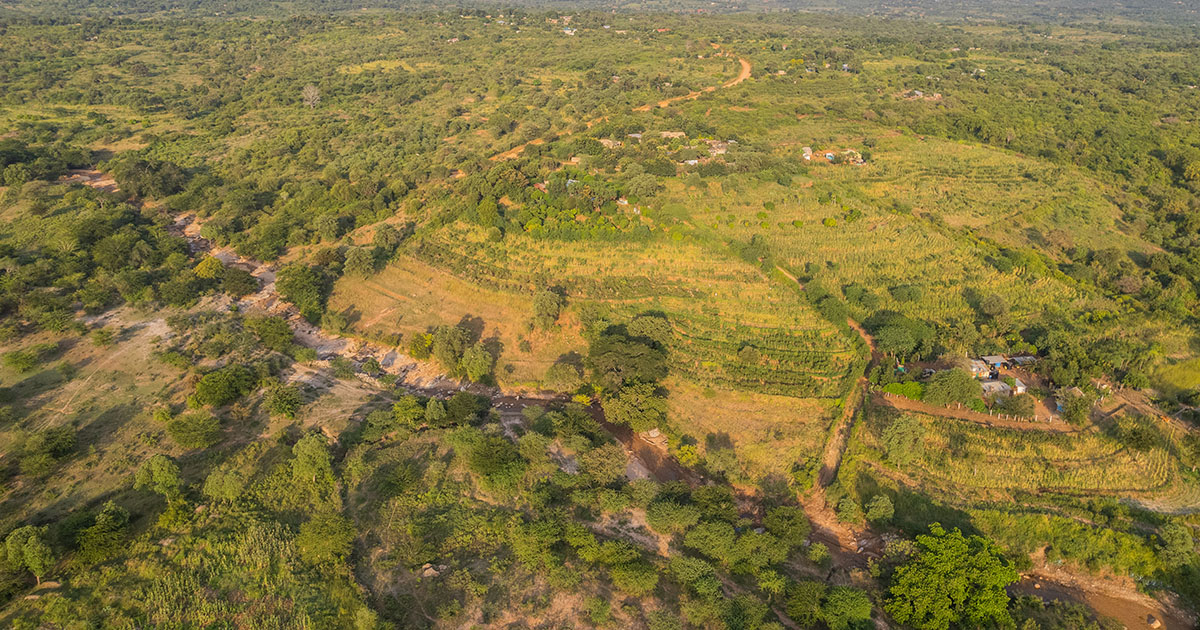









Healthy soils provide a wide range of ecosystem services. But soil erosion (one component of land degradation) jeopardizes the sustainable delivery of these services worldwide, and particularly in the humid tropics where erosion potential is high due to heavy rainfall. The Millennium Ecosystem Assessment pointed out the role of poor land-use and management choices in increasing land degradation. We hypothesized that land use has a limited influence on soil erosion provided vegetation cover is developed enough or good management practices are implemented. We systematically reviewed the literature to study how soil and vegetation management influence soil erosion control in the humid tropics. More than 3600 measurements of soil loss from 55 references covering 21 countries were compiled. Quantitative analysis of the collected data revealed that soil erosion in the humid tropics is dramatically concentrated in space (over landscape elements of bare soil) and time (e.g. during crop rotation). No land use is erosion-prone per se, but creation of bare soil elements in the landscape through particular land uses and other human activities (e.g. skid trails and logging roads) should be avoided as much as possible. Implementation of sound practices of soil and vegetation management (e.g. contour planting, no-till farming and use of vegetative buffer strips) can reduce erosion by up to 99%. With limited financial and technical means, natural resource managers and policy makers can therefore help decrease soil loss at a large scale by promoting wise management of highly erosion-prone landscape elements and enhancing the use of low-erosion-inducing practices.
This work is licensed under CC-BY 4.0

Download:

This work is licensed under CC-BY 4.0
DOI:
https://doi.org/10.1016/j.agee.2015.01.027Score Altmetric:
Dimensions Nombre de citations:
Exporter la citation:
RIS (.ris)
TI  - Soil erosion in the humid tropics: A systematic quantitative review
AU  - Labrière, N.
AU  - Locatelli, B.
AU  - Laumonier, Y.
AU  - Freycon, V.
AU  - Bernoux, M.
AB  - Healthy soils provide a wide range of ecosystem services. But soil erosion (one component of land degradation) jeopardizes the sustainable delivery of these services worldwide, and particularly in the humid tropics where erosion potential is high due to heavy rainfall. The Millennium Ecosystem Assessment pointed out the role of poor land-use and management choices in increasing land degradation. We hypothesized that land use has a limited influence on soil erosion provided vegetation cover is developed enough or good management practices are implemented. We systematically reviewed the literature to study how soil and vegetation management influence soil erosion control in the humid tropics. More than 3600 measurements of soil loss from 55 references covering 21 countries were compiled. Quantitative analysis of the collected data revealed that soil erosion in the humid tropics is dramatically concentrated in space (over landscape elements of bare soil) and time (e.g. during crop rotation). No land use is erosion-prone per se, but creation of bare soil elements in the landscape through particular land uses and other human activities (e.g. skid trails and logging roads) should be avoided as much as possible. Implementation of sound practices of soil and vegetation management (e.g. contour planting, no-till farming and use of vegetative buffer strips) can reduce erosion by up to 99%. With limited financial and technical means, natural resource managers and policy makers can therefore help decrease soil loss at a large scale by promoting wise management of highly erosion-prone landscape elements and enhancing the use of low-erosion-inducing practices.
PY  - 2015
UR  - https://www.cifor-icraf.org/knowledge/publication/5499/
DO  - https://doi.org/10.1016/j.agee.2015.01.027
KW  - ecosystem services, land use, land use planning, landscape, management, quantitative analysis, systematic reviews
ER  -
Endnote (.ciw)
%T Soil erosion in the humid tropics: A systematic quantitative review
%A Labrière, N.
%A Locatelli, B.
%A Laumonier, Y.
%A Freycon, V.
%A Bernoux, M.
%D 2015
%U https://www.cifor-icraf.org/knowledge/publication/5499/
%R https://doi.org/10.1016/j.agee.2015.01.027
%X Healthy soils provide a wide range of ecosystem services. But soil erosion (one component of land degradation) jeopardizes the sustainable delivery of these services worldwide, and particularly in the humid tropics where erosion potential is high due to heavy rainfall. The Millennium Ecosystem Assessment pointed out the role of poor land-use and management choices in increasing land degradation. We hypothesized that land use has a limited influence on soil erosion provided vegetation cover is developed enough or good management practices are implemented. We systematically reviewed the literature to study how soil and vegetation management influence soil erosion control in the humid tropics. More than 3600 measurements of soil loss from 55 references covering 21 countries were compiled. Quantitative analysis of the collected data revealed that soil erosion in the humid tropics is dramatically concentrated in space (over landscape elements of bare soil) and time (e.g. during crop rotation). No land use is erosion-prone per se, but creation of bare soil elements in the landscape through particular land uses and other human activities (e.g. skid trails and logging roads) should be avoided as much as possible. Implementation of sound practices of soil and vegetation management (e.g. contour planting, no-till farming and use of vegetative buffer strips) can reduce erosion by up to 99%. With limited financial and technical means, natural resource managers and policy makers can therefore help decrease soil loss at a large scale by promoting wise management of highly erosion-prone landscape elements and enhancing the use of low-erosion-inducing practices.
%K ecosystem services
%K land use
%K land use planning
%K landscape
%K management
%K quantitative analysis
%K systematic reviews
Année de publication
2015
ISSN
0167-8809
Auteurs
Labrière, N.; Locatelli, B.; Laumonier, Y.; Freycon, V.; Bernoux, M.
Langue
English
Mots clés
ecosystem services, land use, land use planning, landscape, management, quantitative analysis, systematic reviews
Source
Agriculture, Ecosystems and Environment. 203: 127-139