

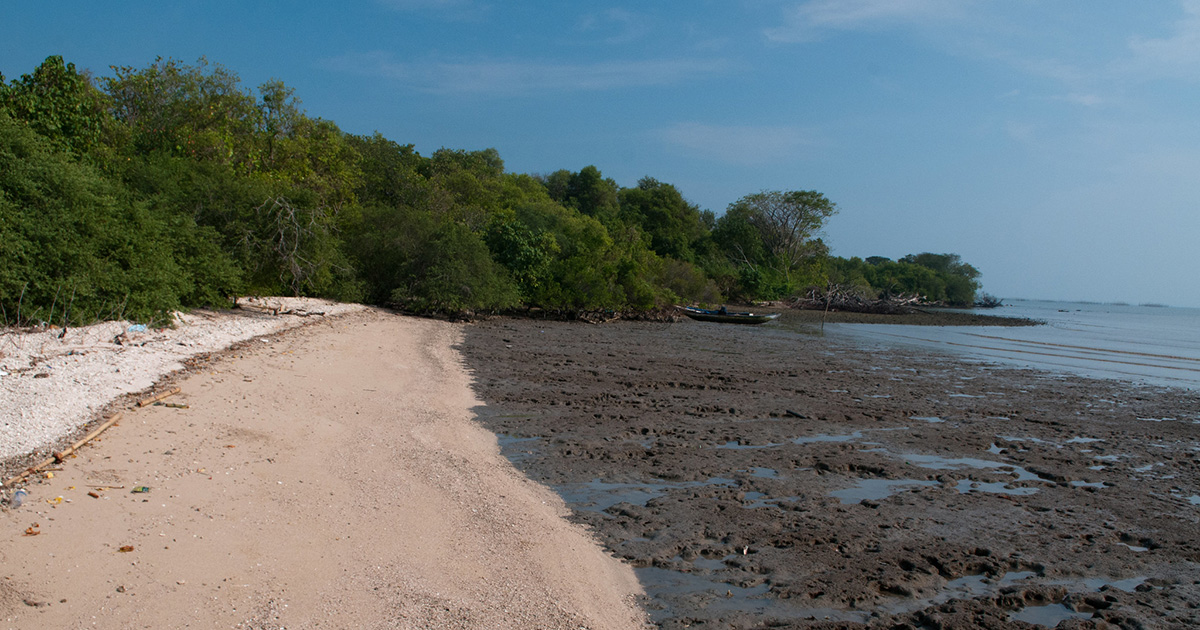




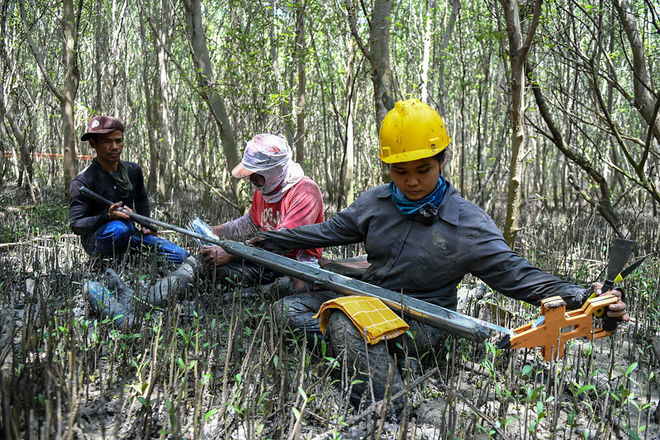



In this study, we observed the effects of constructing permeable barriers in the low-lying coastal zone and severely eroded coast of Demak District, Central Java, Indonesia in the context of mangrove forest structures and carbon (C) dynamics. Forest structures were characterized by stand density, basal area, and ecological indices. The dynamics of C, expressed as total ecosystem carbon stocks (TECS), were compared in mangrove forests, abandoned ponds, and productive ponds by estimating C pools from above- and belowground biomass, dead organic matter, and soil. We found that permeable barriers, whether or not protect mangroves, results in the similarity of above- and belowground C due to no considerable difference in basal area. By contrast, soil properties in terms of bulk density, N concentration, and C:N ratio statistically varied among sites. We discovered that changes in soil properties were associated with duration of permeable barriers, resulting in an increase of soil C in mangrove sites, i.e., 618.84±30.39 Mg C ha−1; 704.13±17.73 Mg C ha−1; and 759.88±15.26 Mg C ha−1 in 0-, 1-, and 4-year-old permeable barriers, respectively. Moreover, these barriers were proved not only could enrich soil C in mangroves but also provide a habitat for Avicennia sp. seedlings in the newly reclaimed coastline.
This work is licensed under CC-BY 4.0

Download:

This work is licensed under CC-BY 4.0
DOI:
https://doi.org/10.13057/biodiv/d211134Score Altmetric:
Dimensions Nombre de citations:
Exporter la citation:
RIS (.ris)
TI  - Effects of permeable barriers on total ecosystem carbon stocks of mangrove forests and abandoned ponds in Demak District, Central Java, Indonesia
AU  - Ardhani, T.S.P.
AU  - Murdiyarso, D.
AU  - Kusmana, C.
AB  - In this study, we observed the effects of constructing permeable barriers in the low-lying coastal zone and severely eroded coast of Demak District, Central Java, Indonesia in the context of mangrove forest structures and carbon (C) dynamics. Forest structures were characterized by stand density, basal area, and ecological indices. The dynamics of C, expressed as total ecosystem carbon stocks (TECS), were compared in mangrove forests, abandoned ponds, and productive ponds by estimating C pools from above- and belowground biomass, dead organic matter, and soil. We found that permeable barriers, whether or not protect mangroves, results in the similarity of above- and belowground C due to no considerable difference in basal area. By contrast, soil properties in terms of bulk density, N concentration, and C:N ratio statistically varied among sites. We discovered that changes in soil properties were associated with duration of permeable barriers, resulting in an increase of soil C in mangrove sites, i.e., 618.84±30.39 Mg C ha−1; 704.13±17.73 Mg C ha−1; and 759.88±15.26 Mg C ha−1 in 0-, 1-, and 4-year-old permeable barriers, respectively. Moreover, these barriers were proved not only could enrich soil C in mangroves but also provide a habitat for Avicennia sp. seedlings in the newly reclaimed coastline.
PY  - 2020
UR  - https://www.cifor-icraf.org/knowledge/publication/7816/
DO  - https://doi.org/10.13057/biodiv/d211134
ER  -
Endnote (.ciw)
%T Effects of permeable barriers on total ecosystem carbon stocks of mangrove forests and abandoned ponds in Demak District, Central Java, Indonesia
%A Ardhani, T.S.P.
%A Murdiyarso, D.
%A Kusmana, C.
%D 2020
%U https://www.cifor-icraf.org/knowledge/publication/7816/
%R https://doi.org/10.13057/biodiv/d211134
%X In this study, we observed the effects of constructing permeable barriers in the low-lying coastal zone and severely eroded coast of Demak District, Central Java, Indonesia in the context of mangrove forest structures and carbon (C) dynamics. Forest structures were characterized by stand density, basal area, and ecological indices. The dynamics of C, expressed as total ecosystem carbon stocks (TECS), were compared in mangrove forests, abandoned ponds, and productive ponds by estimating C pools from above- and belowground biomass, dead organic matter, and soil. We found that permeable barriers, whether or not protect mangroves, results in the similarity of above- and belowground C due to no considerable difference in basal area. By contrast, soil properties in terms of bulk density, N concentration, and C:N ratio statistically varied among sites. We discovered that changes in soil properties were associated with duration of permeable barriers, resulting in an increase of soil C in mangrove sites, i.e., 618.84±30.39 Mg C ha−1; 704.13±17.73 Mg C ha−1; and 759.88±15.26 Mg C ha−1 in 0-, 1-, and 4-year-old permeable barriers, respectively. Moreover, these barriers were proved not only could enrich soil C in mangroves but also provide a habitat for Avicennia sp. seedlings in the newly reclaimed coastline.
Année de publication
2020
ISSN
1412-033X
Auteurs
Ardhani, T.S.P.; Murdiyarso, D.; Kusmana, C.
Langue
English
Source
Biodiversitas. 21(11): 5298-5307
Géographique
Indonesia