







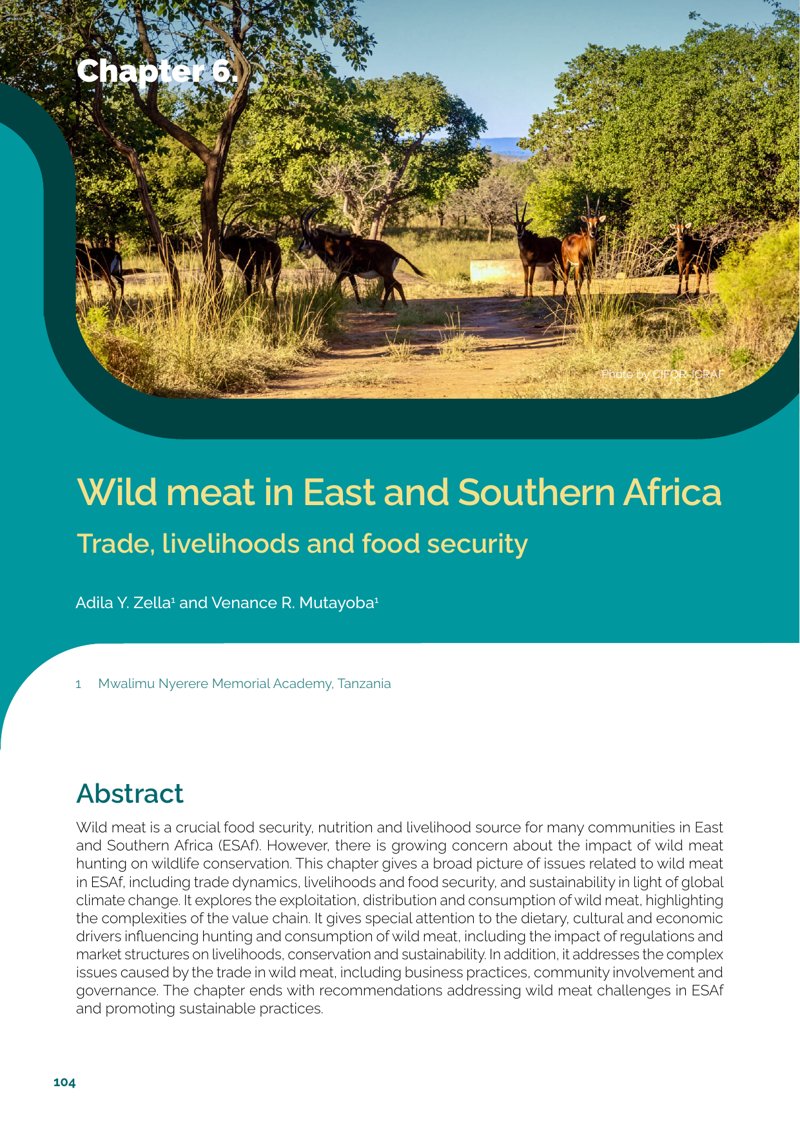


Wild meat is a crucial food security, nutrition and livelihood source for many East and Southern African communities (ESAf). However, there is growing concern about the impact of wild meat hunting on wildlife conservation. This chapter gives a broad picture of issues related to wild meat in ESAf, including trade dynamics, livelihoods and food security, and sustainability in light of global climate change. It explores the exploitation, distribution and consumption of wild meat, highlighting the complexities of the value chain. It gives special attention to the dietary, cultural and economic drivers influencing hunting and consumption of wild meat, including the impact of regulations and market structures on livelihoods, conservation and sustainability. In addition, it addresses the complex issues caused by the trade in wild meat, including business practices, community involvement and governance. The chapter ends with recommendations addressing wild meat challenges in ESAf and promoting sustainable practices.
This work is licensed under CC-BY 4.0
This work is licensed under CC-BY 4.0
Exporter la citation:
RIS (.ris)
TI  - Wild meat in East and Southern Africa: Trade, livelihoods and food security
AU  - Zella, A.Y.
AU  - Mutayoba, V.R.
AB  - Wild meat is a crucial food security, nutrition and livelihood source for many East and Southern African communities (ESAf). However, there is growing concern about the impact of wild meat hunting on wildlife conservation. This chapter gives a broad picture of issues related to wild meat in ESAf, including trade dynamics, livelihoods and food security, and sustainability in light of global climate change. It explores the exploitation, distribution and consumption of wild meat, highlighting the complexities of the value chain. It gives special attention to the dietary, cultural and economic drivers influencing hunting and consumption of wild meat, including the impact of regulations and market structures on livelihoods, conservation and sustainability. In addition, it addresses the complex issues caused by the trade in wild meat, including business practices, community involvement and governance. The chapter ends with recommendations addressing wild meat challenges in ESAf and promoting sustainable practices.
PY  - 2026
PB  - CIFOR-ICRAF
PP  - Bogor, Indonesia and Nairobi, Kenya
UR  - https://www.cifor-icraf.org/knowledge/publication/46406/
KW  - community involvement, food security, livelihoods, nutrition, trade, value chains, wild meat, wildlife conservation
ER  -
Endnote (.ciw)
%T Wild meat in East and Southern Africa: Trade, livelihoods and food security
%A Zella, A.Y.
%A Mutayoba, V.R.
%D 2026
%I CIFOR-ICRAF
%C Bogor, Indonesia and Nairobi, Kenya
%U https://www.cifor-icraf.org/knowledge/publication/46406/
%X Wild meat is a crucial food security, nutrition and livelihood source for many East and Southern African communities (ESAf). However, there is growing concern about the impact of wild meat hunting on wildlife conservation. This chapter gives a broad picture of issues related to wild meat in ESAf, including trade dynamics, livelihoods and food security, and sustainability in light of global climate change. It explores the exploitation, distribution and consumption of wild meat, highlighting the complexities of the value chain. It gives special attention to the dietary, cultural and economic drivers influencing hunting and consumption of wild meat, including the impact of regulations and market structures on livelihoods, conservation and sustainability. In addition, it addresses the complex issues caused by the trade in wild meat, including business practices, community involvement and governance. The chapter ends with recommendations addressing wild meat challenges in ESAf and promoting sustainable practices.
%K community involvement
%K food security
%K livelihoods
%K nutrition
%K trade
%K value chains
%K wild meat
%K wildlife conservation
Année de publication
2026
Auteurs
Langue
English
Mots clés
community involvement, food security, livelihoods, nutrition, trade, value chains, wild meat, wildlife conservation
Source
State of the Forests 2025: The Forests of the East and Southern Africa. CIFOR-ICRAF: Bogor, Indonesia and Nairobi, KenyaGéographique
Tanzania, Kenya, Mozambique, Ethiopia, Uganda, Namibia, Botswana, Seychelles, Zambia, Zimbabwe