






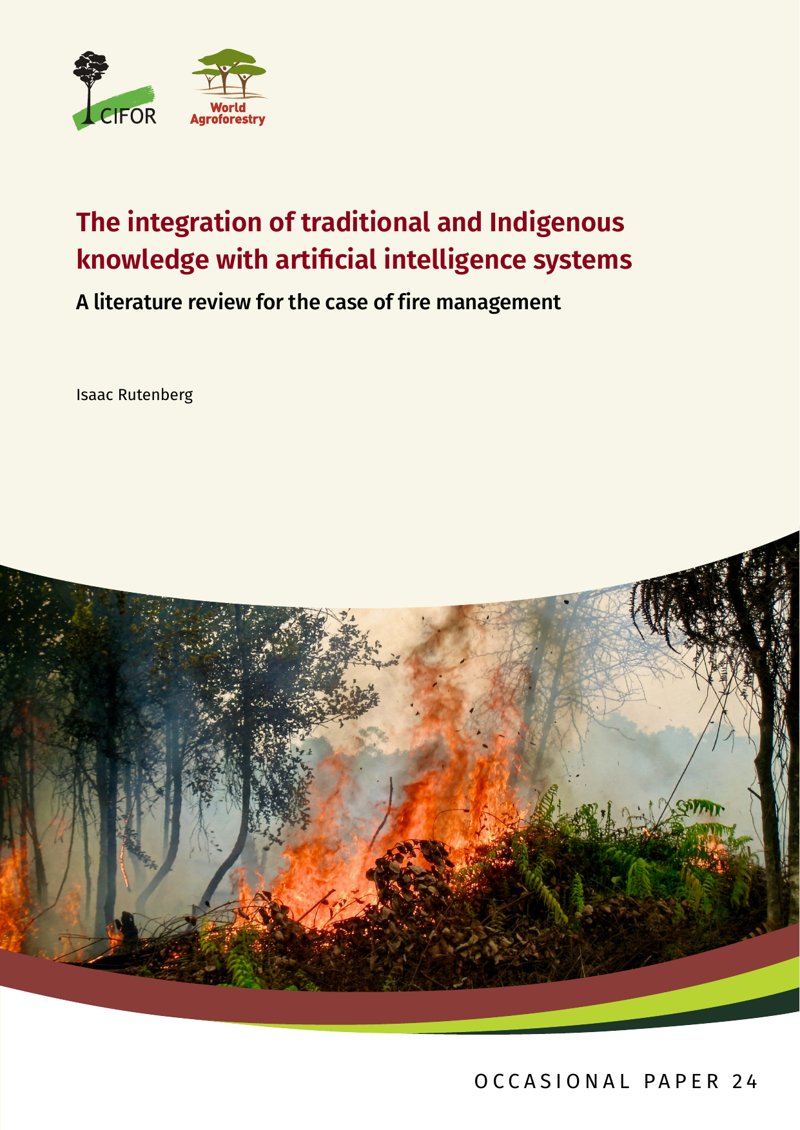


This review examines concepts and literature at the intersection of traditional and Indigenous knowledge (TIK), artificial intelligence (AI), and integrated fire management (IFM) within ecosystems. The growing importance of fire management is increasingly evident as climate change intensifies ecological, economic, and public safety risks associated with wildfires. Human societies have grappled with fire since the earliest stages of development, and this history is reflected in the substantial body of traditional knowledge related to the use and management of fire within landscapes. At the same time, recent advances in AI have expanded the reach of computational systems into many domains of human–environment interaction, including wildfire monitoring, prediction, and management. The integration of TIK with AI systems for the purpose of IFM is therefore emerging as an area of growing interest that builds upon substantial bodies of work in each of these three domains. This review therefore assesses how TIK and AI may complement one another in supporting integrated fire management, while also identifying the principal challenges, ethical considerations, and knowledge gaps associated with such integration. Although the literature examined spans multiple geographic regions, particular attention is given to Canada, where extensive wildfire-prone landscapes, longstanding Indigenous fire stewardship practices, and increasing institutional interest in integrating Indigenous knowledge with technological approaches to wildfire management together provide a compelling case study.
This work is licensed under CC-BY 4.0

This work is licensed under CC-BY 4.0
DOI:
https://doi.org/10.17528/cifor-icraf/009450Score Altmetric:
Dimensions Nombre de citations:
Exporter la citation:
RIS (.ris)
TI  - The integration of traditional and Indigenous knowledge with artificial intelligence systems: A literature review for the case of fire management
AU  - Rutenberg, I.
AB  - This review examines concepts and literature at the intersection of traditional and Indigenous knowledge (TIK), artificial intelligence (AI), and integrated fire management (IFM) within ecosystems. The growing importance of fire management is increasingly evident as climate change intensifies ecological, economic, and public safety risks associated with wildfires. Human societies have grappled with fire since the earliest stages of development, and this history is reflected in the substantial body of traditional knowledge related to the use and management of fire within landscapes. At the same time, recent advances in AI have expanded the reach of computational systems into many domains of human–environment interaction, including wildfire monitoring, prediction, and management. The integration of TIK with AI systems for the purpose of IFM is therefore emerging as an area of growing interest that builds upon substantial bodies of work in each of these three domains. This review therefore assesses how TIK and AI may complement one another in supporting integrated fire management, while also identifying the principal challenges, ethical considerations, and knowledge gaps associated with such integration. Although the literature examined spans multiple geographic regions, particular attention is given to Canada, where extensive wildfire-prone landscapes, longstanding Indigenous fire stewardship practices, and increasing institutional interest in integrating Indigenous knowledge with technological approaches to wildfire management together provide a compelling case study.
PY  - 2026
PB  - CIFOR-ICRAF
PP  - Bogor, Indonesia and Nairobi, Kenya
UR  - https://www.cifor-icraf.org/knowledge/publication/9450/
DO  - https://doi.org/10.17528/cifor-icraf/009450
KW  - artificial intelligence, climate change, fire managemet, forest fires, indigenous knowledge, resilience, wildfires
ER  -
Endnote (.ciw)
%T The integration of traditional and Indigenous knowledge with artificial intelligence systems: A literature review for the case of fire management
%A Rutenberg, I.
%D 2026
%I CIFOR-ICRAF
%C Bogor, Indonesia and Nairobi, Kenya
%U https://www.cifor-icraf.org/knowledge/publication/9450/
%R https://doi.org/10.17528/cifor-icraf/009450
%X This review examines concepts and literature at the intersection of traditional and Indigenous knowledge (TIK), artificial intelligence (AI), and integrated fire management (IFM) within ecosystems. The growing importance of fire management is increasingly evident as climate change intensifies ecological, economic, and public safety risks associated with wildfires. Human societies have grappled with fire since the earliest stages of development, and this history is reflected in the substantial body of traditional knowledge related to the use and management of fire within landscapes. At the same time, recent advances in AI have expanded the reach of computational systems into many domains of human–environment interaction, including wildfire monitoring, prediction, and management. The integration of TIK with AI systems for the purpose of IFM is therefore emerging as an area of growing interest that builds upon substantial bodies of work in each of these three domains. This review therefore assesses how TIK and AI may complement one another in supporting integrated fire management, while also identifying the principal challenges, ethical considerations, and knowledge gaps associated with such integration. Although the literature examined spans multiple geographic regions, particular attention is given to Canada, where extensive wildfire-prone landscapes, longstanding Indigenous fire stewardship practices, and increasing institutional interest in integrating Indigenous knowledge with technological approaches to wildfire management together provide a compelling case study.
%K artificial intelligence
%K climate change
%K fire managemet
%K forest fires
%K indigenous knowledge
%K resilience
%K wildfires
Publisher
CIFOR-ICRAF: Bogor, Indonesia and Nairobi, Kenya
Année de publication
2026
Auteurs
Langue
English
Mots clés
artificial intelligence, climate change, fire managemet, forest fires, indigenous knowledge, resilience, wildfires