


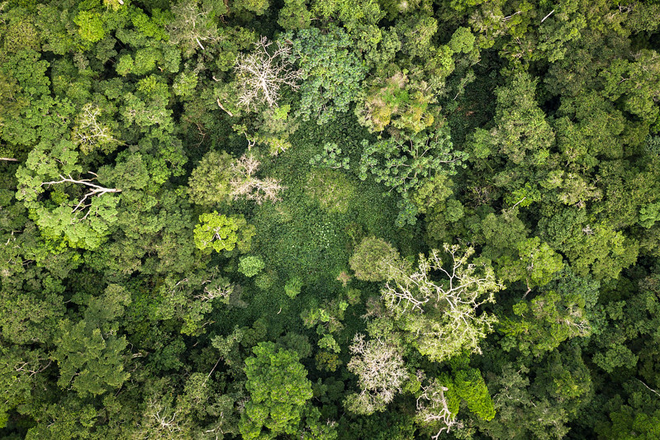



Cocoa plantation is a major land-use system that influences the functional structure of the forest landscape in Ghana. As a key driver of forest landscape dynamics, there is no adequate existing information on the nature, extent and magnitude of land-use change associated with cocoa expansion into forests. Therefore, we have studied the land-use transitions and intensities by using image-fusion on vegetation indices (VI) and a digital elevation model (DEM) to detect and distinguish cocoa plantation from the forest and other vegetation types. This was followed by intensity analysis based on historical land-use changes. With the VI-DEM image, we mapped out different cocoa plantations from the forest and other vegetations with a higher degree of success. The land-use categories were clustered into five main types (closed forest, open-forest, cocoa, lands-in-transition and settlement) to evaluate the transition and intensities from 1986 to 2015. The results showed two main transition patterns, namely 1) the conversion of forest to settlement and cocoa plantation; 2) the conversion of closed forests to open forest, due to logging and conversion of cocoa plantation to lands-in-transition (LIT). The intensity analysis further revealed that expansion in cocoa plantation instead targets least resisted open-forest and LIT areas with an isolated localised fragment of the fringes of forest reserves. Generally, the study revealed that the VI-DEM image-fusion technique is effective for detecting and isolating cocoa plantations, forest and other land-uses with high accuracy. Estimation of cocoa-led deforestation improved after isolating cocoa plantations. Cocoa expansions target more often open-forest and lands-in-transition than closed-forest. When cocoa expansion occurs in closed-forest, it is episodic, localised and coincides with the early stage of the boom-bust pattern.

DOI:
https://doi.org/10.1016/j.apgeog.2018.07.027Score Altmetric:
Dimensions Nombre de citations:
Exporter la citation:
RIS (.ris)
TI  - Assessing land-use typologies and change intensities in a structurally complex Ghanaian cocoa landscape
AU  - Benefoh, D.T.
AU  - Villamor, G.B.
AU  - van Noordwijk, M.
AU  - Borgemeister, C.
AU  - Asante, W.A.
AU  - Asubonteng, K.O.
AB  - Cocoa plantation is a major land-use system that influences the functional structure of the forest landscape in Ghana. As a key driver of forest landscape dynamics, there is no adequate existing information on the nature, extent and magnitude of land-use change associated with cocoa expansion into forests. Therefore, we have studied the land-use transitions and intensities by using image-fusion on vegetation indices (VI) and a digital elevation model (DEM) to detect and distinguish cocoa plantation from the forest and other vegetation types. This was followed by intensity analysis based on historical land-use changes. With the VI-DEM image, we mapped out different cocoa plantations from the forest and other vegetations with a higher degree of success. The land-use categories were clustered into five main types (closed forest, open-forest, cocoa, lands-in-transition and settlement) to evaluate the transition and intensities from 1986 to 2015. The results showed two main transition patterns, namely 1) the conversion of forest to settlement and cocoa plantation; 2) the conversion of closed forests to open forest, due to logging and conversion of cocoa plantation to lands-in-transition (LIT). The intensity analysis further revealed that expansion in cocoa plantation instead targets least resisted open-forest and LIT areas with an isolated localised fragment of the fringes of forest reserves. Generally, the study revealed that the VI-DEM image-fusion technique is effective for detecting and isolating cocoa plantations, forest and other land-uses with high accuracy. Estimation of cocoa-led deforestation improved after isolating cocoa plantations. Cocoa expansions target more often open-forest and lands-in-transition than closed-forest. When cocoa expansion occurs in closed-forest, it is episodic, localised and coincides with the early stage of the boom-bust pattern.
PY  - 2018
UR  - https://www.cifor-icraf.org/knowledge/publication/14093/
DO  - https://doi.org/10.1016/j.apgeog.2018.07.027
KW  - conservation areas, land use
ER  -
Endnote (.ciw)
%T Assessing land-use typologies and change intensities in a structurally complex Ghanaian cocoa landscape
%A Benefoh, D.T.
%A Villamor, G.B.
%A van Noordwijk, M.
%A Borgemeister, C.
%A Asante, W.A.
%A Asubonteng, K.O.
%D 2018
%U https://www.cifor-icraf.org/knowledge/publication/14093/
%R https://doi.org/10.1016/j.apgeog.2018.07.027
%X Cocoa plantation is a major land-use system that influences the functional structure of the forest landscape in Ghana. As a key driver of forest landscape dynamics, there is no adequate existing information on the nature, extent and magnitude of land-use change associated with cocoa expansion into forests. Therefore, we have studied the land-use transitions and intensities by using image-fusion on vegetation indices (VI) and a digital elevation model (DEM) to detect and distinguish cocoa plantation from the forest and other vegetation types. This was followed by intensity analysis based on historical land-use changes. With the VI-DEM image, we mapped out different cocoa plantations from the forest and other vegetations with a higher degree of success. The land-use categories were clustered into five main types (closed forest, open-forest, cocoa, lands-in-transition and settlement) to evaluate the transition and intensities from 1986 to 2015. The results showed two main transition patterns, namely 1) the conversion of forest to settlement and cocoa plantation; 2) the conversion of closed forests to open forest, due to logging and conversion of cocoa plantation to lands-in-transition (LIT). The intensity analysis further revealed that expansion in cocoa plantation instead targets least resisted open-forest and LIT areas with an isolated localised fragment of the fringes of forest reserves. Generally, the study revealed that the VI-DEM image-fusion technique is effective for detecting and isolating cocoa plantations, forest and other land-uses with high accuracy. Estimation of cocoa-led deforestation improved after isolating cocoa plantations. Cocoa expansions target more often open-forest and lands-in-transition than closed-forest. When cocoa expansion occurs in closed-forest, it is episodic, localised and coincides with the early stage of the boom-bust pattern.
%K conservation areas
%K land use
Année de publication
2018
ISSN
0143-6228
Auteurs
Benefoh, D.T.; Villamor, G.B.; van Noordwijk, M.; Borgemeister, C.; Asante, W.A.; Asubonteng, K.O.
Langue
English
Mots clés
conservation areas, land use
Source
Applied Geography. 99: 109-119
Géographique
Ghana