
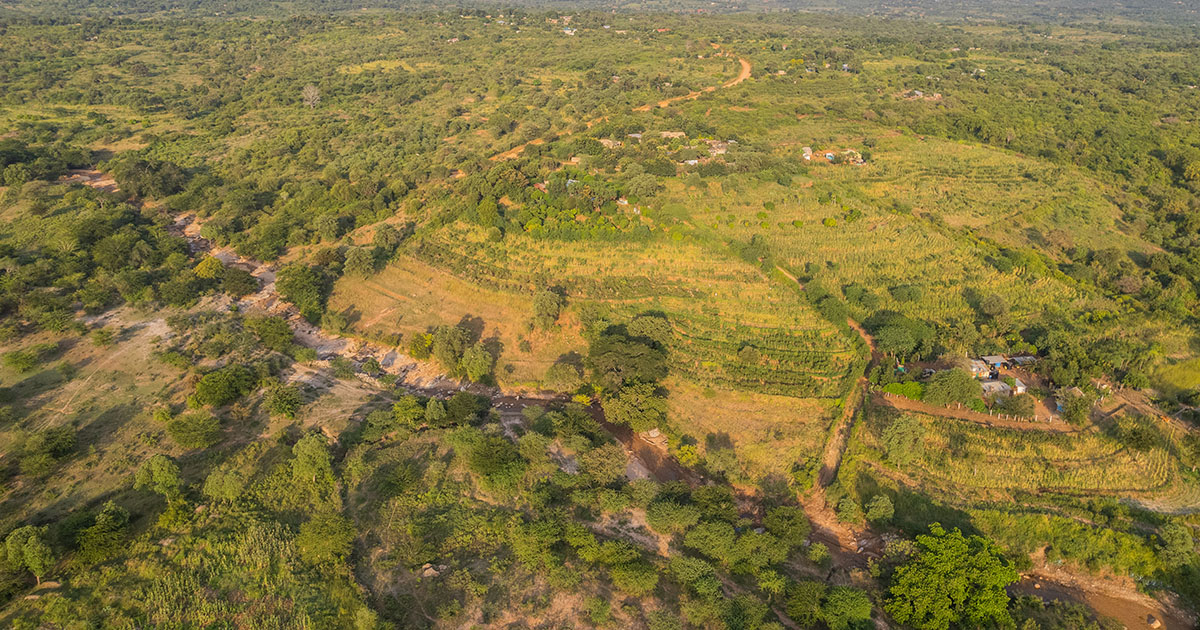





The relationship between trees, grass and soil in a dry savanna in Mali was investigated, to identify variables that are most relevant to assess vegetation units. A 65 ha plateau was inventoried using a systematic square grid sampling pattern. Thirteen soil or topography variables, and tree and grass characteristics were measured at each sampling point. Multivariate analysis was used to separately analyse soil, tree and grass data, and to characterize tree-grass and tree-soil relationships. Four units of soils, four units of tree formations, and four units of grass formations were identified. There was a correspondence between these groups, indicative of four vegetation units: thicket, bare land, shrub savanna and tree savanna. Soil depth and soil texture were the soil variables that best related to tree vegetation. A negative correlation was found between tree basal area and grass dry biomass. Finally, vegetation units, as identified from tree species composition, had contrasted diameter structures and densities.

DOI:
https://doi.org/10.1111/j.1365-2028.2005.00568.xScore Altmetric:
Dimensions Nombre de citations:
Exporter la citation:
RIS (.ris)
TI  - Tree formations in relation with soil and grasses in a dry savanna in Mali, West Africa
AU  - Picard, N.
AU  - Gueguen, K.
AU  - Abdoulaye, H.A.
AU  - Diarisso, D.
AU  - Karembe, M.
AU  - Birnbaum, P.
AU  - Nasi, R.
AB  - The relationship between trees, grass and soil in a dry savanna in Mali was investigated, to identify variables that are most relevant to assess vegetation units. A 65 ha plateau was inventoried using a systematic square grid sampling pattern. Thirteen soil or topography variables, and tree and grass characteristics were measured at each sampling point. Multivariate analysis was used to separately analyse soil, tree and grass data, and to characterize tree-grass and tree-soil relationships. Four units of soils, four units of tree formations, and four units of grass formations were identified. There was a correspondence between these groups, indicative of four vegetation units: thicket, bare land, shrub savanna and tree savanna. Soil depth and soil texture were the soil variables that best related to tree vegetation. A negative correlation was found between tree basal area and grass dry biomass. Finally, vegetation units, as identified from tree species composition, had contrasted diameter structures and densities.
PY  - 2005
UR  - https://www.cifor-icraf.org/knowledge/publication/1959/
DO  - https://doi.org/10.1111/j.1365-2028.2005.00568.x
KW  - dry forests, grasses, relationships, savannas, soil, trees, vegetation
ER  -
Endnote (.ciw)
%T Tree formations in relation with soil and grasses in a dry savanna in Mali, West Africa
%A Picard, N.
%A Gueguen, K.
%A Abdoulaye, H.A.
%A Diarisso, D.
%A Karembe, M.
%A Birnbaum, P.
%A Nasi, R.
%D 2005
%U https://www.cifor-icraf.org/knowledge/publication/1959/
%R https://doi.org/10.1111/j.1365-2028.2005.00568.x
%X The relationship between trees, grass and soil in a dry savanna in Mali was investigated, to identify variables that are most relevant to assess vegetation units. A 65 ha plateau was inventoried using a systematic square grid sampling pattern. Thirteen soil or topography variables, and tree and grass characteristics were measured at each sampling point. Multivariate analysis was used to separately analyse soil, tree and grass data, and to characterize tree-grass and tree-soil relationships. Four units of soils, four units of tree formations, and four units of grass formations were identified. There was a correspondence between these groups, indicative of four vegetation units: thicket, bare land, shrub savanna and tree savanna. Soil depth and soil texture were the soil variables that best related to tree vegetation. A negative correlation was found between tree basal area and grass dry biomass. Finally, vegetation units, as identified from tree species composition, had contrasted diameter structures and densities.
%K dry forests
%K grasses
%K relationships
%K savannas
%K soil
%K trees
%K vegetation
Année de publication
2005
ISSN
0141-6707
Auteurs
Picard, N.; Gueguen, K.; Abdoulaye, H.A.; Diarisso, D.; Karembe, M.; Birnbaum, P.; Nasi, R.
Langue
English
Mots clés
dry forests, grasses, relationships, savannas, soil, trees, vegetation
Source
African Journal of Ecology. 43(3): 201-214
Géographique
Mali