


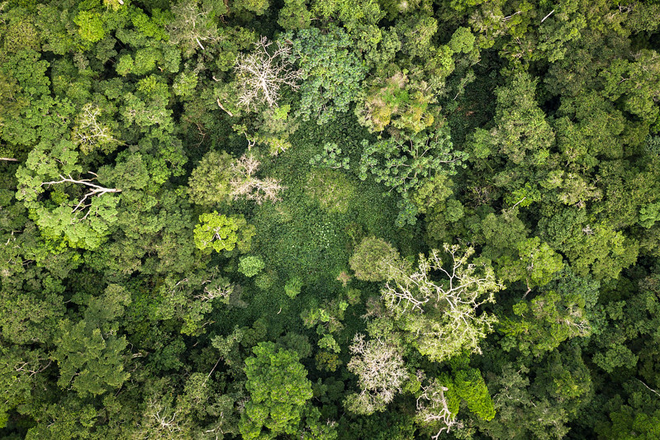



The impact of climatic changes that occurred during the last glacial maximum and the Holocene on vegetation changes in the Amazon Basin and the Guiana Shield are still widely debated. The aim of our study was to investigate whether major changes in vegetation (i.e. transitions between rainforests and C4 savannas) occurred in northern French Guiana during the Holocene. We measured variations in the d13C of soil organic matter at eight sites now occupied by forest or savannah. The forest sites were selected to cover two regions (forest refugia and peneplains) which are thought to have experienced different intensities of disturbance during the latest Pleistocene and the Holocene. We found that none of the forest sites underwent major disturbances during the Holocene, i.e. they were not replaced by C4 savannahs or C4 forest savannahs for long periods. Our results thus suggest that tropical rainforests in northern French Guiana were resilient to drier climatic conditions during the Holocene. Nevertheless, geographical and vertical variations in the 13C of SOM were compatible with minor changes in vegetation, variations in soil processes or in soil physical properties.

DOI:
https://doi.org/10.1016/j.yqres.2009.11.007Score Altmetric:
Dimensions Nombre de citations:
Exporter la citation:
RIS (.ris)
TI  - The impact of climate changes during the Holocene on vegetation in northern French Guiana
AU  - Freycon, V.
AU  - Krencker, M.
AU  - Schwartz, D.
AU  - Nasi, R.
AU  - Bonal, D.
AB  - The impact of climatic changes that occurred during the last glacial maximum and the Holocene on vegetation changes in the Amazon Basin and the Guiana Shield are still widely debated. The aim of our study was to investigate whether major changes in vegetation (i.e. transitions between rainforests and C4 savannas) occurred in northern French Guiana during the Holocene. We measured variations in the d13C of soil organic matter at eight sites now occupied by forest or savannah. The forest sites were selected to cover two regions (forest refugia and peneplains) which are thought to have experienced different intensities of disturbance during the latest Pleistocene and the Holocene. We found that none of the forest sites underwent major disturbances during the Holocene, i.e. they were not replaced by C4 savannahs or C4 forest savannahs for long periods. Our results thus suggest that tropical rainforests in northern French Guiana were resilient to drier climatic conditions during the Holocene. Nevertheless, geographical and vertical variations in the 13C of SOM were compatible with minor changes in vegetation, variations in soil processes or in soil physical properties.
PY  - 2010
UR  - https://www.cifor-icraf.org/knowledge/publication/2976/
DO  - https://doi.org/10.1016/j.yqres.2009.11.007
KW  - climate change, ecological disturbance, environmental impact, forests, grasslands, palaeobotany, palaeoclimatology, savannas, soil organic matter, soil physical properties, tropical rain forests, vegetation
ER  -
Endnote (.ciw)
%T The impact of climate changes during the Holocene on vegetation in northern French Guiana
%A Freycon, V.
%A Krencker, M.
%A Schwartz, D.
%A Nasi, R.
%A Bonal, D.
%D 2010
%U https://www.cifor-icraf.org/knowledge/publication/2976/
%R https://doi.org/10.1016/j.yqres.2009.11.007
%X The impact of climatic changes that occurred during the last glacial maximum and the Holocene on vegetation changes in the Amazon Basin and the Guiana Shield are still widely debated. The aim of our study was to investigate whether major changes in vegetation (i.e. transitions between rainforests and C4 savannas) occurred in northern French Guiana during the Holocene. We measured variations in the d13C of soil organic matter at eight sites now occupied by forest or savannah. The forest sites were selected to cover two regions (forest refugia and peneplains) which are thought to have experienced different intensities of disturbance during the latest Pleistocene and the Holocene. We found that none of the forest sites underwent major disturbances during the Holocene, i.e. they were not replaced by C4 savannahs or C4 forest savannahs for long periods. Our results thus suggest that tropical rainforests in northern French Guiana were resilient to drier climatic conditions during the Holocene. Nevertheless, geographical and vertical variations in the 13C of SOM were compatible with minor changes in vegetation, variations in soil processes or in soil physical properties.
%K climate change
%K ecological disturbance
%K environmental impact
%K forests
%K grasslands
%K palaeobotany
%K palaeoclimatology
%K savannas
%K soil organic matter
%K soil physical properties
%K tropical rain forests
%K vegetation
Année de publication
2010
ISSN
0033-5894
Auteurs
Freycon, V.; Krencker, M.; Schwartz, D.; Nasi, R.; Bonal, D.
Langue
English
Mots clés
climate change, ecological disturbance, environmental impact, forests, grasslands, palaeobotany, palaeoclimatology, savannas, soil organic matter, soil physical properties, tropical rain forests, vegetation
Source
Quaternary Research. 73: 220-225
Géographique
Papua New Guinea