



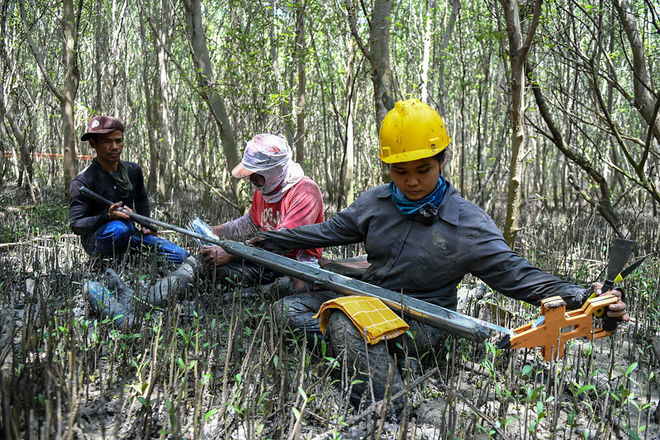
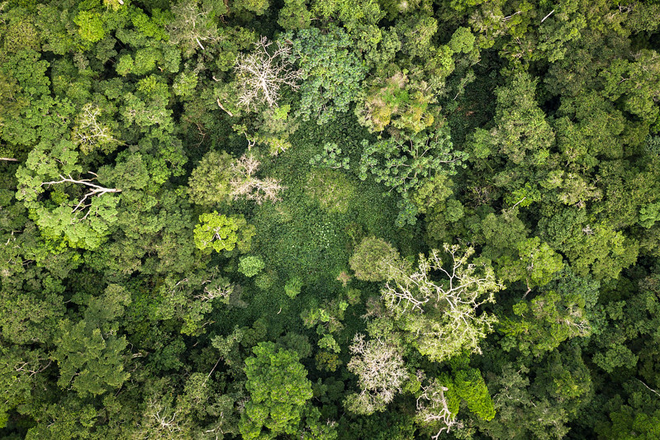



Growing concerns about unnecessarily destructive selective logging of tropical forests and its impacts on greenhouse gas (GHG) emissions motivated this study on post-logging biomass dynamics over a 16-year period in a control plot and in plots subjected to conventional logging (CL) or reduced-impact logging (RIL) in Paragominas, Pará State, Brazil. All trees >25cm were monitored in 25.4ha plots of each treatment, each with a subplot of 5.25ha for trees >10cmdbh. The commercial timber volumes in felled trees were 38.9 and 37.4m3ha-1 in the RIL and CL plots, respectively, but the extracted volumes were 38.6 and 29.7 m3 ha-1, respectively. Immediately after logging, plots subjected to RIL and CL lost 17% and 26% of their above-ground biomass, respectively. Over the 16years after logging, the average annual increments in above-ground biomass (recruitment plus residual tree growth minus mortality) were 2.8Mgha-1 year-1 in the RIL plot but only 0.5Mgha-1year-1 in the CL plot. By 16years post-logging, the RIL plot recovered 100% of its original above-ground biomass while the CL plot recovered only 77%; over the same period, biomass in the control plot maintained 96% of its initial stock. These findings reinforce the claim that conversion from CL to RIL would represent an efficient forest-based strategy to mitigate climate change under the REDD+ and would be an important step towards sustainable forest management.

DOI:
https://doi.org/10.1016/j.foreco.2013.11.022Score Altmetric:
Dimensions Nombre de citations:
Exporter la citation:
RIS (.ris)
TI  - Forest biomass recovery after conventional and reduced-impact logging in Amazonian Brazil
AU  - West, T.A.P.
AU  - Vidal, E.
AU  - Putz, F. E.
AB  - Growing concerns about unnecessarily destructive selective logging of tropical forests and its impacts on greenhouse gas (GHG) emissions motivated this study on post-logging biomass dynamics over a 16-year period in a control plot and in plots subjected to conventional logging (CL) or reduced-impact logging (RIL) in Paragominas, Pará State, Brazil. All trees >25cm were monitored in 25.4ha plots of each treatment, each with a subplot of 5.25ha for trees >10cmdbh. The commercial timber volumes in felled trees were 38.9 and 37.4m3ha-1 in the RIL and CL plots, respectively, but the extracted volumes were 38.6 and 29.7 m3 ha-1, respectively. Immediately after logging, plots subjected to RIL and CL lost 17% and 26% of their above-ground biomass, respectively. Over the 16years after logging, the average annual increments in above-ground biomass (recruitment plus residual tree growth minus mortality) were 2.8Mgha-1 year-1 in the RIL plot but only 0.5Mgha-1year-1 in the CL plot. By 16years post-logging, the RIL plot recovered 100% of its original above-ground biomass while the CL plot recovered only 77%; over the same period, biomass in the control plot maintained 96% of its initial stock. These findings reinforce the claim that conversion from CL to RIL would represent an efficient forest-based strategy to mitigate climate change under the REDD+ and would be an important step towards sustainable forest management.
PY  - 2014
UR  - https://www.cifor-icraf.org/knowledge/publication/4359/
DO  - https://doi.org/10.1016/j.foreco.2013.11.022
KW  - biomass production, climate change, forests, mitigation, redd+
ER  -
Endnote (.ciw)
%T Forest biomass recovery after conventional and reduced-impact logging in Amazonian Brazil
%A West, T.A.P.
%A Vidal, E.
%A Putz, F. E.
%D 2014
%U https://www.cifor-icraf.org/knowledge/publication/4359/
%R https://doi.org/10.1016/j.foreco.2013.11.022
%X Growing concerns about unnecessarily destructive selective logging of tropical forests and its impacts on greenhouse gas (GHG) emissions motivated this study on post-logging biomass dynamics over a 16-year period in a control plot and in plots subjected to conventional logging (CL) or reduced-impact logging (RIL) in Paragominas, Pará State, Brazil. All trees >25cm were monitored in 25.4ha plots of each treatment, each with a subplot of 5.25ha for trees >10cmdbh. The commercial timber volumes in felled trees were 38.9 and 37.4m3ha-1 in the RIL and CL plots, respectively, but the extracted volumes were 38.6 and 29.7 m3 ha-1, respectively. Immediately after logging, plots subjected to RIL and CL lost 17% and 26% of their above-ground biomass, respectively. Over the 16years after logging, the average annual increments in above-ground biomass (recruitment plus residual tree growth minus mortality) were 2.8Mgha-1 year-1 in the RIL plot but only 0.5Mgha-1year-1 in the CL plot. By 16years post-logging, the RIL plot recovered 100% of its original above-ground biomass while the CL plot recovered only 77%; over the same period, biomass in the control plot maintained 96% of its initial stock. These findings reinforce the claim that conversion from CL to RIL would represent an efficient forest-based strategy to mitigate climate change under the REDD+ and would be an important step towards sustainable forest management.
%K biomass production
%K climate change
%K forests
%K mitigation
%K redd+
Année de publication
2014
ISSN
0378-1127
Auteurs
West, T.A.P.; Vidal, E.; Putz, F. E.
Langue
English
Mots clés
biomass production, climate change, forests, mitigation, redd+
Source
Forest Ecology and Management. 314(15): 59-63