





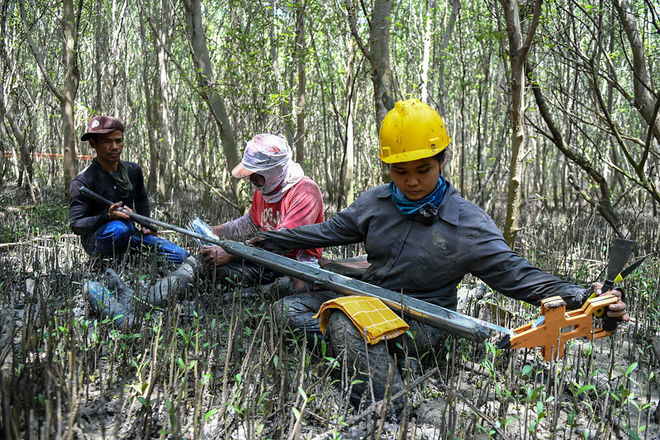
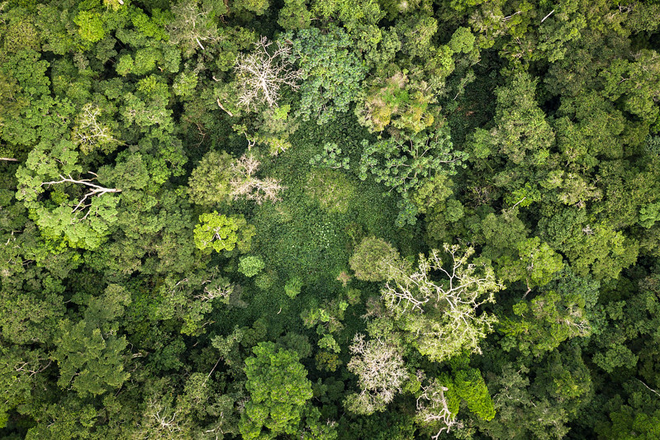



Patterns in above-ground biomass of tropical forests over short altitudinal gradients are poorly known. The aim of this study was to investigate the variation of above-ground biomass with altitude in old-growth forests and determine the importance of changes in floristic composition as a cause of this variation. We used a dataset from 15 1-ha permanent plots established from lowland (200 m asl) to submontane forests (900 m asl) in the Ngovayang Massif, south-western Cameroon. We analysed variation over altitude in two specific functional traits, the potential maximum tree height and the wood density. Forest above-ground biomass decreased from 500-600 Mg ha-1 in lowland plots to around 260 Mg ha-1 at the highest altitudes. The contribution to above-ground biomass of large-tree species (dbh = 70 cm) decreased with altitude, while the contribution of smaller trees was constant. Contribution of the Fabaceae subfamily Caesalpinioideae decreased with altitude, while those of Clusiaceae, Phyllanthaceae and Burseraceae increased. While potential maximum tree height significantly decreased, wood specific gravity displayed no trend along the gradient. Finally, the decrease in above-ground biomass along the short altitudinal gradient can be at least partially explained by a shift in species composition, with large-tree species being filtered out at the highest altitudes. These results suggest that global change could lead to significant shifts in the properties of montane forests over time.

DOI:
https://doi.org/10.1017/S0266467416000602Score Altmetric:
Dimensions Nombre de citations:
Exporter la citation:
RIS (.ris)
TI  - Altitudinal filtering of large-tree species explains above-ground biomass variation in an Atlantic Central African rain forest
AU  - Gonmadje, C.
AU  - Picard, N.
AU  - Gourlet-Fleury, S.
AU  - Réjou-Méchain, M.
AU  - Freycon, V.
AU  - Sunderland, T.C.H.
AU  - McKey, D.
AU  - Doumenge, C.
AB  - Patterns in above-ground biomass of tropical forests over short altitudinal gradients are poorly known. The aim of this study was to investigate the variation of above-ground biomass with altitude in old-growth forests and determine the importance of changes in floristic composition as a cause of this variation. We used a dataset from 15 1-ha permanent plots established from lowland (200 m asl) to submontane forests (900 m asl) in the Ngovayang Massif, south-western Cameroon. We analysed variation over altitude in two specific functional traits, the potential maximum tree height and the wood density. Forest above-ground biomass decreased from 500-600 Mg ha-1 in lowland plots to around 260 Mg ha-1 at the highest altitudes. The contribution to above-ground biomass of large-tree species (dbh = 70 cm) decreased with altitude, while the contribution of smaller trees was constant. Contribution of the Fabaceae subfamily Caesalpinioideae decreased with altitude, while those of Clusiaceae, Phyllanthaceae and Burseraceae increased. While potential maximum tree height significantly decreased, wood specific gravity displayed no trend along the gradient. Finally, the decrease in above-ground biomass along the short altitudinal gradient can be at least partially explained by a shift in species composition, with large-tree species being filtered out at the highest altitudes. These results suggest that global change could lead to significant shifts in the properties of montane forests over time.
PY  - 2017
UR  - https://www.cifor-icraf.org/knowledge/publication/6373/
DO  - https://doi.org/10.1017/S0266467416000602
KW  - biomass production, carbon, rain forests, trees, tropical forests
ER  -
Endnote (.ciw)
%T Altitudinal filtering of large-tree species explains above-ground biomass variation in an Atlantic Central African rain forest
%A Gonmadje, C.
%A Picard, N.
%A Gourlet-Fleury, S.
%A Réjou-Méchain, M.
%A Freycon, V.
%A Sunderland, T.C.H.
%A McKey, D.
%A Doumenge, C.
%D 2017
%U https://www.cifor-icraf.org/knowledge/publication/6373/
%R https://doi.org/10.1017/S0266467416000602
%X Patterns in above-ground biomass of tropical forests over short altitudinal gradients are poorly known. The aim of this study was to investigate the variation of above-ground biomass with altitude in old-growth forests and determine the importance of changes in floristic composition as a cause of this variation. We used a dataset from 15 1-ha permanent plots established from lowland (200 m asl) to submontane forests (900 m asl) in the Ngovayang Massif, south-western Cameroon. We analysed variation over altitude in two specific functional traits, the potential maximum tree height and the wood density. Forest above-ground biomass decreased from 500-600 Mg ha-1 in lowland plots to around 260 Mg ha-1 at the highest altitudes. The contribution to above-ground biomass of large-tree species (dbh = 70 cm) decreased with altitude, while the contribution of smaller trees was constant. Contribution of the Fabaceae subfamily Caesalpinioideae decreased with altitude, while those of Clusiaceae, Phyllanthaceae and Burseraceae increased. While potential maximum tree height significantly decreased, wood specific gravity displayed no trend along the gradient. Finally, the decrease in above-ground biomass along the short altitudinal gradient can be at least partially explained by a shift in species composition, with large-tree species being filtered out at the highest altitudes. These results suggest that global change could lead to significant shifts in the properties of montane forests over time.
%K biomass production
%K carbon
%K rain forests
%K trees
%K tropical forests
Année de publication
2017
ISSN
0266-4674
Auteurs
Gonmadje, C.; Picard, N.; Gourlet-Fleury, S.; Réjou-Méchain, M.; Freycon, V.; Sunderland, T.C.H.; McKey, D.; Doumenge, C.
Langue
English
Mots clés
biomass production, carbon, rain forests, trees, tropical forests
Source
Journal of Tropical Ecology. 33(2): 143-154
Géographique
Cameroon