

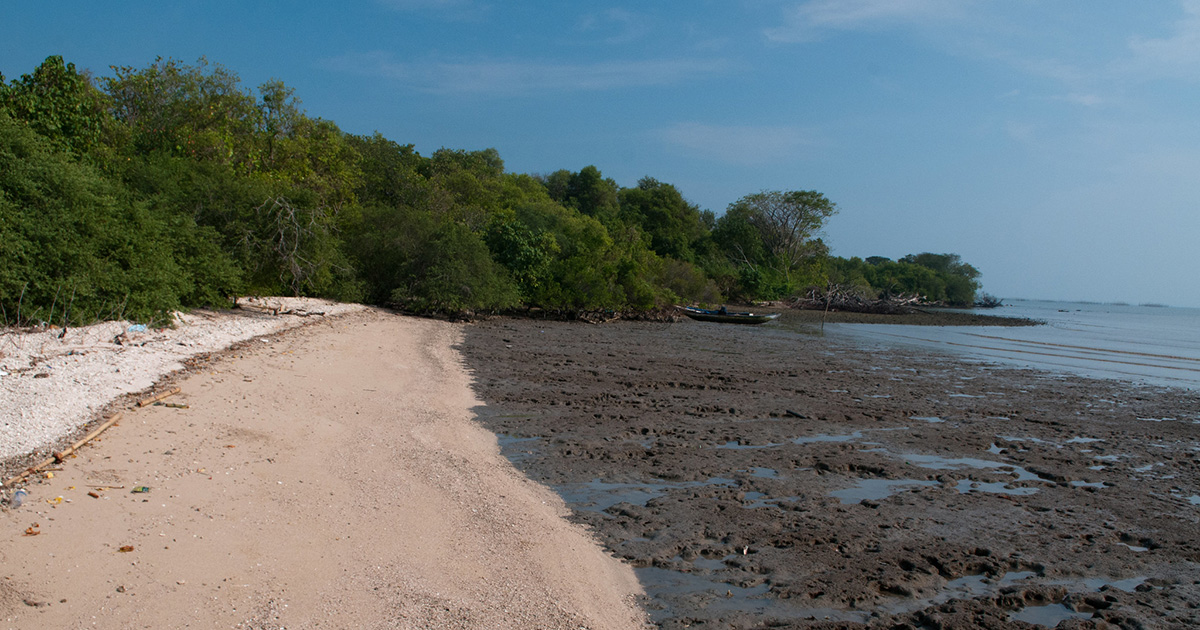







Mangrove ecosystems are distributed worldwide, along tropical and subtropical coastlines. For a long time, mangrove biogeographers have been challenged by the question: why is mangrove distribution restricted to its current latitudinal limits? The Araranguá estuary in Brazil is located ~75 km beyond the eastern South America mangrove limit. Despite its geomorphology apparently being suitable for mangrove colonization, mangroves have been reported absent from this estuary. In this work, we analyze key environmental variables (such as the longest available observational in-situ records of air temperature) and provide an assessment of other environmental players (such as the adjacent ocean circulation and upwelling system) to better understand which factors could be determinant in the species range limits in eastern South America. Our results and assessment suggest that, depending on the season, multiple factors could combine to prevent a poleward dispersion of mangrove species. These are mainly the northward-directed longshore drift which dominates throughout the year and the high occurrence of chilling events during winter, although seasonal upwelling of cold waters in spring and summer could also influence the propagules’ viability.

DOI:
https://doi.org/10.1016/j.ecss.2021.107607Score Altmetric:
Dimensions Nombre de citations:
Exporter la citation:
RIS (.ris)
TI  - Seasonal atmospheric and oceanographic factors influencing poleward mangrove expansion in the southeastern American coast
AU  - Ximenes, A.C.
AU  - Ponsoni, L.
AU  - Lira, C.F.
AU  - Dahdouh-Guebas, F.
AU  - Koedam, N.
AB  - Mangrove ecosystems are distributed worldwide, along tropical and subtropical coastlines. For a long time, mangrove biogeographers have been challenged by the question: why is mangrove distribution restricted to its current latitudinal limits? The Araranguá estuary in Brazil is located ~75 km beyond the eastern South America mangrove limit. Despite its geomorphology apparently being suitable for mangrove colonization, mangroves have been reported absent from this estuary. In this work, we analyze key environmental variables (such as the longest available observational in-situ records of air temperature) and provide an assessment of other environmental players (such as the adjacent ocean circulation and upwelling system) to better understand which factors could be determinant in the species range limits in eastern South America. Our results and assessment suggest that, depending on the season, multiple factors could combine to prevent a poleward dispersion of mangrove species. These are mainly the northward-directed longshore drift which dominates throughout the year and the high occurrence of chilling events during winter, although seasonal upwelling of cold waters in spring and summer could also influence the propagules’ viability.
PY  - 2021
UR  - https://www.cifor-icraf.org/knowledge/publication/8253/
DO  - https://doi.org/10.1016/j.ecss.2021.107607
KW  - biogeography, coastal areas, expansion, mangroves, seasonal variation, species composition, wetlands
ER  -
Endnote (.ciw)
%T Seasonal atmospheric and oceanographic factors influencing poleward mangrove expansion in the southeastern American coast
%A Ximenes, A.C.
%A Ponsoni, L.
%A Lira, C.F.
%A Dahdouh-Guebas, F.
%A Koedam, N.
%D 2021
%U https://www.cifor-icraf.org/knowledge/publication/8253/
%R https://doi.org/10.1016/j.ecss.2021.107607
%X Mangrove ecosystems are distributed worldwide, along tropical and subtropical coastlines. For a long time, mangrove biogeographers have been challenged by the question: why is mangrove distribution restricted to its current latitudinal limits? The Araranguá estuary in Brazil is located ~75 km beyond the eastern South America mangrove limit. Despite its geomorphology apparently being suitable for mangrove colonization, mangroves have been reported absent from this estuary. In this work, we analyze key environmental variables (such as the longest available observational in-situ records of air temperature) and provide an assessment of other environmental players (such as the adjacent ocean circulation and upwelling system) to better understand which factors could be determinant in the species range limits in eastern South America. Our results and assessment suggest that, depending on the season, multiple factors could combine to prevent a poleward dispersion of mangrove species. These are mainly the northward-directed longshore drift which dominates throughout the year and the high occurrence of chilling events during winter, although seasonal upwelling of cold waters in spring and summer could also influence the propagules’ viability.
%K biogeography
%K coastal areas
%K expansion
%K mangroves
%K seasonal variation
%K species composition
%K wetlands
Année de publication
2021
ISSN
0272-7714
Auteurs
Ximenes, A.C.; Ponsoni, L.; Lira, C.F.; Dahdouh-Guebas, F.; Koedam, N.
Langue
English
Mots clés
biogeography, coastal areas, expansion, mangroves, seasonal variation, species composition, wetlands
Source
Estuarine, Coastal and Shelf Science. 262: 107607
Géographique
Brazil