

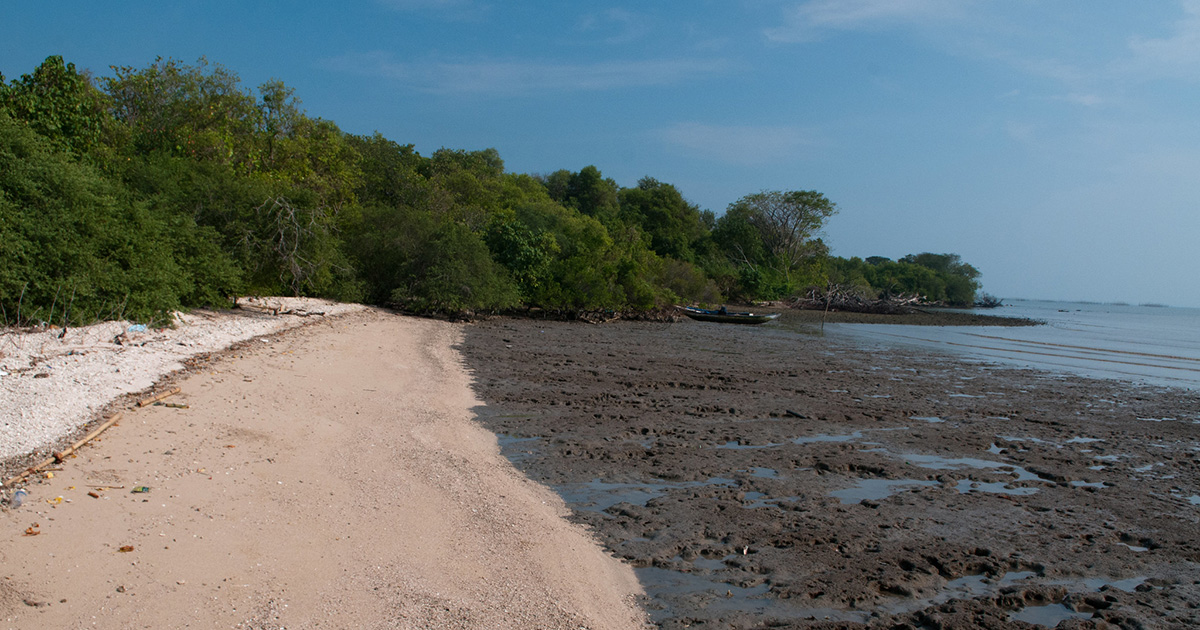




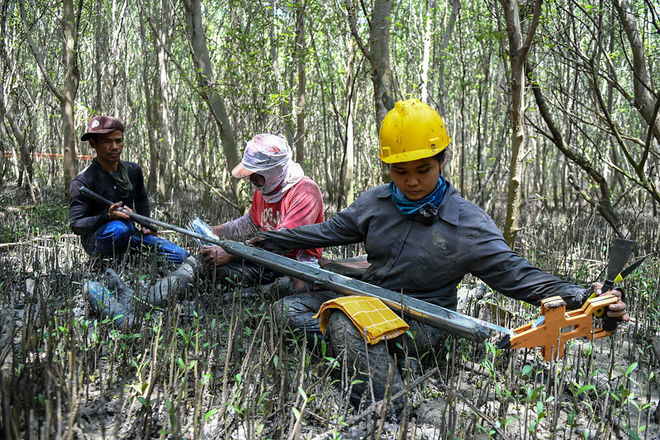
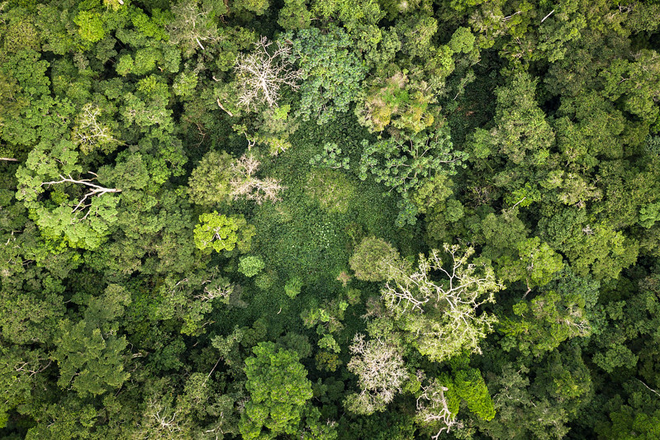



Indonesia has lost more mangroves than any other country. The importance of mangroves for carbon storage and biodiversity is well recognised, but much less is known about what they contribute to the communities living near them who are called on to protect them. Malnutrition in Indonesia is high, with more than a third of children stunted, partly due to poor diets. Fish are nutrient-rich and are the most widely consumed animal source food in Indonesia, making the relationship between mangroves and fish consumption of great importance. Aquaculture is also tremendously important for fish production in Indonesia and has replaced large areas of mangroves over the last two decades. We performed a cross-sectional, spatial analysis in this study. We combined data on fish consumption for rural Indonesian coastal households from the Indonesian National Socioeconomic Survey with spatial data on mangrove forest and aquaculture area from the Indonesian Ministry of Environment and Forestry to create a cross-sectional spatial dataset. Using a mixed-effects regression model, we estimated to what extent living in proximity to different densities of mangroves and aquaculture was associated with fresh fish consumption for rural coastal households. Our sample included 6741 villages with 107 486 households in 2008. The results showed that rural coastal households residing near high-density mangroves consumed 28% (134/477) more fresh fish and other aquatic animals, and those residing near medium-density mangroves consumed 19% (90/477) more fresh fish and other aquatic animals, than coastal households who did not live near mangroves. Coastal households that lived near high-density aquaculture consumed 2% (9/536) more fresh fish, and those that lived near medium-density aquaculture consumed 1% (3/536) less, than other rural coastal households.
This work is licensed under CC-BY 4.0
00196-1&apiKey=3948bb216041dbffcb29a618defafc29&httpAccept=image%2Fjpeg)
Download:

This work is licensed under CC-BY 4.0
DOI:
https://doi.org/10.1016/S2542-5196(23)00196-1Score Altmetric:
Dimensions Nombre de citations:
Exporter la citation:
RIS (.ris)
TI  - Quantifying the contribution of mangroves to local fish consumption in Indonesia: a cross-sectional spatial analysis
AU  - Ickowitz, A.
AU  - Lo, M.
AU  - Nurhasan, M.
AU  - Maulana, A.M.
AU  - Brown, B.M.
AB  - Indonesia has lost more mangroves than any other country. The importance of mangroves for carbon storage and biodiversity is well recognised, but much less is known about what they contribute to the communities living near them who are called on to protect them. Malnutrition in Indonesia is high, with more than a third of children stunted, partly due to poor diets. Fish are nutrient-rich and are the most widely consumed animal source food in Indonesia, making the relationship between mangroves and fish consumption of great importance. Aquaculture is also tremendously important for fish production in Indonesia and has replaced large areas of mangroves over the last two decades. We performed a cross-sectional, spatial analysis in this study. We combined data on fish consumption for rural Indonesian coastal households from the Indonesian National Socioeconomic Survey with spatial data on mangrove forest and aquaculture area from the Indonesian Ministry of Environment and Forestry to create a cross-sectional spatial dataset. Using a mixed-effects regression model, we estimated to what extent living in proximity to different densities of mangroves and aquaculture was associated with fresh fish consumption for rural coastal households. Our sample included 6741 villages with 107 486 households in 2008. The results showed that rural coastal households residing near high-density mangroves consumed 28% (134/477) more fresh fish and other aquatic animals, and those residing near medium-density mangroves consumed 19% (90/477) more fresh fish and other aquatic animals, than coastal households who did not live near mangroves. Coastal households that lived near high-density aquaculture consumed 2% (9/536) more fresh fish, and those that lived near medium-density aquaculture consumed 1% (3/536) less, than other rural coastal households.
PY  - 2023
UR  - https://www.cifor-icraf.org/knowledge/publication/9001/
DO  - https://doi.org/10.1016/S2542-5196(23)00196-1
KW  - fisheries, food consumption, food resources, mangroves, nutrition, spatial analysis
ER  -
Endnote (.ciw)
%T Quantifying the contribution of mangroves to local fish consumption in Indonesia: a cross-sectional spatial analysis
%A Ickowitz, A.
%A Lo, M.
%A Nurhasan, M.
%A Maulana, A.M.
%A Brown, B.M.
%D 2023
%U https://www.cifor-icraf.org/knowledge/publication/9001/
%R https://doi.org/10.1016/S2542-5196(23)00196-1
%X Indonesia has lost more mangroves than any other country. The importance of mangroves for carbon storage and biodiversity is well recognised, but much less is known about what they contribute to the communities living near them who are called on to protect them. Malnutrition in Indonesia is high, with more than a third of children stunted, partly due to poor diets. Fish are nutrient-rich and are the most widely consumed animal source food in Indonesia, making the relationship between mangroves and fish consumption of great importance. Aquaculture is also tremendously important for fish production in Indonesia and has replaced large areas of mangroves over the last two decades. We performed a cross-sectional, spatial analysis in this study. We combined data on fish consumption for rural Indonesian coastal households from the Indonesian National Socioeconomic Survey with spatial data on mangrove forest and aquaculture area from the Indonesian Ministry of Environment and Forestry to create a cross-sectional spatial dataset. Using a mixed-effects regression model, we estimated to what extent living in proximity to different densities of mangroves and aquaculture was associated with fresh fish consumption for rural coastal households. Our sample included 6741 villages with 107 486 households in 2008. The results showed that rural coastal households residing near high-density mangroves consumed 28% (134/477) more fresh fish and other aquatic animals, and those residing near medium-density mangroves consumed 19% (90/477) more fresh fish and other aquatic animals, than coastal households who did not live near mangroves. Coastal households that lived near high-density aquaculture consumed 2% (9/536) more fresh fish, and those that lived near medium-density aquaculture consumed 1% (3/536) less, than other rural coastal households.
%K fisheries
%K food consumption
%K food resources
%K mangroves
%K nutrition
%K spatial analysis
Année de publication
2023
ISSN
2542-5196
Auteurs
Ickowitz, A.; Lo, M.; Nurhasan, M.; Maulana, A.M.; Brown, B.M.
Langue
English
Mots clés
fisheries, food consumption, food resources, mangroves, nutrition, spatial analysis
Source
Lancet Planetary Health. 7(10): e819-e830
Géographique
Indonesia