

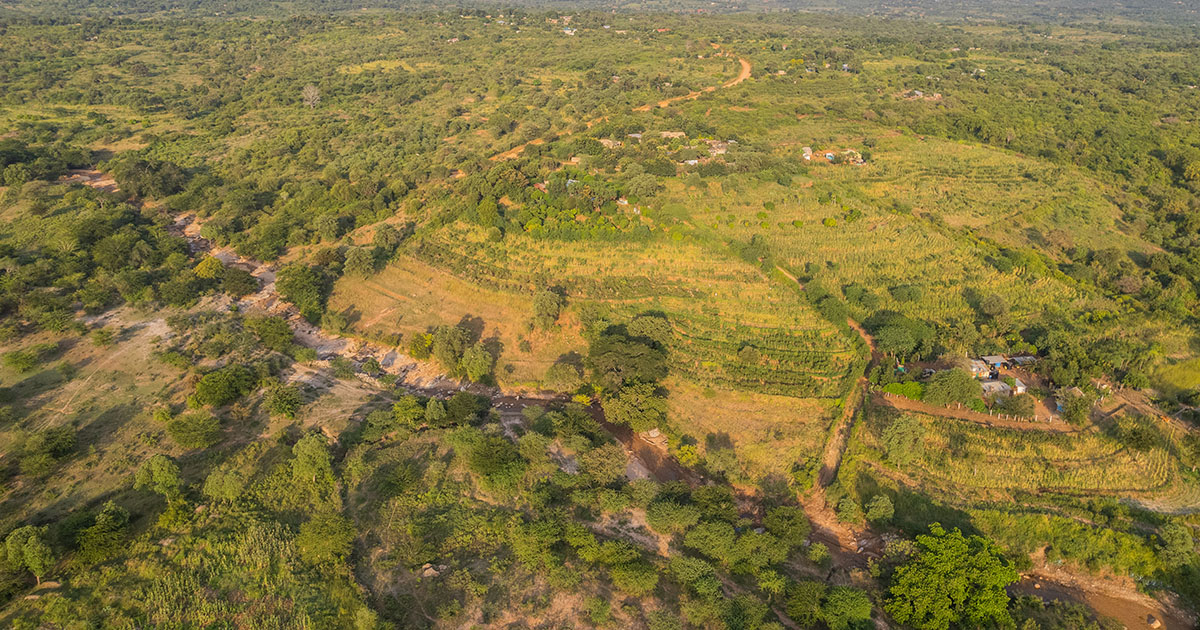






The article examines the influence of local perceptions of climate variability and pest–disease incidence on crops and its management and on adaptive forest–agricultural practices. The study was conducted in the humid forest of Southern Cameroon along a resource use intensification and population gradient using a semi-structured questionnaire administrated to farmers. The results showed that the level of severity of crops–pests incidence was perceived as high, with an increase over the past 15 years. A high incidence of pests–diseases was perceived on yield/income of cocoa, cassava, and groundnuts. The results indicated that each crop has its management practices of pests–diseases both at the crop and land use level. The farmers respond positively to their perception of climate variability by anticipating cropping practices, by harvesting earlier or later, and by adapting strategies of pests–diseases with crops and land use practices that affect the sustainability of forest–agriculture.

DOI:
https://doi.org/10.1111/j.2153-9561.2012.01064.xScore Altmetric:
Dimensions Nombre de citations:
Exporter la citation:
RIS (.ris)
TI  - Perceptions of Climate Variability and Pest-Disease Incidence on Crops and Adaptive Forest-Agricultural Practices
AU  - Mala, W.A.
AU  - Geldenhuys, C.J.
AU  - Prabhu, R.
AB  - The article examines the influence of local perceptions of climate variability and pest–disease incidence on crops and its management and on adaptive forest–agricultural practices. The study was conducted in the humid forest of Southern Cameroon along a resource use intensification and population gradient using a semi-structured questionnaire administrated to farmers. The results showed that the level of severity of crops–pests incidence was perceived as high, with an increase over the past 15 years. A high incidence of pests–diseases was perceived on yield/income of cocoa, cassava, and groundnuts. The results indicated that each crop has its management practices of pests–diseases both at the crop and land use level. The farmers respond positively to their perception of climate variability by anticipating cropping practices, by harvesting earlier or later, and by adapting strategies of pests–diseases with crops and land use practices that affect the sustainability of forest–agriculture.
PY  - 2012
UR  - https://www.cifor-icraf.org/knowledge/publication/26850/
DO  - https://doi.org/10.1111/j.2153-9561.2012.01064.x
KW  - agroforestry, climate change, deforestation, pests, plant diseases
ER  -
Endnote (.ciw)
%T Perceptions of Climate Variability and Pest-Disease Incidence on Crops and Adaptive Forest-Agricultural Practices
%A Mala, W.A.
%A Geldenhuys, C.J.
%A Prabhu, R.
%D 2012
%U https://www.cifor-icraf.org/knowledge/publication/26850/
%R https://doi.org/10.1111/j.2153-9561.2012.01064.x
%X The article examines the influence of local perceptions of climate variability and pest–disease incidence on crops and its management and on adaptive forest–agricultural practices. The study was conducted in the humid forest of Southern Cameroon along a resource use intensification and population gradient using a semi-structured questionnaire administrated to farmers. The results showed that the level of severity of crops–pests incidence was perceived as high, with an increase over the past 15 years. A high incidence of pests–diseases was perceived on yield/income of cocoa, cassava, and groundnuts. The results indicated that each crop has its management practices of pests–diseases both at the crop and land use level. The farmers respond positively to their perception of climate variability by anticipating cropping practices, by harvesting earlier or later, and by adapting strategies of pests–diseases with crops and land use practices that affect the sustainability of forest–agriculture.
%K agroforestry
%K climate change
%K deforestation
%K pests
%K plant diseases
Année de publication
2012
ISSN
2153-9561
Auteurs
Mala, W.A.; Geldenhuys, C.J.; Prabhu, R.
Langue
English
Mots clés
agroforestry, climate change, deforestation, pests, plant diseases
Source
Culture, Agriculture, Food and Environment. 34(1): 53-67
Géographique
Cameroon