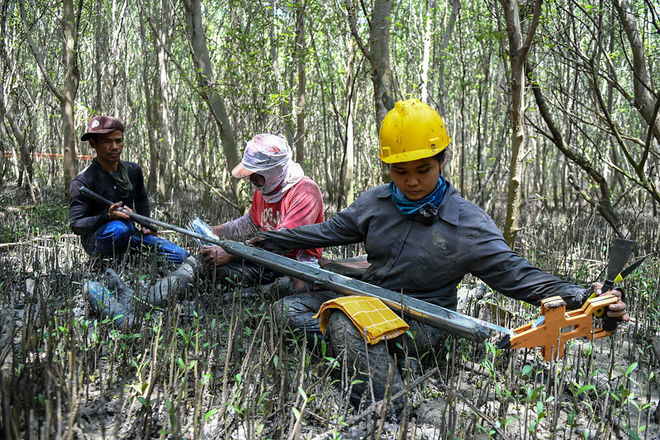




To address deforestation, South Sumatra Goverment was committed to be the frontrunner in attaining Green Growth 2017. All economic activities related to land use must comply with the regulations. The private sector supports them with some initiatives by several certifications as their commitment toward zero deforestation (ZDC). However, from the land cover data, South Sumatra Province is one of the highest forest cover loss in Indonesia followed by increasing economic activities. This study aims to explain commitments of the public and private sectors in complying toward zero deforestation. We conducted interviews with relevant agencies and collect the data regarding interventions and initiatives. This study used compliance theory to analyze the commitments of both sectors. The results showed that the public and private sectors in South Sumatra have shown their commitment with the type of treaty-induced compliance. The compliance showed how the commitment is integrated into policies, aligned public and private governance arrangements, and a good environmental quality change by reduced deforestation rate. This showed that one of the ZDC’s objectives is at least halve the rate of loss of natural forests globally by 2020 has been implemented by both. Thus, they strive to end natural forest loss by 2030.
This work is licensed under CC-BY 4.0

Download:

This work is licensed under CC-BY 4.0
DOI:
https://doi.org/10.29244/jpsl.11.4.638-652Score Altmetric:
Dimensions Nombre de citations:
Exporter la citation:
RIS (.ris)
TI  - Public and Private Sector to Zero Deforestation Commitmen in South Sumatra
AU  - Ristiana, N.I.
AU  - Purnomo, H.
AU  - Hero, Y.
AU  - Okarda, B.
AU  - Puspitaloka, D.
AU  - Sanjaya, M.
AB  - To address deforestation, South Sumatra Goverment was committed to be the frontrunner in attaining Green Growth 2017. All economic activities related to land use must comply with the regulations. The private sector supports them with some initiatives by several certifications as their commitment toward zero deforestation (ZDC). However, from the land cover data, South Sumatra Province is one of the highest forest cover loss in Indonesia followed by increasing economic activities. This study aims to explain commitments of the public and private sectors in complying toward zero deforestation. We conducted interviews with relevant agencies and collect the data regarding interventions and initiatives. This study used compliance theory to analyze the commitments of both sectors. The results showed that the public and private sectors in South Sumatra have shown their commitment with the type of treaty-induced compliance. The compliance showed how the commitment is integrated into policies, aligned public and private governance arrangements, and a good environmental quality change by reduced deforestation rate. This showed that one of the ZDC’s objectives is at least halve the rate of loss of natural forests globally by 2020 has been implemented by both. Thus, they strive to end natural forest loss by 2030.
PY  - 2022
UR  - https://www.cifor-icraf.org/knowledge/publication/8465/
DO  - https://doi.org/10.29244/jpsl.11.4.638-652
KW  - deforestation, economic development, forest governance, private sectors, public sectors, spatial analysis
ER  -
Endnote (.ciw)
%T Public and Private Sector to Zero Deforestation Commitmen in South Sumatra
%A Ristiana, N.I.
%A Purnomo, H.
%A Hero, Y.
%A Okarda, B.
%A Puspitaloka, D.
%A Sanjaya, M.
%D 2022
%U https://www.cifor-icraf.org/knowledge/publication/8465/
%R https://doi.org/10.29244/jpsl.11.4.638-652
%X To address deforestation, South Sumatra Goverment was committed to be the frontrunner in attaining Green Growth 2017. All economic activities related to land use must comply with the regulations. The private sector supports them with some initiatives by several certifications as their commitment toward zero deforestation (ZDC). However, from the land cover data, South Sumatra Province is one of the highest forest cover loss in Indonesia followed by increasing economic activities. This study aims to explain commitments of the public and private sectors in complying toward zero deforestation. We conducted interviews with relevant agencies and collect the data regarding interventions and initiatives. This study used compliance theory to analyze the commitments of both sectors. The results showed that the public and private sectors in South Sumatra have shown their commitment with the type of treaty-induced compliance. The compliance showed how the commitment is integrated into policies, aligned public and private governance arrangements, and a good environmental quality change by reduced deforestation rate. This showed that one of the ZDC’s objectives is at least halve the rate of loss of natural forests globally by 2020 has been implemented by both. Thus, they strive to end natural forest loss by 2030.
%K deforestation
%K economic development
%K forest governance
%K private sectors
%K public sectors
%K spatial analysis
Année de publication
2022
ISSN
2086-4639
Auteurs
Ristiana, N.I.; Purnomo, H.; Hero, Y.; Okarda, B.; Puspitaloka, D.; Sanjaya, M.
Langue
English
Mots clés
deforestation, economic development, forest governance, private sectors, public sectors, spatial analysis
Source
Jurnal Pengelolaan Sumberdaya Alam dan Lingkungan (Journal of Natural Resources and Environmental Management). 11(4): 638-652
Géographique
Indonesia