





Key messages
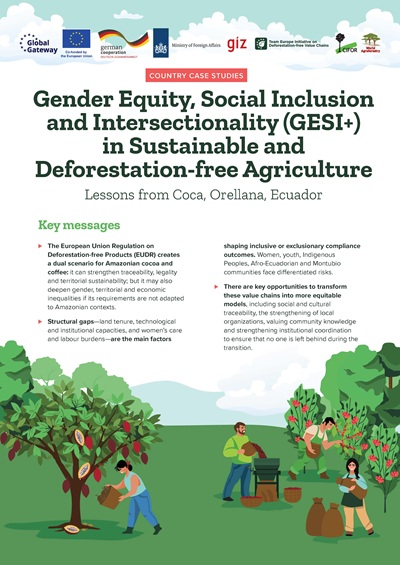
- The European Union Regulation on Deforestation-free Products (EUDR) creates a dual scenario for Amazonian cocoa and coffee: it can strengthen traceability, legality and territorial sustainability; but it may also deepen gender, territorial and economic inequalities if its requirements are not adapted to Amazonian contexts.
- Structural gaps—land tenure, technological and institutional capacities, and women’s care and labour burdens—are the main factors shaping inclusive or exclusionary compliance outcomes. Women, youth, Indigenous Peoples, Afro-Ecuadorian and Montubio communities face differentiated risks.
- There are key opportunities to transform these value chains into more equitable models, including social and cultural traceability, the strengthening of local organizations, valuing community knowledge and strengthening institutional coordination to ensure that no one is left behind during the transition.
This work is licensed under CC-BY 4.0
Exportar la cita:
RIS (.ris)
TI  - Gender Equity, Social Inclusion and Intersectionality (GESI+) in Sustainable and Deforestation-free Agriculture. Lessons from Coca, Orellana, Ecuador
AU  - Chapalbay, R.
AU  - Vallejo, E.
AU  - Gallagher, E.
AB  - Key messages

The European Union Regulation on Deforestation-free Products (EUDR) creates a dual scenario for Amazonian cocoa and coffee: it can strengthen traceability, legality and territorial sustainability; but it may also deepen gender, territorial and economic inequalities if its requirements are not adapted to Amazonian contexts.
Structural gaps—land tenure, technological and institutional capacities, and women’s care and labour burdens—are the main factors shaping inclusive or exclusionary compliance outcomes. Women, youth, Indigenous Peoples, Afro-Ecuadorian and Montubio communities face differentiated risks.
There are key opportunities to transform these value chains into more equitable models, including social and cultural traceability, the strengthening of local organizations, valuing community knowledge and strengthening institutional coordination to ensure that no one is left behind during the transition.

PY  - 2026
PB  - CIFOR-ICRAF and GIZ
PP  - Bogor, Indonesia; Nairobi, Kenya; Bonn, Germany
UR  - https://www.cifor-icraf.org/knowledge/publication/46417/
KW  - cocoa (plant), coffee, deforestation, equity, gender, indigenous peoples, land tenure, local communities, sustainability, sustainable agriculture, value chains
ER  -
Endnote (.ciw)
%T Gender Equity, Social Inclusion and Intersectionality (GESI+) in Sustainable and Deforestation-free Agriculture. Lessons from Coca, Orellana, Ecuador
%A Chapalbay, R.
%A Vallejo, E.
%A Gallagher, E.
%D 2026
%I CIFOR-ICRAF and GIZ
%C Bogor, Indonesia; Nairobi, Kenya; Bonn, Germany
%U https://www.cifor-icraf.org/knowledge/publication/46417/
%X Key messages

The European Union Regulation on Deforestation-free Products (EUDR) creates a dual scenario for Amazonian cocoa and coffee: it can strengthen traceability, legality and territorial sustainability; but it may also deepen gender, territorial and economic inequalities if its requirements are not adapted to Amazonian contexts.
Structural gaps—land tenure, technological and institutional capacities, and women’s care and labour burdens—are the main factors shaping inclusive or exclusionary compliance outcomes. Women, youth, Indigenous Peoples, Afro-Ecuadorian and Montubio communities face differentiated risks.
There are key opportunities to transform these value chains into more equitable models, including social and cultural traceability, the strengthening of local organizations, valuing community knowledge and strengthening institutional coordination to ensure that no one is left behind during the transition.

%K cocoa (plant)
%K coffee
%K deforestation
%K equity
%K gender
%K indigenous peoples
%K land tenure
%K local communities
%K sustainability
%K sustainable agriculture
%K value chains
Publisher
CIFOR-ICRAF and GIZ: Bogor, Indonesia; Nairobi, Kenya; Bonn, Germany
Año de publicación
2026
Autores
Chapalbay, R.; Vallejo, E.; Gallagher, E.
Idioma
English
Palabras clave
cocoa (plant), coffee, deforestation, equity, gender, indigenous peoples, land tenure, local communities, sustainability, sustainable agriculture, value chains
Geográfico
Ecuador